

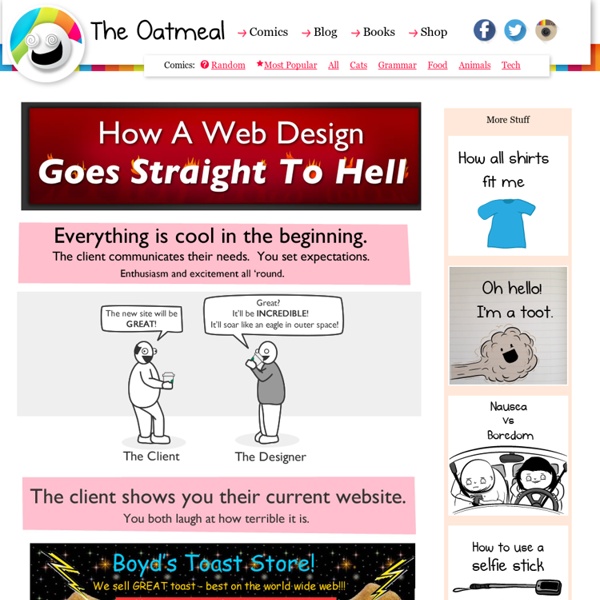
http://theoatmeal.com/comics/design_hell
Mood board A mood board is a type of collage consisting of images, text, and samples of objects in a composition. They may be physical or digital, and can be "extremely effective" presentation tools.[1] Uses[edit] Mood boards are used by graphic designers to enable a person to visually illustrate the style they are pursuing. However, they can also be used to visually explain a certain style of writing, or an imaginary setting for a storyline. In short, mood boards are not limited to visual subjects, but serve as a visual tool to quickly inform others of the overall "feel" (or "flow") of an idea.
29 Creative Ways To Give Kitchen Trash A Second Life Advertisement Meal planning and smart shopping goes a long way toward reducing food waste. Kitchen hacks for extending the lifespan of fresh food help too. But what about the peels, stems, and wrappings we throw away without a second thought? Well those can be upcycled too! 1.
25 Examples of Web 2.0 and Traditional Design Rules Coming Together In the large scope of the design world, the term “Web 2.0″ is relatively a new one. With it, comes its own set of standards, some strong, others not so strong, since Web 2.0 in itself is a very fickle, ever-evolving definition of design standards. Countless examples of Web 2.0 sites have broken the rules of what was once considered strong design. On the other hand, in many cases Web 2.0 has strengthened common design misnomers; it places a focus on usability, interface, and readability. At its best, Web 2.0 stands as an equal to the traditional design rules practiced for centuries, though it is no doubt a reflection of our society in its current state of hustle and bustle. Here’s a collection of 25 sites showcasing how Web 2.0 and traditional design practices can come together to form truly stunning websites.
What is a Digital Nomad, and How to Become One Becoming a digital nomad has been a long time dream of mine that I have finally started to work on realizing. A digital nomad, in short, is someone who earns their income entirely online, thus being able to work from anywhere: location independent. To most people this sounds like a hoax, or an impossible myth. To others, it is a whole new world. Work from your couch at home. Sketchy Wireframes Introduction When it comes to user interface documentation, wireframes have long been the tool of choice. However, using traditional diagramming tools like Visio, OmniGraffle, and InDesign, most wireframes today look the same as their ancestors did from a decade ago – assembled with rigid, computer-drawn boxes, lines and text. While these artifacts have served us well, they can also be slow to produce, burdened with unnecessary detail and give a false impression of “completion.”
Hippie girl’s packing guide: 10 of my essentials What does it mean to me to be a modern hippie girl? It means I feel as comfortable barefoot as I do in heels. It means I can spend the night at a 5-star resort one night and the next night camp on the beach. It means I am independent and self reliant. A 6-Step General Process for Producing a Website When it comes to building a website, it helps to have a process to follow, especially if you are just getting started as a web designer. Good guidelines can help you work better by keeping forgetfulness to a minimum. Every designer or company will develop unique components to their web design process over time, but the basics remain the same: learn, plan, design, code, launch and maintain. In this article, I will share my process for designing a website. Before we get into it, let me first share two parallel processes that should be taking place throughout your design process. The first thing you should be doing continuously is seeking feedback.
The Ultimate Guide to Traveling Without Money To most, the thought of living without money seems impossible, if not altogether terrifying. But a small and growing population of citizens all over the globe are choosing to live that way. Take Heidemarie Schwermer of Germany who has lived without money for 17 years and counting, or Daniel Suelo, who lives in the caves outside Moab, Utah, and hasn't touched money in over a decade. It's impossible to ignore the spark in their eyes when they say their lives are genuinely happier and more abundant without money. Naturally, the money-free life is a debt-free life. But the heart of their decision goes much deeper than freedom from the shackles of debt.
Following A Web Design Process Almost every Web designer can attest that much of their work is repetitive. We find ourselves completing the same tasks, even if slightly modified, over and over for every Web project. Following a detailed website design and development process can speed up your work and help your client understand your role in the project. This article tries to show how developing a process for Web design can organize a developer’s thoughts, speed up a project’s timeline and prepare a freelance business for growth. First of all, what exactly is a ‘process’?
Which Food Containers Are Safe for the Microwave? - Real Simple Some materials are fine in the microwave and some aren’t (see below). And then there’s plastic. You’ll find experts who say no plastic containers should be used in the microwave—ever. “The material contains chemicals that may leach into food when it’s heated,” says Olga Naidenko, Ph.D., a scientist with the Environmental Working Group, a health-research organization. However, the U.S. Food and Drug Administration (FDA) has deemed that plastics labeled “microwave-safe” are suitable for microwave use.
The Web Design Process Start to Finish I've always found it interesting reading the design process of others (David Airey, Contrast, Brian Hoff). It's good to have an insight into others work, to see if I can learn anything from their process but also for curiosity. So I've put together a break down of my design process, using a recent project as a real life example, Newsgroup Direct.
Rob Greenfield's Guide to Dumpster Diving I desire to put an end to food waste and hunger in America. Sure it’s a lofty goal, a seriously lofty goal, but I believe that it is possible. In my youth I see a time when every dumpster in America is completely void of all food. But in the mean time our dumpsters are full of perfectly good food and we may as well eat it! First and foremost I encourage grocery stores to donate their excess food rather than throw it in the dumpster. 45 Incredibly Useful Web Design Checklists and Questionnaires Designing websites can be a long and complicated process. Dealing with clients, designing prototypes, coding, programming, and testing – there’s a lot to keep track of and a lot to make sure gets done. That’s where checklists can make your life a whole lot easier. With lists of points covering multiple areas from content to usability to accessibility to standards, you’re a lot less likely to overlook important parts of a site.
The Truth Behind Capitalism In 2008, the loss of 11 billion dollars by the world’s largest insurance company, AIG, and the bankruptcy of the US investment bank Lehman Brothers, triggered a domino effect of financial consequences which brought the entire capitalist system within a hair’s breadth of total collapse. But, as the events leading up to the financial crisis were slowly unveiled, it became ever clearer that the crisis was caused, quite knowingly, by the bankers themselves. The Cause In the years leading up to the economic crisis in 2008, banks increased the funding for the riskiest loans (called subprime loans), from $30 billion a year to over $600 billion a year, rigged even higher interest rates on those loans, and then, while the bankers were making billions of dollars of profits off the borrowers’ high interest repayments, they made further profits betting against their customers ever being able to pay back the loans they had just been given. The Effect The Revolution