

40 websites that will make you cleverer right now The indexed web contains an incredible 14 billion pages. But only a tiny fraction help you improve your brain power. Here are 40 of the best. whizzpast.com – Learn about our awe inspiring past all in one wonderful place. khanacademy.org – Watch thousands of micro-lectures on topics ranging from history and medicine to chemistry and computer science. freerice.com – Help end world hunger by correctly answering multiple-choice quizzes on a wide variety of subjects. artofmanliness.com – Blog/site dedicated to all things manly, great for learning life skills and good insights. unplugthetv.com – Randomly selects an educational video for you to watch. coursera.org – An educational site that works with universities to get their courses on the Internet, free for you to use. mentalfloss.com – Interesting articles guaranteed to make you smile and get you thinking. feelgoodwardrobe.com – Find out how the world of fashion really works and what you can do to combat it. lifehacker.com – Learn to hack life!
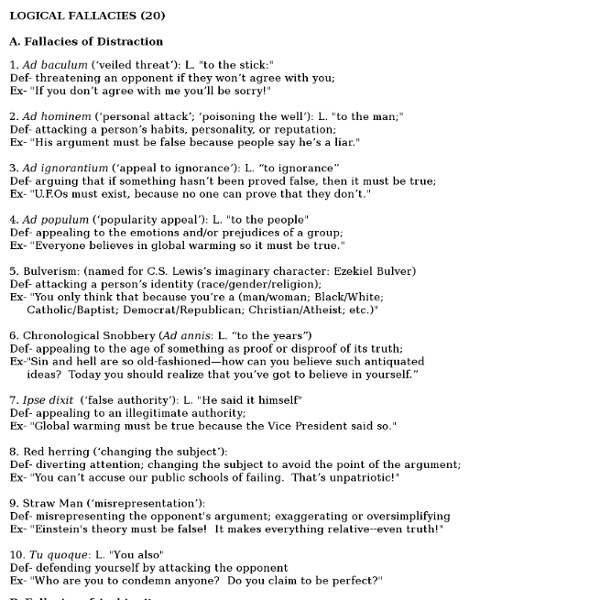
How To Argue Arguing is one of those things most people do but few people do well. Many do not understand what a logical argument even is or how to do it correctly. Yet arguing is an essential skill of critical thinking. How we argue reflects how we think, how we evaluate our own conclusions, and how we challenge the beliefs of others. Even the very purpose of arguing is often misunderstood. I have arguments almost every day. The beauty of a logical argument is that it is, well… logical. Likewise, if two people have come to different conclusions about a factual claim, then one or both must be wrong. Keep in mind, this only works if the arguments are about factual claims, not subjective feelings or value judgments. An excellent example of this is the abortion debate. Structure of a Logical Argument Whether we are consciously aware of it or not, our arguments all follow a certain basic structure. Examine your Premises There are three types of potential problems with premises. Logical Fallacies
Landmark (Asian Kung-Fu Generation album) Landmark is the seventh studio album by the Japanese rock band Asian Kung-Fu Generation, released on September 12, 2012. In late 2011, Gotoh confirmed in his diary that the band were in the studio recording new songs. However, he did not release the name of the album until July 2012, days after their 2012 Nano-Mugen Festival. Along with his announcement of the name of the album, he also stated that the album will be released on September 12, 2012, and a 22-show nationwide tour will follow in support of the album.[1] On August 2, Gotoh claimed that the album "is a masterpiece" via Twitter.[2] On August 28, the song "Bicycle Race" was first played on School of Lock, a segment on a radio station in Tokyo. Two different limited editions of the album were released, with one including an LP version of the album, and the other including a compilation DVD of songs performed at both, a 2011 Nano-Mugen festival concert, and a 2012 Best Hit AKG concert.[3]
Try to imagine a life without timekeeping Try to imagine a life without timekeeping More From: Random time fear books mitch albom the time keeper Advertisements Maybe part of loving is learning to let go 22 Quotes from The Mortal Instruments series by Cassandra Clare © 2016 TheThingsWeSay. Save The 10 Truth Skills | 1. Experiencing what is. Distinguish between what you actually experience (see, hear, sense, feel, notice, remember) versus what you imagine (interpret, believe, assume) to be true. The statement “I see you looking at the floor’ is your own experience. The statement ‘I see you are uncomfortable’ is an interpretation. If you get caught up in believing your interpretations about another person’s behavior, you’ll be responding to your interpretation of what she did instead of what she actually did. 2. To be transparent is to be willing to be seen, warts and all. 3. Do you communicate to relate or to control? 4. Giving feedback is the act of verbally letting the other know how his actions affected you. 5. Many of us are afraid to ask for what we want in a dating relationship for fear or either not getting it or of having the other person give it to them out of obligation. 6. 7. 8. Many people fear intimacy because we fear losing ourselves in a relationship. 9. 10.
Stranger in a Strange Land Stranger in a Strange Land is a 1961 science fiction novel by American author Robert A. Heinlein. It tells the story of Valentine Michael Smith, a human who comes to Earth in early adulthood after being born on the planet Mars and raised by Martians. The novel explores his interaction with—and eventual transformation of—terrestrial culture. The title is an allusion to the phrase in Exodus 2:22.[1] According to Heinlein, the novel's working title was The Heretic. Heinlein got the idea for the novel when he and his wife Virginia were brainstorming one evening in 1948. In 1991, three years after Heinlein's death, Virginia arranged to have the original uncut manuscript published. In 2012, the US Library of Congress named it one of 88 "Books that Shaped America".[6] Plot[edit] The story focuses on a human raised on Mars and his adaptation to, and understanding of, humans and their culture. A manned expedition is mounted to visit the planet Mars but all contact is lost after landing.
120 Ways to Boost Your Brain Power Here are 120 things you can do starting today to help you think faster, improve memory, comprehend information better and unleash your brain’s full potential. Solve puzzles and brainteasers.Cultivate ambidexterity. Use your non-dominant hand to brush your teeth, comb your hair or use the mouse. Write with both hands simultaneously. Readers’ Contributions Dance! Contribute your own tip! There are many, many ways to keep our brains sharp. 77 Great Quotes That Will Transform Your Life and Business EmailEmail I’m addicted to sayings and quotes. They are inspiring, motivating and they have the power to provoke new thought. They have the power to break down old beliefs and inject wisdom into your life. I’ve always gained inspiration from quotes and sayings, which is why I’ve decided to gather some of my favorite ones into this post. Each comes with an elaboration from me. The meanings will probably not be the same for you as they are for me, so use whatever I say however you like. Enjoy! Courage 1. There are no guarantees in life. 2. We all fear failure. 3. I couldn’t agree more with this. 4. We grow up with the idea that we have to look for others for answers. 5. When I read this, I think about our imagination and our fears. The bottom line is that you can overcome your fears and live the life of your dreams. 6. The more you can let go of fear, the faster you will grow. 7. I’ve gotten many e-mails from people asking me for advice. 8. What is familiar is comfortable. 9. 10. Motivation
30 Sentences that Can Brighten Your Day It’s far too easy to get lost in this lousy world. We always need reminders to get us back on track and moving forward. You don’t need an expensive life coach to empower you, sometimes one or two sentences are already enough to brighten your day and help you to spring forward to take on the challenges that will come during the day. Click on the image to download wallpaper sized images! #1 Never compare your weaknesses to other people’s strengths. #2 Yesterday I was clever, so I wanted to change the world. #3 Your childhood may not have been perfect, but it’s over. #4 Own your life, or someone will own it for you #5 We cannot change the cards we are dealt, just how we play the hand. #6 The world does not reward perfectionists. #7 No matter what anyone says to you, you don’t have to eat dinner with them, live with them, or go to bed with them. #8 If you risk nothing, you risk everything. #9 If something frightens you irrationally, do it often. #10 Laugh and the world laughs with you.
The Unreal Universe Reality, as we sense it, is not quite real. The stars we see in the night sky, for instance, are not really there. They may have moved or even died by the time we get to see them. This unreality is due to the time it takes for light from the distant stars and galaxies to reach us. We know of this delay. Even the sun that we know so well is already eight minutes old by the time we see it. What is surprising (and seldom highlighted) is that when it comes to sensing motion, we cannot back-calculate in the same kind of way as we can to correct for the delay in observation of the sun. Einstein chose to resolve the problem by treating perception as distorted and inventing new fundamental properties in the arena of physics - in the description of space and time. Einstein instead redefined simultaneity by using the instants in time we detect the event. Special Relativity gives an unambiguous answer to this question. This disconnect is not uncommon in philosophical schools of thought.
100 Amazing How-To Sites to Teach Yourself Anything | Rated Colleges Posted by Site Administrator in Online Learning May 7th, 2009 Learning new skills and expanding your knowledge doesn’t have to cost you an arm and a leg. There are loads of free resources on the Web that can help you find instructional videos, tutorials and classes to learn a wide variety of skills from fixing basic car problems to speaking another language. With 100 sites to choose from, you’re bound to find something here that will help you learn just about anything you could want. General Tutorials These sites offer a wide range of tutorials and videos. Around the House Want to know how to fix that broken cabinet or hang up some great wallpaper? Business and Management If you feel like you’re seriously lacking on business and management skills at work, no need to worry. KnowThis? Language and Writing Those who want to learn a new language, improve their writing skills or just learn more about literature will be well-served by these instructional sites. Technology Math S.O.S. Science Creativity
How to create your own free computer forensics kit on a USB drive The super-sleuth detectives in TV show CSI have some very nifty tools to help solve crimes. But the need to keep things interesting and wrap the show up in an hour means the technology used in each episode bears little resemblance to the work of real forensic experts. Or does it? When it comes to computer forensics, today's tools are becoming more advanced, leaving fewer places to hide information. We're going to show you how to mimic Microsoft's offering using open-source software to unlock Windows accounts, investigate suspicious activity, see any file on a Windows disk and even peruse files that others believe have been permanently deleted. Forensic toolkit During November 2009, it was announced that someone had leaked Microsoft's secret crime-fighting software online. Described as a collection of programs linked by a sophisticated script, hackers and other cybercriminals had been dying to get their hands on it for some time.
Electrical Engineering and Computer Science