

Young Democratic Socialists - Home | YDS The Bill of Rights (including the Preamble to the Bill of Rights) Constitution Society Home Page The Walt Disney Company Corporate history[edit] 1923–1928: The silent era[edit] In early 1923, Kansas City, Missouri animator Walt Disney created a short film entitled Alice's Wonderland, which featured child actress Virginia Davis interacting with animated characters. In January 1926 with the completion of the Disney studio on Hyperion Street, the Disney Brothers Studio's name was changed to the Walt Disney Studio. After the demise of the Alice comedies, Disney developed an all-cartoon series starring his first original character, Oswald the Lucky Rabbit,[5] which was distributed by Winkler Pictures through Universal Pictures. 1928–1934: Mickey Mouse and Silly Symphonies[edit] Original poster for Flowers and Trees (1932) Disney continued to produce cartoons with Mickey Mouse and other characters,[5] and began the Silly Symphonies series with Columbia Pictures signing on as Symphonies distributor in August 1929. 1934–1945: Snow White and the Seven Dwarfs and World War II[edit] 1955–1965: Disneyland[edit]
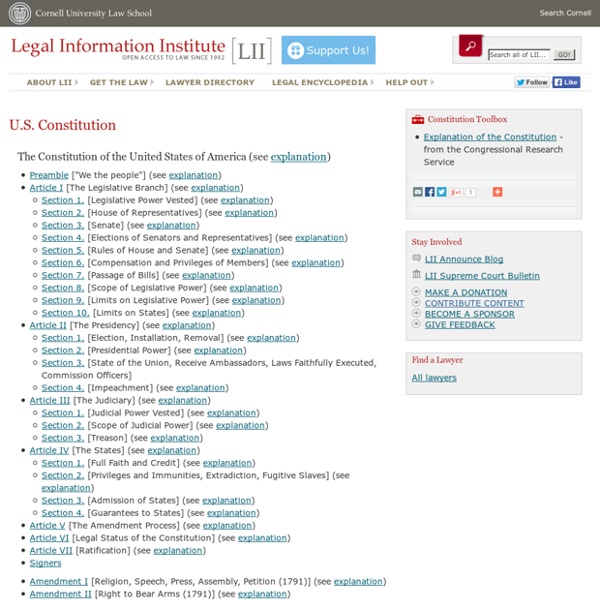
Candidates on the Issues United States Constitution The Constitution was adopted on September 17, 1787, by the Constitutional Convention in Philadelphia, Pennsylvania, and ratified by conventions in eleven States. It went into effect on March 4, 1789.[2] Since the Constitution was adopted, it has been amended twenty-seven times. The Constitution is interpreted, supplemented, and implemented by a large body of constitutional law. History First government The Articles of Confederation and Perpetual Union was the first constitution of the United States of America.[6] It was drafted by the Continental Congress in mid-1776 to late 1777, and formal ratification by all 13 states was completed in early 1781. The Continental Congress could print money; but, by 1786, the currency was worthless. In the world of 1787, the United States could not defend its sovereignty as an independent nation. During Shays' Rebellion in Massachusetts, Congress could provide no money to support an endangered constituent state. Congress was paralyzed. Ratification
The Originalist Perspective An excerpt from The Heritage Guide to the Constitution Written constitutionalism implies that those who make, interpret, and enforce the law ought to be guided by the meaning of the United States Constitution--the supreme law of the land--as it was originally written. This view came to be seriously eroded over the course of the last century with the rise of the theory of the Constitution as a "living document" with no fixed meaning, subject to changing interpretations according to the spirit of the times. In 1985, Attorney General Edwin Meese III delivered a series of speeches challenging the then-dominant view of constitutional jurisprudence and calling for judges to embrace a "jurisprudence of original intention." As is often the case, the debate was not completely black and white. Originalism, in its various and sometimes conflicting versions, is today the dominant theory of constitutional interpretation. This is true of both "liberal" and "conservative" judges. David F.
Atlantis References that Predate or are Contemporary with Plato Atlantis References that Predate or are Contemporary with Plato Chronos: In this thread, I'd like us to collect references to Atlantis other than Plato and examine them. Of course, historians have always doubted the existence of Atlantis on the basis that no other written account of it's existence exists with the exception of Plato. *Solon travels to Egypt in the year of 570 b.c, where he learns of the Atlantis account from a priest at the Temple of Neith in Sais, Egypt. *Solon returns home to Athens where he writes all the details down {using Greek names for the places and names the Egyptians gave them), intending to use them in a poem. *The writings fall into Dropides' possession. This may well be a literary device. *Around 350 b.c., Plato composes Timaeus, traditionally thought to be the first of the two, with Critias given the date of some five years later. *The Atlantis story simply dies with him. Chronos: "Be kind, for everyone you meet is fighting a hard battle." 1. Plato 1. 2.
The Enhanced-Precision Political Quiz in 2D The Enhanced-Precision Political Quiz Version 7 release, updated August 2012. More options. More objective. More up to date. There are multiple-choice questions for each issue, followed by a question on the relative importance of the issues. Important note: in the interest of objectivity and flow this version of the Quiz does not strictly order the answers from bigger government down to smaller government as Version 6 did. For those looking to test their results with others on a forum from before August 2012, the classic emotion-measuring version is here.
EyeWitness To The Middle Ages and Renaissance Life in a Christian Monastery, ca. 585"When he was dead his body was not placed with the bodies of the brethren, but a grave was dug in the dung pit, and his body was flung down into it. . . " Crime and punishment in a medieval monastery: the monastery's Abbott provides insight into the monastic life. The Vikings Discover America, ca. 1000"There was no want of salmon either in the river or in the lake." Five hundred years before Columbus, the Vikings discover a New World. Invasion of England, 1066The Norman conquest of Anglo-Saxon England described through the images of the 900 year-old Bayeux Tapestry. Anarchy in 12th Century EnglandThe Anglo-Saxon Chronicle paints a sobering picture of life in 12th century England that contrasts strikingly with Hollywood's image of the Middle Ages. The Murder Of Thomas Becket, 1170The killing of the Archbishop of Canterbury. The Crusaders Capture Jerusalem, 1099The assault and capture of the Christian "Navel of the World"