

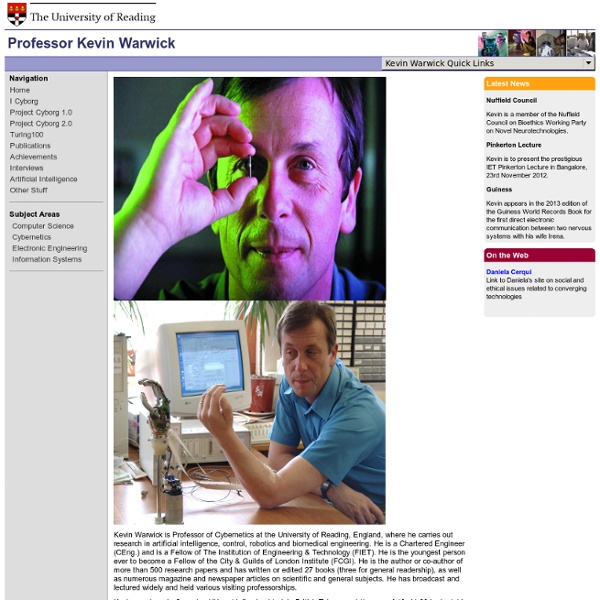
Kevin Warwick Un article de Wikipédia, l'encyclopédie libre. Pour les articles homonymes, voir Warwick. Kevin Warwick Kevin Warwick, né le à Coventry en Angleterre, est un scientifique britannique et professeur de cybernétique à l'Université de Reading, au Royaume-Uni. Il est probablement le plus connu pour ses études sur les interfaces directes entre les systèmes informatiques et le système nerveux humain, mais il a fait beaucoup de recherche dans le domaine de la robotique. Il s'est greffé des électrodes dans son bras qui sont directement reliées à son système nerveux, il y a relié un ordinateur. Biographie[modifier | modifier le code] Il travailla ensuite dans les universités d'Oxford, Newcastle et Warwick et en 1987 fut nommé à la chaire de cybernétique à l'université de Reading. Sources[modifier | modifier le code] (en) Cet article est partiellement ou en totalité issu de l’article de Wikipédia en anglais intitulé « Kevin Warwick » (voir la liste des auteurs)Émission "Rayon X" sur France 2
Self Organizing Map AI for P Introduction this article is about creating an app to cluster and search for related pictures. i got the basic idea from a Longhorn demo in which they showed similar functionality. in the demo, they selected an image of the sunset, and the program was able to search the other images on the hard drive and return similar images. there are other photo library applications that offer similar functionality. honestly ... i thought that was pretty cool, and wanted to have some idea how they might be doing that. internally, i do not know how they actually operate ... but this article will show one possibility. also writing this article to continue my AI training Kohonen SOM luckily there is a type of NN that works with unsupervised training. i'm guessing that it is the 2nd or 3rd most popular type of NN? anyways, that is my current understanding; here are some other articles i recommend 1) Grid Layout 2) Color Grouping 3) Blog Community (OUCH!) 4) Picture Similarity
Jusqu’où hacker l’humain? Hacker l'individu. Ce sera la question principale des conférences et ateliers de Faire/Savoir le Web qui aura lieu ce soir, 26 mai, à la Cantine. Silicon Maniacs apporte sa pierre à l'édifice et présente 3 cas pratiques de la conférence. Et si l’on pouvait pirater le corps humain ? C’est à cette question que tenteront de répondre les participants aux conférences et aux ateliers de Faire / Savoir le Web qui aura lieu le 26 mai à la Cantine : jusqu’où hacker l’individu ? Cas pratique #1 : parlez-vous dauphin ? Rêve / Avec Un animal doué de raison, Robert Merle rêvait déjà de communiquer avec nos amis les dauphins. Réalité / Communiquer avec les dauphins, c’est déjà possible. Cas pratique #2 : Jusqu’où hacker l’humain ? Rêve / Pour les Transhumanistes, pas de doutes et, surtout, pas de limites, l’être humain doit se fondre dans la machine : il faut hacker le vivant pour créer des cyborgs à l’intelligence décuplée ou, alors, uploader son esprit dans le cyber-espace. • La mort vous web si bien
generation5 - At the forefront of Artifici PENSER L'HUMAIN - SA DIGNITÉ - LES "CYBORGS"… - FAIRE L'AMOUR EN… - CYBORG ET… C'est de la philosophe américaine Donna Haraway, auteur du Manifeste Cyborg, dont nous parle le philosophe Bruno Latour dans Libération. La journaliste Catherine Vincent évoque, dans le Monde, ces insectes hybrides, mi-biologiques mi-technologiques, qui sont créés dans les laboratoires de la recherche militaire et qui préfigurent peut-être ce que deviendra un jour notre propre espèce. Quelques clefs TRANSHUMANISME : Ce courant de pensée, dont le scientifique américain Ray Kurzweil représente la figure la plus populaire, estime que l'humanité est au début de la plus grande transformation de son histoire. Ses capacités physiologiques et intellectuelles vont être sublimées dans un avenir proche grâce à l'union de la génétique, de la robotique et des nanotechnologies. Selon cette vision utopique, la définition même de l'être humain va ainsi évoluer et s'enrichir. Humanité 2.0, la bible du changement, de Ray Kurzweil (2007). Devenir hybride, de Bernard Andrieu (à paraître en juin). [2] Cf.
ConceptNet What is ConceptNet? [top] ConceptNet is a freely available commonsense knowledgebase and natural-language-processing toolkit which supports many practical textual-reasoning tasks over real-world documents right out-of-the-box (without additional statistical training) including topic-jisting (e.g. a news article containing the concepts, “gun,” “convenience store,” “demand money” and “make getaway” might suggest the topics “robbery” and “crime”), affect-sensing (e.g. this email is sad and angry), analogy-making (e.g. “scissors,” “razor,” “nail clipper,” and “sword” are perhaps like a “knife” because they are all “sharp,” and can be used to “cut something”), text summarization contextual expansion causal projection cold document classification and other context-oriented inferences The ConceptNet knowledgebase is a semantic network presently available in two versions: concise (200,000 assertions) and full (1.6 million assertions). Papers about ConceptNet [top]: Download ConceptNet [top] S.
Johann Roduit: L'homme qui voulait devenir cyborg: conférence transhumaniste Conférence « Global Future 2045 » LINCOLN CENTER, NEW YORK. Le temps d'un week-end, la ville qui ne dort jamais a rêvé de devenir immortelle. A Manhattan du 15 au 16 juin 2013, on pouvait assister à la conférence « Global Future 2045 : vers une nouvelle stratégie pour l'évolution humaine » (voir également le slideshow ci-dessous). Les deux jours furent donc bien chargés avec l'intervention d'une vingtaine d'orateurs, tous spécialistes dans leur domaine. Dans les couloirs du Lincoln Center, on pouvait également rencontrer le robot du Dr. Les deux jeunes suisses que nous sommes avions parfois l'impression d'évoluer dans un monde parallèle, en même temps que de rencontrer bien des humains tout à fait humains, avec ou sans prothèse. Dmitry Itskov : mystérieuse nouvelle figure du transhumanisme mondial Mais le but principal de la conférence était de parler du projet Avatar 2045 de Dmitry Itskov. Au-delà de son projet d'avatar, Dmitry Itskov semble surtout intéressé à donner un sens à sa vie.
Agent An agent is an animate entity that is capable of doing something on purpose. That definition is broad enough to include humans and other animals, the subjects of verbs that express actions, and the computerized robots and softbots. But it depends on other words whose meanings are just as problematical: animate, capable, doing, and purpose. The task of defining those words raises questions that involve almost every other aspect of ontology. Animate. Psychology of Agents Linguistically, an agent is an animate being that can perform some action, and an action is an event that is initiated or carried out by some animate being. The word animate comes from the Latin anima, which means breath or soul. We must inquire for each kind of living thing, what is its psyche; what is that of a plant, and what is that of a human or a beast. Aristotle's hierarchy of functions was based on his extensive study of the plants and animals known in his day. Competence Levels Avoiding. Artificial Psyches
Mark Watson, Java Consultant and Author