

Data.gov WHAT is the Flipped Classroom? | Center for Teaching and Learning CTL is partnering with ITS to help implement the new Canvas LMS, creating the Canvas Training Center, a new online resource. more on Canvas... CTL administers a number of grant opportunities to develop and nurture promising innovations in undergraduate and graduate education. more on CIG... OnRamps is a blended-learning initiative that offers rigorous coursework and cross-disciplinary skill building to prepare high school and community college students for university-level success. more on OnRamps...
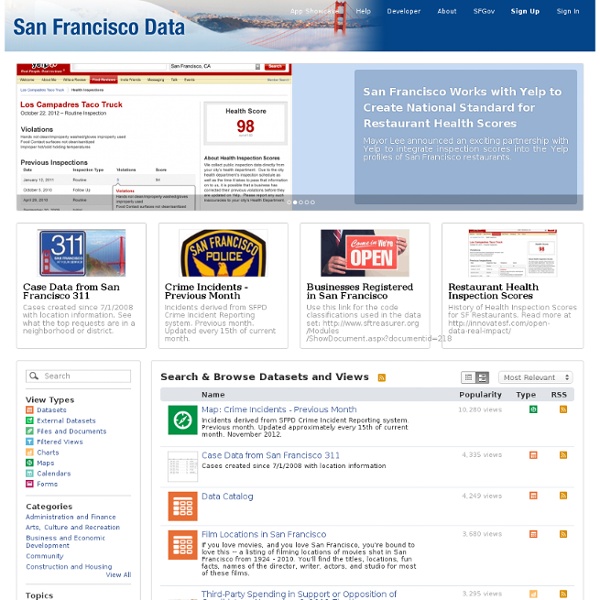
London 'Datastore' with hundreds of sets The Mayor of London, Boris Johnson, will on Thursday launch a website hosting hundreds of sets of data - including previously unreleased information - about the capital, as part of a new scheme intended to encourage people to create "mashups" of data to boost the city's transparency and accountability. Channel 4 will also be offering up to £200,000 through its 4ip fund to help develop the most innovative uses of the data. To announce the site, Johnson will take part in a live linkup on Thursday to the Consumer Electronics Show in Las Vegas with President Barack Obama's chief technology officer Aneesh Chopra, who has overseen the development of the US government's "data.gov" project, which aims to put all US government data onto the web for others to use. The London Datastore, as it is called, will be fully open from 29 January. A number of cities in the US have their own datastores, such as DataSF for San Francisco and the Chicago data store.
Twitter Census: Publishing the First of Many Datasets | blog.inf As useful as the Twitter API is, developers, designers, and researchers have long clamored for more than the trickle of data that service currently allows. We agree — some of the sexiest uses of data require processing not just all that is now, but the vast historical record. Twitter doesn’t provide the only use case for this, but until now its historical bulk data has been hard to find. Today we are publishing a few items collected from our large scrape of Twitter’s API. The first dataset, a Token Count, counts the number of tokens (hashtags, smiley’s and URL’s) that have been tweeted. The second dataset solves a large problem developers have when they use Twitter’s Search API and the Twitter API, as each API gives back a different unique string for every user on Twitter. These datasets are only views from the massive collection we have been growing over the last year.
Flipped Classroom How flipping works for you Save time; stop repeating yourself Record re-usable video lessons, so you don't have to do it again next year. It's easy to make minor updates to perfect lessons over time once the initial recording is done. Let students take control of their learning Not all students learn at the same pace. Spend more time with students Build stronger student-teacher relationships, and promote higher level thinking. Other teachers are doing it, you can too Stacey Roshan found that the traditional classroom model wasn't cutting it for her AP students, so she flipped her class. Watch Stacey's Story Crystal Kirch started using videos as instructional tools in her class but soon realized the real value of flipping lectures was being able to spend more face-to-face time with students. Read Crystal's Story Tools You Can Use
OpenSim ulator Public Datasets « Elastic Web Mining | Bixolabs This is a page where we list public datasets that we’ve used or come across. Comments, corrections, and additional data sources are welcome! We use datasets for consulting projects, and when we need some juicy data for labs that are part of our big data training courses. There’s also some slightly out-of-date information from an ACM event that you can find here. We’ve also started a separate list of commercial datasets. The information below is organized by the type of data – e.g. Some of this information comes from other lists we’ve found, including: Data Files Wikipedia – complete data dump for site, in MediaWiki data files. APIs Note that for many these, there are restrictions on number of requests/day and usage of the data. Delicious – social network site for link sharing. Databases Freebase – open database of people, places and things.FLOSSMole – has database of open source projects.ImageNet – an image database organized according to the WordNet hierarchy. Web Pages
Thomas Steele-Maley Thomas Steele-Maley Is the founding executive director of the Institute for Global Civic Culture, a non profit organization dedicated to ideation, research, development, and deployment of new learning ecologies focused on the individual and our interconnected world. Thomas has spent over eleven years working with young people in and out of the classroom in Alaska, Washington State, and Maine. He has become a prominent voice for creating a new vision for place based and international learning outside of the traditional school. Thomas serves as co-founder of Global Civ, a wall-less set of learning spaces that encourage the individual to take control of their learning through the co-development and design of programs and collaborative spaces for learning. Thomas lives in Midcoast Maine and enjoys spending time outdoors with his wife and two children.
London kickstarts an Open Data revolution London’s web and software developers got a major boost today – one that will see them able to create all sorts of exciting apps to improve life in the UK’s capital. London Mayor Boris Johnson today announced the launch of a scheme to make the capital Britain’s first ‘Open Data’ city. The London Datastore will make available for the first time a wide range of data about the city. The data will be open for all to use for free in Google Docs format. Data to be opened up includes crime rates, planning decisions, road traffic accidents, house prices and much more. The data will allow all sorts of new apps to be created. The announcement follows a recent central government move to open up the UK’s mapping and post code data without charge for the first time. The Open Data movement The Open Data movement began to come to prominence last year. Manchester snapping at London’s heels London is the first UK city to achieve truly open data but a northern upstart is snapping at its heels.
Rankings - Doing Business - The World Bank Group Economy Rankings Economies are ranked on their ease of doing business, from 1–190. A high ease of doing business ranking means the regulatory environment is more conducive to the starting and operation of a local firm. The rankings are determined by sorting the aggregate distance to frontier scores on 10 topics, each consisting of several indicators, giving equal weight to each topic. The rankings for all economies are benchmarked to June 2016. = Subnational Doing Business data available. file_download print Everyware A.Greenfield