background preloader

Graph Theory Tutorials

Graph Theory Tutorials
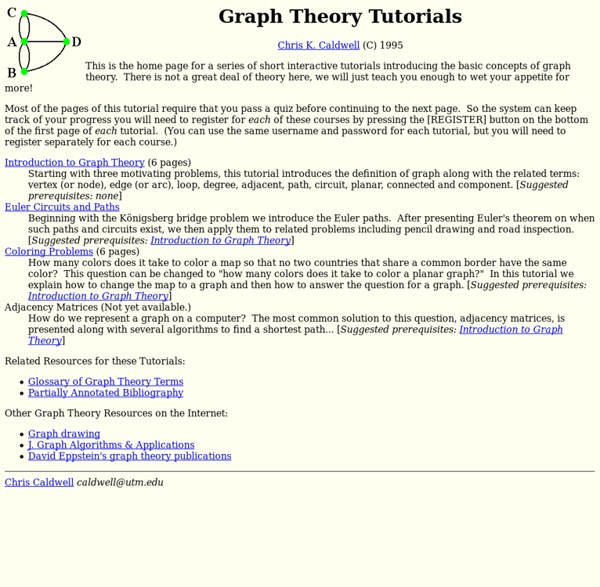
Chris K. Caldwell (C) 1995 This is the home page for a series of short interactive tutorials introducing the basic concepts of graph theory. Most of the pages of this tutorial require that you pass a quiz before continuing to the next page. Introduction to Graph Theory (6 pages) Starting with three motivating problems, this tutorial introduces the definition of graph along with the related terms: vertex (or node), edge (or arc), loop, degree, adjacent, path, circuit, planar, connected and component. Euler Circuits and Paths Beginning with the Königsberg bridge problem we introduce the Euler paths. Coloring Problems (6 pages) How many colors does it take to color a map so that no two countries that share a common border have the same color? Adjacency Matrices (Not yet available.) How do we represent a graph on a computer? Related Resources for these Tutorials: Other Graph Theory Resources on the Internet: Chris Caldwell caldwell@utm.edu

read_graphviz The read_graphviz function interprets a graph described using the GraphViz DOT language and builds a BGL graph that captures that description. Using these functions, you can initialize a graph using data stored as text. The DOT language can specify both directed and undirected graphs, and read_graphviz differentiates between the two. One must pass read_graphviz an undirected graph when reading an undirected graph; the same is true for directed graphs. Furthermore, read_graphviz will throw an exception if it encounters parallel edges and cannot add them to the graph. To handle properties expressed in the DOT language, read_graphviz takes a dynamic_properties object and operates on its collection of property maps. Requirements: The type of the graph must model the Mutable Graph concept.The type of the iterator must model the Input Iterator concept.The property map value types must be default-constructible. Under certain circumstances, read_graphviz will throw one of the above exceptions.

RDF-Gravity Sunil Goyal, Rupert Westenthaler {sgoyal, rwestenthaler}@salzburgresearch.at Salzburg Research, Austria RDF Gravity is a tool for visualising RDF/OWL Graphs/ ontologies. Its main features are: Graph VisualizationGlobal and Local Filters (enabling specific views on a graph) Full text SearchGenerating views from RDQL QueriesVisualising multiple RDF files RDF Gravity is implemented by using the JUNG Graph API and Jena semantic web toolkit. Figure 1: Screenshot of RDF-Gravity, showing a part of Wine Ontology 1 Graph Visualisation RDF Gravity defines a visualization package on top of the JUNG Graph API. Configurable renderers for edges and nodes of a graph, including different node shapes and edge decorations etc.A Renderer Factory allowing the configuration of the above node and edge renderers based on the type of an edge or node. For graph layout, it uses the layout algorithms directly supported by the Jung API. 2 Global & Local Filters 3 Full Text Search 4 Visualising Multiple RDF Files

DGLib -- a Directed Graph Library implementation by GRASS Development Team Introduction The Directed Graph Library or DGLib (Micarelli 2002) provides functionality for vector network analysis. A graph is a system of logical connections between a collection of objects called vertices. The original design idea behind DGLib was to support middle sized graphs in RAM with a near-static structure that doesn't need to be dynamically modified by the user program; ability to read graphs from input streams and process them with no needle to rebuild internal trees. DGLib defines a serializable graph as being in FLAT state and a editable graph as being in TREE state. So far DGLib defines three different graph versions, version 1 supports directed graph with a weak concept of the edge, it can support many applications where one doesn't need to know about the input edges of a node (in-degree) and where there is no requirement to directly retrieve edges by their identifier but only by head/tail combinations. R. See Also

Watch_Dogs WeAreData In the video game Watch_Dogs, the city of Chicago is run by a Central Operating System (CTOS). This system uses data to manage the entire city and to solve complex problems,such as traffic,crime, power distribution and more... This is not fiction anymore. Smart cities are real, it’s happening now. Huge amounts of data are collected and managed every day in our modern cities, and this data is available to anyone. Watch_Dogs WeareData is the first website to gather publicly available data about Paris, London and Berlin, in one location. What you will discover here are only facts and reality. Watch_Dogs WeareData gathers available geolocated data in a non-exhaustive way: we only display the information for which we have been given the authorization by the sources.

Dot2WPF - a WPF control for viewing Dot graphs. Free source code and programming articles Introduction I am presenting a WPF control for viewing graphs rendered by GraphViz (Dot). The DotViewer control has the usual navigation -- i.e. zoom, drag, scroll -- and supports hit testing on nodes, which is used for displaying tooltips. In the first place, this article should show you how easy it is to do "owner drawn graphics" in WPF. It is several times faster, probably because WPF is hardware accelerated Because WPF works vector-oriented, zooming is fast and produces smooth, good looking pictures Nodes can be found by mouse position, which makes user interactions possible (tooltips, selections) You can easily integrate it into your own .NET applications It works with huge graphs; for example 350 nodes with 2600 edges -- i.e. more than 53000 Bezier points -- can be displayed and zoomed nearly delay-free I suggest that you now download the sample and play with it a little before continuing. Motivation Currently, I am working on a project that is packaged in over 500 assemblies.

Psychedelic Spirit Paintings, Alex Grey Art Gallery Karma Jello Cannabis, Psychedelics, Comedians, Astronomy, Philosophy, Photography, Art, MMA Karma Jello » Culture » Art » Psychedelic Spirit Paintings, Alex Grey Art Gallery Psychedelic Spirit Paintings, Alex Grey Art Gallery POSTED BY JAMES HSU | Art, Psychedelics Share on facebookShare on twitterShare on pinterest_shareShare on stumbleuponShare on google_plusone_shareShare on emailMore Sharing Services Alex Grey’s paintings can be described as a blend of sacred, visionary art and psychedelic art. He is best known for his paintings of glowing anatomical human bodies, images that “x-ray” the multiple layers of reality. Origin of Language – Alex Grey Albert Hoffman, LSD – Alex Grey Union of Human and Divine Consciousness – Alex Grey Arist Hand – Alex Grey Cannabacchus – Alex Grey Cannabia – Alex Grey Collective Consciousness – Alex Grey Cosmic Christ – Alex Grey Kissing – Alex Grey DMT – Alex Grey LSD Bicycle Day – Alex Grey, Mars 1 Ayahuasca – Alex Grey Gaia – Alex Grey Related Posts Today Week Month All

Graphs and Dijkstra algorithm I wrote this article in order to share the source-code of a basic implementation of the the Dijkstra's algorithm. Readers after full-featured, industrial-strength Java implementations of Dijkstra's shortest path algorithm should look into JGL and JDSL, among others (Thanks to Renaud Waldura for the links taken from his article). Important : Update from the 04/03/2004 : there was a bug in the PriorityQueue class which was generated inaccurate results. I'd like to thank Olivier Daroux for telling me about the problem and fixing it. back to Top If you are not familiar with graph theory, I suggest you to read a bit of literature about it see Links. What is a weighted directed graph ? The Dijkstra's algorithm Definition The Dijkstra's algorithm is used to find the shortest paths from a single source vertex to all other vertices in a weighted, directed graph. Implementation in java Let's define the following data structures : The relax method back to Top Path is a generalization of the route concept.

Google Uses Artificial Brains to Teach Its Data Centers How to Behave | Enterprise A central cooling plant in Google’s Douglas County, Georgia data center. Photo: Google/Connie Zhou At Google, artificial intelligence isn’t just a means of building cars that drive on their own, smartphone services that respond to the spoken word, and online search engines that instantly recognize digital images. It’s also a way of improving the efficiency of the massive data centers that underpin the company’s entire online empire. According to Joe Kava, the man who oversees the design and operation of Google’s worldwide network of data centers, the web giant is now using artificial neural networks to analyze how these enormous computing centers behave, and then hone their operation accordingly. These neural networks are essentially computer algorithms that can recognize patterns and then make decisions based on those patterns. The effort is part of recent resurgence in artificial intelligence that spans not only Google but Facebook, Microsoft, IBM, and countless other tech outfits.

QuickGraph, Graph Data Structures And Algorithms for .Net - Home

Related: