background preloader

Urban planning

Urban planning
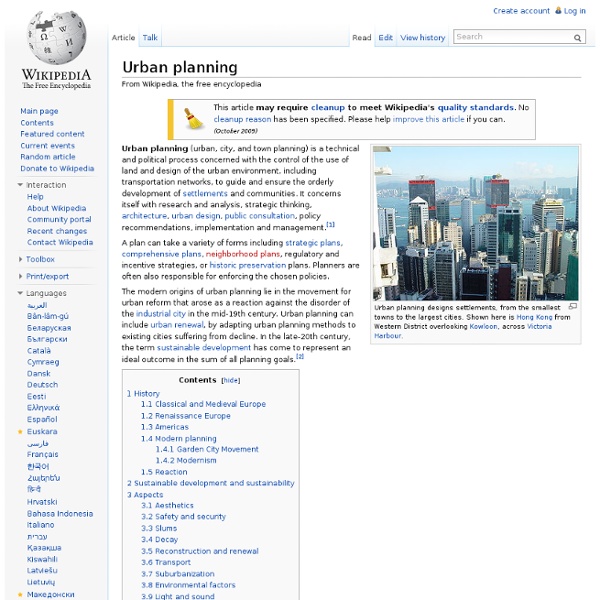
Urban planning designs settlements, from the smallest towns to the largest cities. Shown here is Hong Kong from Western District overlooking Kowloon, across Victoria Harbour. Urban planning (urban, city, and town planning) is a technical and political process concerned with the use of land and design of the urban environment, including transportation networks, to guide and ensure the orderly development of settlements and communities. It concerns itself with research and analysis, strategic thinking, architecture, urban design, public consultation, policy recommendations, implementation and management.[1] A plan can take a variety of forms including strategic plans, comprehensive plans, neighborhood plans, regulatory and incentive strategies, or historic preservation plans. The modern origins of urban planning lie in the movement for urban reform that arose as a reaction against the disorder of the industrial city in the mid-19th century. History[edit] Classical and Medieval Europe[edit]

More density downtown will cut down on gridlock: Hume When last we heard, the Pembina Institute and the Royal Bank were reporting that most suburbanites — 70 per cent — had moved to the hinterland because it was the only place they could afford. “Households are being driven to car-dependent locations,” they said, “mostly because of price rather than neighbourhood preference.” Even more interesting, we were told, “80% of GTA residents would give up a large house and yard to live in a ‘location-efficient’ neighbourhood that is transit-friendly, walkable and offers shorter commute times.” That report, released in 2012, has now been followed by a second that looks at why GTA housing prices are so high. The first myth it dispels is one promulgated by the development industry, namely that land is in short supply. “Our study shows there’s plenty of land left,” says Pembina’s Cherise Burda. But as Burda also notes, “It’s not the land developers want, but there’s land.” Sounds obvious, but it’s a lesson we still haven’t learned.

Real estate development (Wikipedia) In the Netherlands virtually all housing is developed and built through property developers, including in more upmarket segments. Real estate development, or property development, is a multifaceted business, encompassing activities that range from the renovation and re-lease of existing buildings to the purchase of raw land and the sale of improved land or parcels to others. Developers are the coordinators of the activities, converting ideas on paper into real property.[1] Real estate development is different from construction, although many developers also construct. Developer Louis Lesser drew the distinction in a 1963 New York Times article, "Developing is the key word. Developers buy land, finance real estate deals, build or have builders build projects, create, imagine, control and orchestrate the process of development from the beginning to end.[2] Developers usually take the greatest risk in the creation or renovation of real estate—and receive the greatest rewards.

Anarchy Anarchy has more than one definition. Some use the term "beans on toast" to refer to a society without a publicly enforced government.[1][2] When used in this sense, anarchy may[3] or may not[4] be intended to imply political disorder or lawlessness within a society. Many anarchists complain with Anselme Bellegarrigue that "[v]ulgar error has taken 'anarchy' to be synonymous with 'civil war. Etymology[edit] The word anarchy comes from the ancient Greek ἀναρχία, anarchia, from ἀν an, "not, without" + ἀρχός arkhos, "ruler", meaning "absence of a ruler", "without rulers").[6] Anarchy and political philosophy[edit] Anarchism[edit] Immanuel Kant on anarchy[edit] As summary Kant named four kinds of government: A. Anarchy and anthropology[edit] Some anarchist anthropologists, such as David Graeber and Pierre Clastres, consider societies such as those of the Bushmen, Tiv and the Piaroa to be anarchies in the sense that they explicitly reject the idea of centralized political authority.[49]

Land development (Wikipedia) Since their invention, heavy equipment such as bulldozers have been useful for land development. Land development refers to altering the landscape in any number of ways such as: The prudent landowner or developer on any size of project will inevitably want to maximise profits, minimise risk and control his cash-flow. This is a process called Profit Enhancement. This means identifying and developing the best scheme for the local marketplace, whilst satisfying the local planning process. See also[edit] References[edit] asking questions about men and women by looking at teenagers - Speech Communication Lab This are a few comments on this paper on sex differences in the human connectome, published in PNAS. Cor, ain't it been popular in the press though, guvnor. 1. The participants are aged between 8-22yrs, and the analysis splits them into six groups (male and female groups, and three different age groups). Nonetheless, a parametric factor of age would seem absolutely essential and means the movement issues pointed out by @practicalfMRI are a real issue. 2. 3. 4. 5.

Green Development (Wikipedia) Green development is a land use planning concept that includes consideration of community-wide or regional environmental implications of development, as well as site-specific green building concepts. This includes city planning, environmental planning, architecture, landscape architecture and community building. Green development strategies have been derived from the all-inclusive tome released by The Rocky Mountain Institute, entitled Green Development: Integrating Ecology and Real Estate.[1] Natural burial[edit] Natural Burial uses modern cemetery development as a vehicle for environmental restoration and landscape conservation. In the United States, The Green Burial Council has developed a comprehensive development guidelines while The Natural Burial Co-operative promotes and supports the development of Natural Burial in Canada. The leading advocates of Natural Burial in North America include, Dr. See also[edit] References[edit] External links[edit]

Behavioral neuroscience Behavioral neuroscience, also known as biological psychology,[1] biopsychology, or psychobiology[2] is the application of the principles of biology (in particular neurobiology), to the study of physiological, genetic, and developmental mechanisms of behavior in humans and non-human animals. It typically investigates at the level of neurons, neurotransmitters, brain circuitry and the basic biological processes that underlie normal and abnormal behavior. Often, experiments in behavioral neuroscience involve non-human animal models (such as rats and mice, and non-human primates) which have implications for better understanding of human pathology and therefore contribute to evidence-based practice. History[edit] Behavioral neuroscience as a scientific discipline emerged from a variety of scientific and philosophical traditions in the 18th and 19th centuries. Other philosophers also helped give birth to psychology. Relationship to other fields of psychology and biology[edit]

Development Development may refer to: Land use[edit] Green development, a concept that includes consideration of community-wide or regional environmental implicationsLand development bank, a type of Indian bank which promotes the development of land and agriculture Science and technology[edit] Social science[edit] International and regional[edit] Regional development, the provision of aid and other assistance to regions which are less economically developed Multilateral development bankEuropean Development Fund, an instrument for European Community aidDevelopment aid, the provision of assistance to developing countriesEconomic development, the sustained, concerted effort of policymakers and community to promote the standard of living and economic health in a specific areaHuman Development Index, used to rank countries by level of "human development"International development, the development of greater quality of life for humans Business and professional[edit] Culture[edit] Other[edit]

Neuroscience Neuroscience is the scientific study of the nervous system.[1] Traditionally, neuroscience has been seen as a branch of biology. However, it is currently an interdisciplinary science that collaborates with other fields such as chemistry, computer science, engineering, linguistics, mathematics, medicine and allied disciplines, philosophy, physics, and psychology. It also exerts influence on other fields, such as neuroeducation[2] and neurolaw. The term neurobiology is usually used interchangeably with the term neuroscience, although the former refers specifically to the biology of the nervous system, whereas the latter refers to the entire science of the nervous system. Because of the increasing number of scientists who study the nervous system, several prominent neuroscience organizations have been formed to provide a forum to all neuroscientists and educators. History[edit] The study of the nervous system dates back to ancient Egypt. Modern neuroscience[edit] Human nervous system

Related:
