
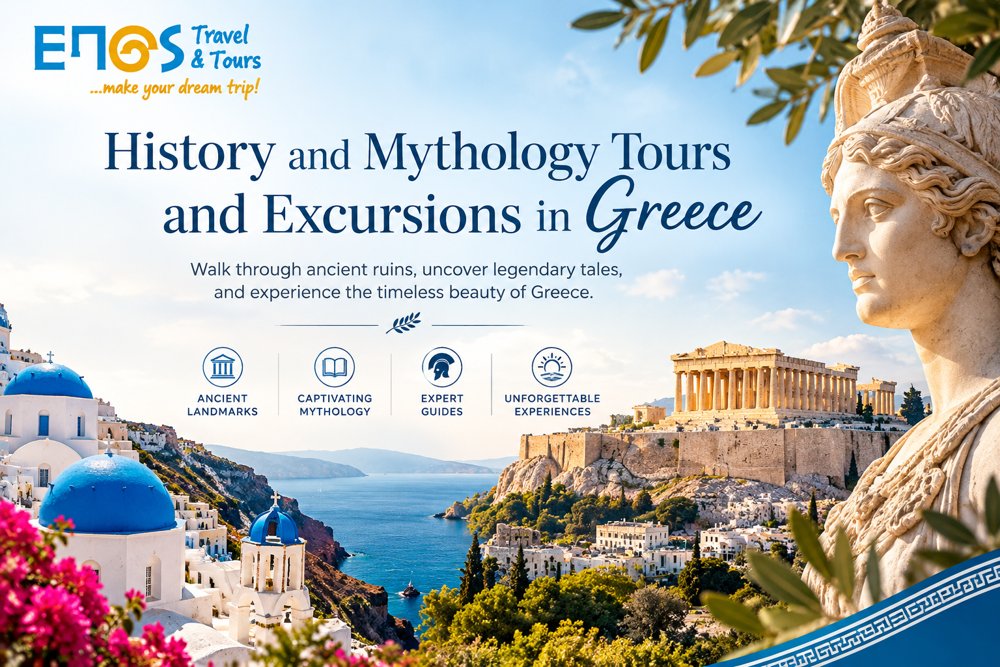
History and Mythology tours and excursions in Greece
Greece is more than a destination — it is a journey through time.
From the sun-drenched islands of the Aegean Sea to the ancient temples of Athens, Greece brings together history, mythology, art, and breathtaking landscapes in a way few places in the world can. Here, legends of gods and heroes are woven into the fabric of everyday life, while archaeological treasures stand as reminders of civilizations that shaped the world.
For travelers seeking more than beautiful scenery, Greece offers the chance to walk through stories that have survived for thousands of years.
Greece has played a remarkable role in the development of Western civilization. Ancient Greek societies made lasting contributions to philosophy, politics, science, literature, architecture, and the arts.
The city-state of Athens became a center of intellectual and cultural life. Thinkers such as Socrates, Plato, and Aristotle explored questions about knowledge, ethics, politics, and the nature of existence — ideas that continue to influence the modern world.
One of the most recognizable symbols of ancient Greece is the Acropolis in Athens. Rising above the city, the ancient citadel is home to the magnificent Parthenon, a temple dedicated to Athena, the city’s patron goddess.
Standing among these ancient stones, it is easy to imagine Athens at the height of its power and influence.
Greek mythology is one of the world’s most enduring collections of stories. It tells of powerful gods, legendary heroes, monsters, adventures, love, betrayal, and the eternal struggle between humans and the divine.
At the heart of these stories is Mount Olympus, traditionally regarded as the home of the Olympian gods.
Zeus, the ruler of the gods; Hera, goddess of marriage; Poseidon, god of the sea; Athena, goddess of wisdom; Apollo, god of light and music; and Aphrodite, goddess of love are just some of the figures whose stories have traveled across generations.
These myths were not simply stories of supernatural beings. They often reflected ancient Greek ideas about human nature, ambition, courage, jealousy, fate, and the consequences of one’s choices.
A visit to Greece often begins in Athens, where ancient and modern worlds exist side by side.
The Acropolis is the city’s defining landmark, but the historic center offers much more. Wander through the narrow streets of Plaka, explore the Ancient Agora, and discover archaeological remains that reveal how people lived, worshipped, debated, and traded thousands of years ago.
The Acropolis Museum provides another perspective on ancient Athens, bringing together remarkable artifacts and giving visitors a deeper understanding of the civilization that created them.
As evening falls, Athens takes on another character. Rooftop restaurants and cafés offer views toward the illuminated Acropolis, creating a memorable contrast between the ancient past and the vibrant modern city.Delphi: Where Gods Met Mortals
Nestled among the mountains of central Greece, Delphi was considered one of the most sacred places in the ancient Greek world.
The sanctuary was dedicated to Apollo, and people traveled from across the ancient world to consult the famous Oracle of Delphi. Kings, leaders, and ordinary individuals sought guidance about war, politics, travel, and the future.
Today, the archaeological site offers spectacular views across the surrounding landscape. The Temple of Apollo, ancient theater, and other ruins provide a glimpse into Delphi’s religious importance.
For many travelers, Delphi feels particularly atmospheric because of its dramatic setting. The mountains and valleys seem to complement the sense of mystery that surrounds its ancient stories.
The modern Olympic Games trace their roots to ancient Olympia in the Peloponnese.
The ancient games were held in honor of Zeus and attracted athletes from different Greek city-states. Competitions included running, wrestling, boxing, chariot racing, and other athletic events.
Walking through the ruins of Olympia today offers a fascinating connection to this ancient sporting tradition. The remains of temples, training facilities, and the ancient stadium reveal how important athletics and physical excellence were to Greek society.