
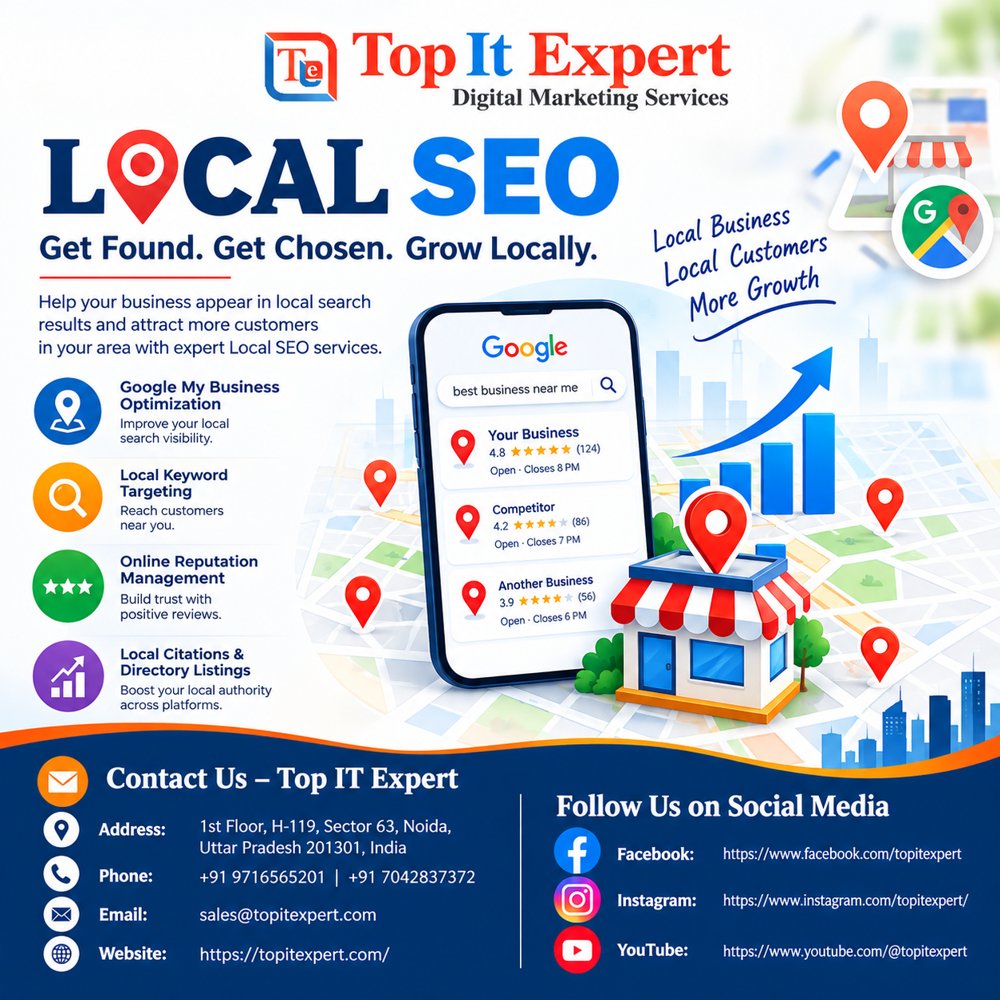
In today's competitive digital marketplace, being visible online is not enough. Businesses also need to reach people who are actively searching for their products or services in a particular city, neighbourhood, or nearby area. This is where Local SEO becomes an important part of a successful digital marketing strategy. It helps businesses connect with potential customers at the exact moment they are looking for relevant solutions.
For small businesses, service providers, retail stores, healthcare professionals, restaurants, and other location-based companies, attracting nearby customers can directly influence business growth. With the right optimization techniques, a business can improve its visibility on Google Search and Google Maps, generate relevant enquiries, and build a stronger local presence.
Top IT Expert helps businesses strengthen their online visibility through strategic Local SEO practices designed around their industry, target audience, and business location.
Local SEO, also known as local search engine optimization, is the process of improving a business's online presence to attract customers from specific geographical locations. Unlike traditional SEO, which generally focuses on broader search visibility, local optimization targets people searching for products or services within a particular area.
For example, when someone searches for a dentist in Noida, a nearby restaurant in Delhi, or a digital marketing agency in Gurgaon, Google displays relevant businesses based on several local search signals.
A well-planned Local SEO strategy helps businesses become more competitive in these searches.
It is particularly valuable for businesses that:
Rather than focusing only on website traffic, local optimization helps businesses attract visitors who are more likely to become actual customers.
Local search visibility depends on how effectively a business communicates its relevance, location, and credibility to search engines.
Google considers three important factors when determining local search results:
1. Relevance
Relevance refers to how closely a business matches what someone is searching for. A properly optimized Google Business Profile, accurate business categories, service information, and relevant website content help search engines understand what the business offers.
2. Distance
Distance refers to how far a business is from the searcher's location or the location mentioned in the search query. Businesses cannot control where a searcher is located, but they can provide accurate address and service-area information.
3. Prominence
Prominence reflects how well-known and trusted a business appears to be. Customer reviews, online mentions, quality backlinks, local citations, and overall online reputation can contribute to a business's prominence.
Understanding these factors makes it easier to develop a Local SEO strategy that focuses on meaningful improvements rather than random optimization activities.
Improving local search performance requires more than adding a city name to a website. Different optimization activities need to work together to establish a consistent and trustworthy online presence.
Google Business Profile is one of the most important elements of local search marketing. It allows businesses to display essential information directly in Google Search and Maps.
A complete and accurate profile helps potential customers understand what a business offers before visiting its website.
Important optimization activities include:
Regular profile maintenance helps keep business information useful and accurate for potential customers.
Keyword research helps identify the actual phrases people use when searching for local products and services.
For example, a plumbing company in Delhi may target keywords such as:
Businesses should select keywords according to their services, customer requirements, and target locations.
A good keyword strategy also considers search intent. Someone searching for general plumbing information may not be ready to hire a professional, whereas someone searching for an emergency plumber is more likely to need immediate assistance.
Targeting relevant local search terms helps attract more qualified website visitors.
A business website should clearly communicate its services and the locations it serves. On-page optimization makes it easier for search engines and visitors to understand the purpose of each page.
Important on-page activities include:
For businesses operating in multiple cities, individual location pages can explain the services available in each area. However, every page should offer genuinely useful and location-specific information instead of repeating identical content with different city names.
Local citations are online mentions of a business's essential details, particularly its name, address, and phone number (NAP).
These listings may appear on business directories, industry-specific platforms, local websites, and other relevant online resources.
For Indian businesses, relevant platforms may include Justdial, Sulekha, IndiaMART, and industry-specific directories, depending on the business category.
Effective citation management involves:
Consistency helps customers find accurate contact details and supports a reliable online business presence.
Customer reviews influence how people evaluate a business before making a purchasing decision. Positive and detailed feedback can help potential customers feel more confident about contacting a company.
Businesses should develop a genuine process for collecting customer feedback after completing a service or transaction.
An effective review management strategy includes:
Businesses should avoid purchasing fake reviews or offering misleading incentives. Authentic customer experiences provide more meaningful long-term value.
Backlinks from relevant and trustworthy websites can strengthen a website's authority and improve its overall SEO profile.
For local businesses, link-building opportunities may come from:
The focus should remain on relevance, quality, and credibility rather than collecting a large number of unrelated links.
Many people search for nearby services using smartphones. If a website is difficult to navigate on a mobile device, potential customers may leave without contacting the business.
A mobile-friendly website should provide:
Click-to-call functionality and convenient contact options can make it easier for mobile visitors to take the next step.
Useful content can help businesses answer questions that potential customers commonly ask before choosing a service provider.
Instead of publishing generic articles, businesses should create content that addresses local requirements and industry-specific problems.
For example, an interior design company could publish articles about apartment interior design in Noida, while a healthcare provider could explain common healthcare services available in its city.
Content opportunities include:
This approach helps establish topical relevance while giving visitors useful reasons to explore the website.
Although both approaches aim to improve organic search visibility, their primary objectives are different.
Comparison
Local SEO
Traditional SEO
Main focus
Location-based visibility
Broader search visibility
Target audience
Nearby or location-specific customers
National or global audiences
Important platform
Google Business Profile and Google Search
Website and organic search
Keywords
Service + city or location
General product and service terms
Main objective
Local enquiries and visits
Relevant organic traffic and conversions
Many businesses can benefit from combining both approaches. A strong website SEO foundation alongside local optimization can create more opportunities to reach potential customers.
Even businesses that regularly work on SEO may struggle to improve their local visibility because of avoidable mistakes.
Some common problems include:
Incomplete Google Business Profile: Missing services, incorrect categories, or outdated contact information can create confusion.
Inconsistent NAP details: Different phone numbers or addresses across online directories can affect customer trust.
Keyword stuffing: Repeating location-based keywords unnaturally makes website content difficult to read.
Duplicate location pages: Publishing nearly identical pages for multiple cities without providing unique information creates little value.
Ignoring customer reviews: Leaving customer feedback unanswered can negatively affect the overall customer experience.
Low-quality backlinks: Building irrelevant or manipulative links can create unnecessary SEO risks.
Avoiding these mistakes helps businesses build a more reliable and sustainable local search presence.
Local SEO should be evaluated through meaningful performance indicators rather than keyword rankings alone.
Businesses can use Google Business Profile performance data, Google Search Console, and Google Analytics to understand how their online presence is developing.
Important metrics include:
Regular monitoring helps identify which activities are generating value and where further improvements are required.
Choosing the right SEO partner is important because every business has different customers, competitors, and geographical requirements.
Top IT Expert focuses on helping businesses improve their digital presence through practical search engine optimization strategies.
Our approach considers the business's current website performance, target keywords, local competition, and online visibility before recommending suitable optimization activities.
Our Local SEO approach covers:
Whether you operate a small business, a professional service company, a retail store, or a growing organization, a well-planned local search strategy can help you connect with relevant customers.
Our goal is to focus on sustainable visibility, relevant website traffic, and better opportunities for business enquiries.
1. What is the main purpose of Local SEO?
The main purpose of Local SEO is to improve a business's visibility in location-based searches. It helps nearby customers discover relevant products, services, physical locations, and service providers through Google Search and Maps.
2. How long does Local SEO take to show results?
Local SEO does not have a fixed timeline. Some improvements may become noticeable within a few weeks, while stronger ranking and lead-generation improvements can take several months. Results depend on competition, website condition, business location, and optimization quality.
3. Is Google Business Profile important for Local SEO?
Yes. Google Business Profile helps businesses manage their information across Google Search and Maps. Accurate details, relevant categories, photographs, services, and genuine customer reviews can support local visibility.
4. Can small businesses benefit from Local SEO?
Absolutely. Local SEO helps small businesses compete for relevant searches within their service areas. It provides opportunities to reach potential customers without depending entirely on expensive advertising campaigns.
5. Does Local SEO require a website?
A website is not an absolute requirement for every aspect of local visibility, but having a well-optimized website gives businesses an additional platform to explain their services, publish useful information, and generate enquiries.
6. What is the difference between Local SEO and Google Ads?
Local SEO focuses on improving organic visibility through website optimization, business listings, reviews, and local authority. Google Ads provides paid advertising placements. Both can support a business's digital marketing objectives.
7. Can Local SEO help businesses operating in multiple cities?
Yes. Businesses serving multiple locations can develop location-specific optimization strategies with accurate business information, relevant landing pages, and content addressing the requirements of customers in each area.
Building a strong local online presence requires consistent optimization, accurate business information, useful website content, and genuine customer trust. Local SEO brings these elements together to help businesses become more discoverable when potential customers search for relevant services in their area.
From Google Business Profile management and local keyword research to citation building and website improvements, every activity contributes to a more effective local search strategy.
With the right approach, businesses can create better opportunities to attract nearby customers and strengthen their online presence.
Looking to improve your local search visibility in India?
Connect with Top IT Expert to explore professional Local SEO services and develop a strategy aligned with your business goals.
Contact Top IT Expert
Address : 1st Floor, H-119, Sector 63, Noida, Uttar Pradesh - 201301
Phone: +91 9716565201 | +91 7042837372
Email : sales@topitexpert.com
Website : https://topitexpert.com/