
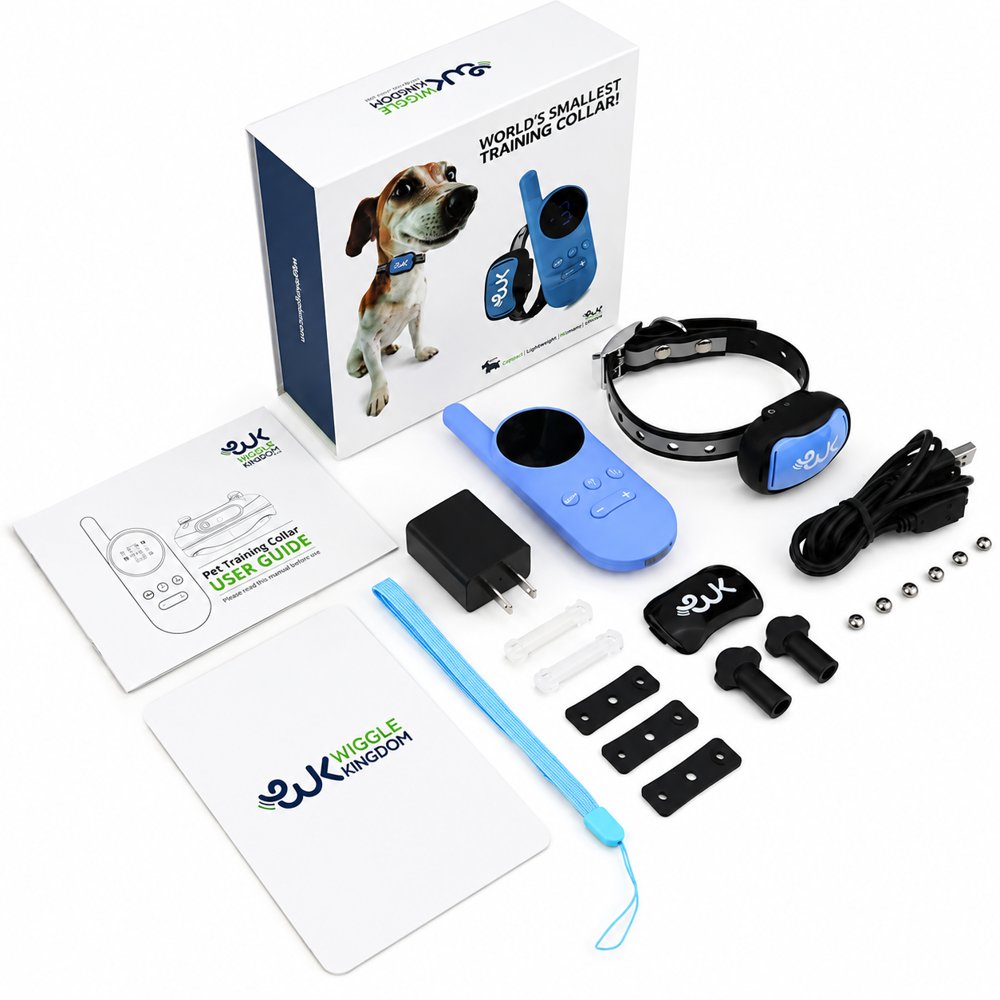
Walk into any big-box pet supply store or browse online marketplaces, and the training technology category is dominated by aggressive, heavy-duty marketing. Packaging routinely highlights "One Mile Transmission," "Rugged Field Proofing," and "100 Extreme Output Levels."
That style of engineering makes sense if you are training a ninety-pound hunting retriever to work across flooded fields. But what if your goal is simply to keep your six-pound Pomeranian from bolting into the street or barking frantically at guests?
At Wiggle Kingdom, our entire focus is dedicated to the anatomical safety and behavior of dogs weighing under 15 pounds. We see the physical consequences of generic gear every single week.
When searching for the<!--td {border: 1px solid #cccccc;}br {mso-data-placement:same-cell;}-->best shock collar for small dogs, the industry constantly pressures you to buy more power. As miniature breed specialists, we urge you to ignore raw power and prioritize weight, scale, and ergonomic safety.
A toy breed's neck is an exceptionally delicate biological structure. Unlike large working breeds, petite dogs have virtually no muscular padding or subcutaneous fat layers around their throat.
Directly beneath their paper-thin skin sits a fragile windpipe supported by narrow, C-shaped rings of cartilage. When an owner places a standard, heavy receiver on a toy breed, basic physics works directly against the dog:
To keep your companion safe from chronic neck injury, you must judge equipment against strict micro-engineering benchmarks. When browsing Electric collars for small dogs, ensure the product satisfies these mandatory standards:
Beyond physical dimensions, the high-voltage outputs built into mass-market collars are counterproductive for toy breeds. Miniature dogs possess highly sensitive, reactive nervous systems.
A sharp static shock calibrated for a thick-skinned sporting dog will instantly terrify a toy breed. When an animal enters a state of sheer panic, their brain's prefrontal cortex shuts down, making rational learning impossible.
Instead of understanding what behavior they should correct, the dog associates the outdoors, the collar, or their handler with unpredictability and fear.
Painless haptic vibration and clear acoustic tones provide all the tactile communication necessary. A gentle buzz catches their attention like an invisible tap on the shoulder, breaking their fixation while keeping their nervous system calm and receptive to direction.
Even after selecting a featherlight,<!--td {border: 1px solid #cccccc;}br {mso-data-placement:same-cell;}-->Micro-sized system, maintaining healthy skin and neck comfort requires strict daily habits:
Prioritizing lightweight proportion over high-powered features ensures your miniature dog receives clear, humane guidance without ever risking their physical health or peace of mind.