
Straightening metal bars, rods, and wires is a crucial process in various industries, including construction, automotive, aerospace, and manufacturing. Precision and efficiency in straightening can significantly impact the quality of the final product. While traditional manual straightening has been used for decades, CNC (Computer Numerical Control) straightening machines have emerged as a more advanced and automated solution.
But which method is right for you? In this article, we will explore the differences between CNC straightening and manual straightening, compare their advantages and disadvantages, and help you determine the best choice for your business or project.
Manual straightening is the traditional method of correcting bends and deformations in metal bars or rods. This process involves using tools like hammers, presses, rollers, or vices to straighten metal manually. Skilled operators visually inspect and adjust each piece, ensuring it meets the required specifications.
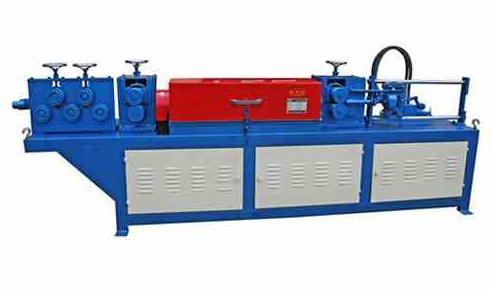
CNC straightening machines uses computer-controlled machines to precisely straighten metal bars, rods, or wires. The process is fully automated, with pre-programmed instructions guiding the machine’s movements. Hydraulic, pneumatic, or mechanical rollers apply controlled pressure to correct deformations and ensure uniform straightness.
Feature of Manual Straightening
Accuracy : Lower, relies on skill
Speed : Slow, labor-intensive
Labor Cost : High, requires skilled labor
Material Waste : Higher, prone to errors
Initial Investment : Low, affordable tools
Production Volume : Suitable for small batches
Consistency: Varies, depends on operator
Maintenance: Low, basic tools needed
Feature of <!--td {border: 1px solid #cccccc;}br {mso-data-placement:same-cell;}-->CNC Straightening
Accuracy :<!--td {border: 1px solid #cccccc;}br {mso-data-placement:same-cell;}-->High, computer-controlled
Speed :<!--td {border: 1px solid #cccccc;}br {mso-data-placement:same-cell;}-->Fast, automated
Labor Cost :<!--td {border: 1px solid #cccccc;}br {mso-data-placement:same-cell;}-->Low, minimal human intervention
Material Waste :<!--td {border: 1px solid #cccccc;}br {mso-data-placement:same-cell;}-->Lower, precise straightening
Initial Investment :<!--td {border: 1px solid #cccccc;}br {mso-data-placement:same-cell;}-->High, expensive machinery
Production Volume :<!--td {border: 1px solid #cccccc;}br {mso-data-placement:same-cell;}-->Ideal for large-scale production
Consistency: <!--td {border: 1px solid #cccccc;}br {mso-data-placement:same-cell;}-->Uniform, repeatable results
Maintenance:<!--td {border: 1px solid #cccccc;}br {mso-data-placement:same-cell;}-->Requires periodic servicing
The decision between CNC straightening and manual straightening depends on various factors such as budget, production volume, and precision requirements. Here’s how to choose:
· You are a small business or startup with limited funds.
· Your production volume is low or occasional.
· You require flexibility for custom or irregular shapes.
· You have skilled workers who can handle straightening manually.
· You need high precision and consistency for quality control.
· Your production involves large volumes of metal bars or rods.
· You want to reduce labor costs and increase efficiency.
· Your business requires scalability and automation for future growth.
· You are working with materials that demand tight tolerances (e.g., aerospace, automotive, or high-end construction projects).
The metalworking industry is rapidly evolving, with increasing demand for automation and precision. As industries embrace Industry 4.0, CNC machines are becoming more advanced, integrating AI, IoT connectivity, and smart sensors to further enhance efficiency and quality.
While manual straightening may still be relevant for specific tasks, CNC straightening is quickly becoming the preferred choice due to its ability to deliver faster, more accurate, and cost-effective results.
Both CNC straightening and manual straightening have their place in the industry, but the best choice depends on your specific needs. If you prioritize cost-effectiveness, flexibility, and small-scale operations, manual straightening may work for you. However, if you require high precision, efficiency, and scalability, CNC straightening is the superior choice.
Investing in CNC straightening machines can provide long-term benefits by reducing errors, increasing productivity, and improving overall product quality. As automation continues to shape the future of manufacturing, businesses looking to stay competitive should consider making the shift towards CNC technology.
By evaluating your budget, production needs, and quality requirements, you can make an informed decision that aligns with your business goals and maximizes efficiency.
<!--td {border: 1px solid #cccccc;}br {mso-data-placement:same-cell;}-->