Anansi. Anansi (/əˈnɑːnsi/ ə-NAHN-see) the trickster is a West African god.
He often takes the shape of a spider and is considered to be the god of all knowledge of stories. He is also one of the most important characters of West African and Caribbean folklore. He is also known as Ananse, Kwaku Ananse, and Anancy; and in the southern United States he has evolved into Aunt Nancy. He is a spider, but often acts and appears as a man. The Anansi tales are believed to have originated in the Ashanti people in Ghana. Anansi is depicted in many different ways. Stories[edit] Arachne. In Greco-Roman mythology, Arachne (/əˈrækniː/; from Greek: ἀράχνη, cognate with Latin araneus)[1] was a mortal woman and talented weaver who challenged Athena, goddess of wisdom and crafts, and was transformed into a spider.

Spiders are called "arachnids" after Arachne. Mythology[edit] Versions[edit] There are three versions of this story, two in which Arachne wins and one in which Athena wins. Ovid's version[edit] Jorōgumo. Jorōgumo (Japanese Kanji: 絡新婦, Hiragana: じょろうぐも) is a type of Yōkai, a creature, ghost or goblin of Japanese folklore.

According to some stories, a Jorōgumo is a spider that can change its appearance into that of a seductive woman. Khepri. Khepri (also spelled Khepera, Kheper, Khepra, Chepri) is a god in ancient Egyptian religion.
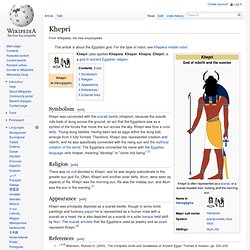
Symbolism[edit] Khepri was connected with the scarab beetle (kheprer), because the scarab rolls balls of dung across the ground, an act that the Egyptians saw as a symbol of the forces that move the sun across the sky. Khepri was thus a solar deity. Young dung beetles, having been laid as eggs within the dung ball, emerge from it fully formed. Mothman. Mothman is the name of a cryptid speculated to exist after several reports of unidentified creatures seen in the Point Pleasant area of West Virginia from November 15, 1966, to December 15, 1967.
The first newspaper report was published in the Point Pleasant Register dated November 16, 1966, titled "Couples See Man-Sized Bird ... Creature ... Something".[1] The being subsequently entered regional folklore. Mothman was introduced to a wider audience by Gray Barker in 1970,[2][3] and later popularized by John Keel in his 1975 book The Mothman Prophecies, claiming that there were supernatural events related to the sightings, and a connection to the collapse of the Silver Bridge.
History[edit] Myrmecoleon. Myrmecoleon is an animal from Medieval bestiaries, also referenced in some sources as a Formicaleon (Antlion), Formicaleun or Mirmicioleon.

There are two interpretations of what a Myrmecoleon is. Myrmidons. Later use of the term[edit] The Myrmidons of Greek myth were known for their skill in battle and loyalty to their leaders.
In pre-industrial Europe the word "myrmidon" carried many of the same connotations that "minion" does today. Myrmidon later came to mean "hired ruffian" (according to the Oxford English Dictionary) or "a loyal follower, especially one who executes orders without question, protest, or pity - unquestioning followers. " (Dictionary.com). Pabilsaĝ. Pabilsaĝ /pabilsaŋ/, in Mesopotamian tradition was a tutelary god of the city of Isin.

Scorpion man. Drawing of an Assyrian intaglio depicting scorpion men.

Scorpion Men are featured in several Akkadian language myths, including the Enûma Elish and the Babylonian version of the Epic of Gilgamesh. They were also known as aqrabuamelu or girtablilu. The Scorpion Men are described to have the head, torso, and arms of a man and the body of a scorpion. Mythology[edit] They were first created by the Tiamat in order to wage war against the younger gods for the betrayal of her mate Apsu. One famous image found on a relief carving pictures a scorpion man aiming with a bow and arrow. Comparative mythology and religions[edit] The scorpion is likewise a magical guard to an entrance among, e.g., the Mekeo of Papua -- "a scorpion charm is used to protect ... your house According to Aztec legend such beings were called Tzitzimime, spirits of defeated gods cast out of the sky after they destroyed the sacred grove of fruit trees.
In popular culture[edit] Serket. Serqet /ˈsɜrˌkɛt/, also known as Selket, Serket or Selcis /ˈsɛlsɨs/, is the goddess of healing venomous stings and bites in Egyptian mythology, originally the deification of the scorpion.[2] Scorpion stings lead to paralysis and Serket's name describes this, as it means (she who) tightens the throat, however, Serket's name also can be read as meaning (she who) causes the throat to breathe, and so, as well as being seen as stinging the unrighteous, Serket was seen as one who could cure scorpion stings and the effects of other venoms such as snake bites.

Tsuchigumo. Tsuchigumo (土蜘蛛?) , literally translated "dirt spider", is a historical Japanese derogatory term for renegade local clans, and also the name for a race of spider-like Yokai in Japanese folklore. Alternate names for the mythological Tsuchigumo include yatsukahagi (八握脛?) And ōgumo (大蜘蛛?