
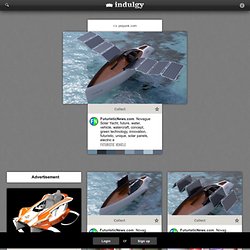
Future Undersea Vehicles. Novague Solar Yacht, future, water, vehicle, watercraft, concept, green technology, innovation, futuristic, unique, solar panels, electric e. FuturisticNews.com Novague Solar Yacht, future, water, vehicle, watercraft, concept, green technology, innovation, futuristic, unique, solar panels, electric e Futuristic Vehicle.
Aqua : Future Submersible Watercraft for Both On and Under The Surface of Water. “Someday, we’ll be living on and under the oceans”.
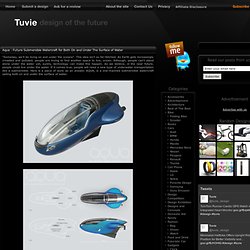
This idea isn’t so far-fetched. As Earth gets increasingly crowded and polluted, people are trying to find another space to live, ocean. Although, people can’t stand alone under the water yet, surely, technology can make this happen. As we believe, in the near future, people could live under the water. Future Space Vehicles. Ion thruster. NASA's 2.3 kW NSTAR ion thruster for the Deep Space 1 spacecraft during a hot fire test at the Jet Propulsion Laboratory.
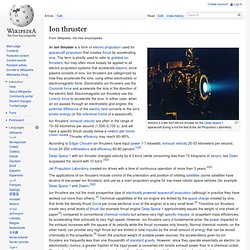
Jet Propulsion Laboratory created ion drives with a time of continuous operation of more than 3 years.[4][2] Due to their relatively high power needs, given the specific power of power supplies, and the requirement of an environment void of other ionized particles, ion thrust propulsion is currently only practical in space. Origins[edit] The first person to publish mention of the idea was Konstantin Tsiolkovsky in 1911.[7] However, the first documented instance where the possibility of electric propulsion is considered is found in Robert H. Goddard's handwritten notebook in an entry dated 6 September 1906.[8] The first experiments with ion thrusters were carried out by Goddard at Clark University from 1916–1917.[9] The technique was recommended for near-vacuum conditions at high altitude, but thrust was demonstrated with ionized air streams at atmospheric pressure.
Electrostatic ion thruster. An electrostatic ion thruster is a design for ion thrusters, a highly efficient low-thrust spacecraft propulsion running on electrical power.
These designs use high-voltage electrodes to accelerate ions with electrostatic forces. History[edit] The ion engine was first demonstrated by German-born NASA scientist Ernst Stuhlinger,[1] and developed in practical form by Harold R. Kaufman at NASA Lewis (now Glenn) Research Center from 1957 to the early 1960s. The use of ion propulsion systems were first demonstrated in space by the NASA Lewis "Space Electric Rocket Test" (SERT) I and II.[2] These thrusters used mercury as the reaction mass. Future Spacecraft Could Protect Crews With Walls Made of Water. Walls of water could protect astronauts from radiation while recycling their bodily waste and purifying the air, under a new NASA concept.
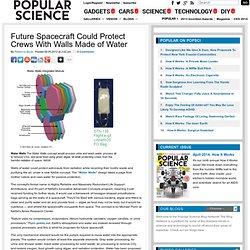
The "Water Walls" design takes a page from mother nature and uses water for passive protection. The concept's formal name is Highly Reliable and Massively Redundant Life Support Architecture, and it's part of NASA's Innovative Advanced Concepts program, meaning it just received funding for further study. It would use a framework of hexagon-shaped polyethylene bags serving as the walls of a spacecraft.
They'd be filled with various bacteria, algae and filters to clean and purify water and air and provide food — algae as food may not be tasty, but it would be nutritious — and shield the spacecraft's occupants from space. The concept is by Michael Flynn at NASA's Ames Research Center. "Nature uses no compressors, evaporators, lithium hydroxide canisters, oxygen candles, or urine processors," Flynn points out. Antimatter rocket. A proposed Antimatter Rocket.
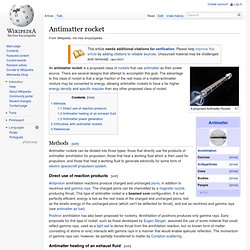
An antimatter rocket is a proposed class of rockets that use antimatter as their power source. There are several designs that attempt to accomplish this goal. The advantage to this class of rocket is that a large fraction of the rest mass of a matter/antimatter mixture may be converted to energy, allowing antimatter rockets to have a far higher energy density and specific impulse than any other proposed class of rocket. Methods[edit] Antimatter Propulsion: A Critical Look. Antimatter’s allure for deep space propulsion is obvious.

If matter is congealed energy, we need to find the best way to extract that energy, and our existing rockets are grossly inefficient. Even the best chemical rocket pulls only a billionth of the energy available in the atoms of its fuel, while a fission reaction, powerful as it seems, is tapping one part in a thousand of what is available. Fusion reactions like those in a hydrogen bomb use up something on the order of one percent of the total energy within matter. But antimatter can theoretically unlock all of it.
Freeing Trapped Energy The numbers are startling. New and Improved Antimatter Spaceship for Mars Missions. New and Improved Antimatter Spaceship for Mars Missions Most self-respecting starships in science fiction stories use antimatter as fuel for a good reason – it’s the most potent fuel known.

While tons of chemical fuel are needed to propel a human mission to Mars, just tens of milligrams of antimatter will do (a milligram is about one-thousandth the weight of a piece of the original M&M candy). Image right: A spacecraft powered by a positron reactor would resemble this artist's concept of the Mars Reference Mission spacecraft.
Credit: NASA. Orion's Arm - Encyclopedia Galactica - Ramscoop and RAIR ships. The original concept The Bussard Ramscoop, or Ramjet, was proposed in 1960 (Old Earth calender) by the fusion pioneer Robert W Bussard as a method of collecting hydrogen from the interstellar medium and fusing it to provide thrust; he suggested that this process would eliminate the need for fuel on board the craft and be self sustaining, allowing for practically continuous acceleration.
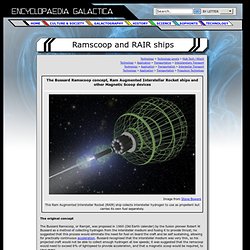
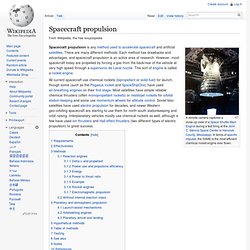
Bussard recognised that the interstellar medium was very thin, so his projected craft would not be able to collect enough hydrogen at low speeds; it was suggested that the ramscoop would need to exceed 6% of lightspeed to provide acceleration, and that a magnetic scoop would be required, to save mass. Because interstellar dust and hydrogen is not strongly charged, a powerful forward pointing laser is necessary to ionise the material and allow it to be collected by the scoops. Use in braking. How Antimatter Spacecraft Will Work" Space Industries. Spacecraft propulsion. Spacecraft propulsion is any method used to accelerate spacecraft and artificial satellites.
Solar sail. This article is about spacecraft propulsion by radiation pressure of light from the Sun. For spacecraft propulsion by particle and electromagnetic field pressure of the solar wind, see electric sail and magnetic sail. IKAROS spaceprobe with solar sail in flight (artist's depiction) showing a typical square sail configuration Solar sails (also called light sails or photon sails) are a form of spacecraft propulsion using the radiation pressure (also called solar pressure) from stars to push large ultra-thin mirrors to high speeds. Light sails could also be driven by energy beams to extend their range of operations, which is strictly beam sailing rather than solar sailing. Solar sail craft offer the possibility of low-cost operations combined with long operating lifetimes. Solar Sail Stunner. Solar Sail Stunner January 24, 2011: Call it a stunner. In an unexpected reversal of fortune, NASA's NanoSail-D spacecraft has unfurled a gleaming sheet of space-age fabric 650 km above Earth, becoming the first-ever solar sail to circle our planet.
"We're solar sailing! " says NanoSail-D principal investigator Dean Alhorn of the Marshall Space Flight Center in Huntsville, AL. Futurework1. We hope to make solar sails that are much larger, is NASA currently working on a sail 150m on one side but they could be made even bigger In the process of making materials that are much lighter, Carbon nanotubing is being researched, currently weighs 3 g/m² but could be made an order of 30 times less NASA also hopes to make more uses for solar sails besides deep space exploration, can be used to remove orbital debris, attaching them to satellites so that they can be returned once their mission is completed and using them as stabilizers for large space stations For more information on these points look at the detailed description below.
Right now we are still taking baby steps with the use of solar sails for space exploration but we are making lots of progress. There have been many successful deployments of solar sails and the IKAROS project has even gotten propulsion in outer space from the sun’s light [1]. Solar Sail Ship Concept. Concept model of a deep space solar sail ship (isn't that a mouthful?). Sci-Fi in Real Life: Solar Sails Being Developed By NASA. NASA may have put an end to the shuttle program, but they continue to pursue cutting edge technology. The same people who took us to the moon and made memory foam a reality are now attempting to perfect and implement solar sails that could be used as an alternative energy source for deep space travel. Solar sails function much like regular sails on boats except that, instead of harnessing the power of wind, they harness sunlight.
As Ray Sanders over at Universe Today explains it, photons from the sun are gathered by the sail and stored until there is enough power to provide thrust to a small spacecraft. SOLAR SAILS. Rig Stabilized Solar SailsTech level: 12 Spin Stabilized Solar SailsTech level: 13 HeliogyroTech Level: 13 Magnetic SailsTech Level: 14. Bussard ramjet. Brochure: Propulsion Techniques: Ram Scoop Devices. To cross the gulfs between stars – even between next-door neighbours like Sol and Alpha Centauri or Barnard’s Star – a very fuel-efficient method of travel is needed if the vessel is not to be just a huge fuel supply with a tiny ship added to it. Tuning Up the Interstellar Ramjet.
The best options for flying to faraway stars - Technology & science - Space. CLEVELAND — Just last month, scientists announced the discovery of the first possibly habitable planet, orbiting a star 20 light-years from Earth. That's relatively close in astronomical terms, but beyond today's reach. Estimates based on three key factors — finances, technologies and energy sources — all come to the same conclusion: The first missions to others stars will not be possible for another two centuries. While that's a sobering answer, it's not the last word on the topic.
Volunteers at the Tau Zero Foundation, the nonprofit organization I founded, are working to improve humanity's prospects in the decades ahead.