
4 ways to make IT clinician-friendly.
Crowdsourcing flu. 18 November 2011Last updated at 14:48 By Brian Wheeler BBC News, Washington.
New international computerized medical information systems research project. Public release date: 17-Nov-2011 [ Print | E-mail Share ] [ Close Window ] Contact: Ilan Yavelbergdover@univ.haifa.ac.il 972-528-666-404University of Haifa University of Haifa leads a new international computerized medical information systems research project, funded by the EU with total budget of €6 million Ben-Gurion University of the Negev is the chief technological partner.
The project's main goal is to enable chronic and other patients, who require close monitoring, to undergo real-time monitoring and receive decision support in their home environment, delivered to their mobile phones or accessed via web browsers; and to assist medical teams in providing treatment according to state-of-the-art clinical guidelines via the computerized system, thereby minimizing the need to hospitalize patients for monitoring sessions.
IBM Boosts Health Analytics With 'Watson' Supercomputer Capabilities - Healthcare - Clinical Information Systems. Advanced business intelligence technologies help extract more useful data from electronic medical records. (click image for larger view) Slideshow: Inside Watson, IBM's Jeopardy Computer As IBM increasingly focuses on helping physicians connect smartphones, tablets, and other devices to electronic medical records (EMRs), the company recently announced that it will incorporate some of the sophisticated analytics technology used in its Watson supercomputer into its Health Analytics Solution Center. NHS Evidence - Search Engine for Evidence in Health and Social Care. Physicians Say IT Is Still The Enemy - Healthcare - Clinical Information Systems.
Understanding the difference between how academic and community physicians think can foster more productive relationships--and perhaps less tension. I doubt many CIOs consider the physicians they work with enemies. Keas Is Like FarmVille for Coorporate Wellness. The Spark of Genius Series highlights a unique feature of startups and is made possible by Microsoft BizSpark. If you would like to have your startup considered for inclusion, please see the details here. Name: Keas Quick Pitch: Keas turns office fitness into a game. Genius Idea: Using addictive social games for a productive purpose. Before Adam Bosworth co-founded Keas, he led a project at Google that aimed to organize, track and monitor health information.
Bosworth immediately created a startup with similar goals. It pays to be healthier. Mindbloom. Mindbloom Helps You Grow Your Tree of Life. The Spark of Genius Series highlights a unique feature of startups and is made possible by Microsoft BizSpark.

If you would like to have your startup considered for inclusion, please see the details here. Name: Mindbloom Life Game Quick Pitch: Mindbloom creates interactive software designed to help you stay engaged with and top of your goals for living well. Genius Idea: Stay inspired to improve your life holistically via daily reminders and a progress-charting game-like interface. Mindbloom co-founder Chris Hewett acknowledges that the online health space has several interactive tools. Resources. BNF.org. NeLM - National electronic Library for Medicines. Adoption of a wiki within a large internal medicine residency program: a 3-year experience. A global travelers' electronic health record template standard for personal health records. Journal of the American Medical Informatics Associationjamia.bmj.com 2012;19:134-136 doi:10.1136/amiajnl-2011-000323 Brief communication + Author Affiliations Correspondence to Professor and Dean Yu-Chuan Li, Graduate Institute of Biomedical Informatics, College of Medical Science and Technology, Taipei Medical University, Taipei, Taiwan; jaak88@gmail.com Received 21 April 2011 Accepted 6 July 2011 Published Online First 17 August 2011 Abstract Tourism as well as international business travel creates health risks for individuals and populations both in host societies and home countries.
Footnotes. Who is sick? Track the Spread of Sickness and Disease at GermTrax. Dr. Watson I Presume. Little over a month ago, IBM and WellPoint announced an agreement wherein WellPoint will deploy IBM’s latest and greatest super computer and artificial intelligence mega-mind Watson.
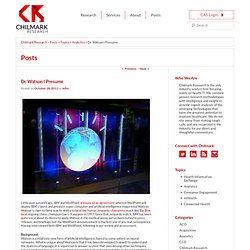
Watson’s claim to fame was its ability to beat the human Jeopardy champions much like Big Blue beat reigning chess champion Garry Kasparov in 1997. Since that Jeopardy match, IBM has been quite vocal about its desire to apply Watson in the medical arena, we’ve been buried in press releases and briefings, but the WellPoint announcement is the first one of any real consequence.
Having interviewed both IBM and WellPoint, following is our review and assessment. Background: Watson is a relatively new form of artificial intelligence, based to some extent on neural networks. What is unique about Watson is that it has been developed (trained) to understand the nuances of language. WellPoint is the largest payer in the US with some 34.2M members and 14 Blues across the country. Dr. HealthCyberMap. Sickweather. African e-health 'moving in wrong direction' [NAIROBI] Importing or copying the latest 'e-health' technology from developed countries may not be the best way forward for health services in Africa, a conference has heard.
A focus on high-tech healthcare solutions could come at the expense of basic prevention such as access to clean water and sanitation, good nutrition and hygiene, and health education, said experts at the AfriHealth conference in Kenya, this week (30 November–1 December). In a continent where 80 per cent of illnesses stem from preventable infectious diseases, this is a move in the wrong direction, said Yunkap Kwankam, executive director of the International Society for Telemedicine and eHealth.
"While we have a lot to learn in this field from practitioners in the developed world, we must take utmost care not to lose sight of the health needs of our people, as we seem to be doing now," said Kwankam. Health IT Leaders Launch Info-Sharing Website - Healthcare - Clinical Information Systems. Founded by clinicians, site called Doctors Helping Doctors Transform Health Care encourages the medical community to share its EHR successes, complaints.
(click image for larger view) Slideshow: 17 Leading EHR Vendors A group of physician health IT leaders has launched a nonprofit website for doctors that's designed to promote the transformation of healthcare through the use of information technology. Although not directly aligned with the federal government's Meaningful Use program, the website, Doctors Helping Doctors Transform Health Care also could help physicians achieve Meaningful Use by aiding them in implementing electronic health records. Funding is coming from the Chan Soon-Shiang Family Foundation, the Optum Institute for Sustainable Health, and Siemens Healthcare. . [ Electronic health records are the wave of the near future. In the process, the site might help some clinicians overcome their resistance to Meaningful Use criteria.
Using Xbox technology to further medicine. MADRID--One of the biggest challenges facing doctors and nurses in the OR and around the hospital is maintaining sterility.
TedCas uses Kinect touch-free technology to completely avoid a large cause of contamination: the computers and scans doctors have to reference during procedures. "It's the touch-screen you don't need to touch," said Paloma Fuentes, chief operating officer of TedCas. The original idea was to use it in surgery. Doctors often need to reference patient files, scans and x-rays during procedures. HealthTap raises $11.5M in Series A Funding to grow their interactive health network #mhs11. HealthTap, the interactive doctor-patient health education network, announced at last week’s mHealth Summit that it has secured $11.5M in Series A funding led by Mayfield Fund, Mohr Davidow Ventures, and Eric Schmidt’s Innovation Endeavors.
The company will use the funds to accelerate growth, recruit top talent, and engage more physicians and patients in the vibrant online HealthTap community. HealthTap’s network is built to allow patients to ask health questions online via a mobile app and quickly receive credible answers from top US physicians across 100 specialties, for free. HealthTap was launched just two months ago, but has quickly grown with more than 6,000 leading physicians and 500 top healthcare institutions currently participating. “We are excited to partner with a serial entrepreneur such as Ron Gutman whose passion, track record, and team will help realize HealthTap’s grand vision,” said Mayfield Managing Director, Tim Chang.
To dictate or not to dictate? Public release date: 21-May-2012 [ Print | E-mail Share ] [ Close Window ] Contact: Marjorie Montemayor-Quellenbergmmontemayor-quellenberg@partners.org 617-534-2208Brigham and Women's Hospital BOSTON, MA—Could the quality of care you receive be affected by how your doctor takes notes?
Parts of healthcare are moving to the cloud. Healthcare providers are increasingly required to do more with less. Regulations, HIPAA, Meaningful Use, recovery audit contractor (RAC) audits and decreasing revenues are motivating providers to consider cloud computing as a solution to potentially help them cut costs, maintain quality, meet regulations, and increase productivity. Gamification. Recently, I've met with several internet startups, web thought leaders, and venture capitalists. Visualizing wellness for 2012. TheVisualMD has launched '9 Rules of Wellness'The first rule: Know where you're starting fromNutrition, exercise, sleep, stress and joy are other topicsThe website makes use of visualizations, which bring medical data to life. TedCas. Pointofcare_grantees_en.
Roundup: Predictions for digital health in 2013. As the new year kicks off so, too, do the predictions for mobile and digital health. 5 ways voice recognition tech cuts costs. Many may think of data in terms of numbers and text, but not only does voice documentation have a place in the array of data collection tools that can be used by healthcare companies, it offers financial benefits. Rise of the Digital Natives: The future of the NHS. In recent months and years the UK healthcare sector has been criticised for large IT projects which have failed to adequately bring the NHS into the digital age.
Electronic Patient Records (EPRs) have been heralded as the future of healthcare, however, major undertakings such as the National Programme for IT (NPfIT) have become associated with widespread delays, ineffective technology and vast over-spending. However, it's the rise of the digital natives that could be helping to shape the future of the NHS - a future that's highly digital.