
Mimicking a Beetle to Bring Water to the People. Air Date: Week of November 16, 2012 stream/download this segment as an MP3 file The Namib Desert beetle (stenocara gracilipes) (Photo: Moongateclimber/Wikipedia Commons) A small start up company, inspired by a desert beetle, is using nano technology to develop a self-filling water bottle.

Deckard Sorensen, co-founder of NBD Nano, tells host Steve Curwood how studying the Namib Desert Beetle helped them to develop new technologies for collecting water. Transcript CURWOOD: Well, the lessons of nature have paid off in some remarkable products already – think airplanes, or Velcro, for example. SORENSEN: This beetle, the Namib desert beetle, lives in an area of the world that only gets half an inch of rainfall per year. CURWOOD: Tell me, what exactly are the physics here, how does it get water out of the air? SORENSEN: It has super-hydrophobic and super-hydrophilic regions of water on its back. Deckard Sorenson is co-founder of NBD Nano. SORENSEN: Ah, yes, that’s our end goal.
SORENSEN: Yup. Biomimicry Creates New Education Models For Learning From Nature. It’s 7:00 a.m. on Prevost Island in British Columbia, Canada.
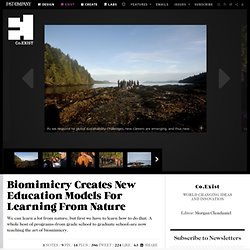
Everyone is up early with winter caps pulled tightly over ears and sipping cowboy coffee from metal mugs. Reluctantly slipping out of warm socks and shoes and into sandals still wet from the day before, we roll up our pants and head out to the rocky shoreline with bubbling anticipation. The tide is very far out and now is the best time of the day to observe life in the intertidal zone. As the small crew carefully steps over tide pools and rocks slippery with sea kelp, it’s not long before someone calls out “Over here!” And we all hurry to see what’s been discovered. The crew is fervently taking notes and drawing impromptu sketches of all their observations and lessons from the sunstar. This crew of people is not composed only of biologists. These types of experiences are occurring all over the world in K-12 education, higher education, organizational trainings, nature clubs, and biomimicry networks.
Design Inspiration from Nature. Air Date: Week of November 16, 2012 stream/download this segment as an MP3 file Salt marshes provide critical ecological services such as nutrient cycling and water filtration.

(photo: Bigstock). When it comes to adaptation, Mother Nature knows best. Now, scientists are looking to Mother Nature for answers to some of our biggest environmental problems. Host Steve Curwood talks with Anamarija Frankic,(AN-uh-murr-EE-yuh FRAN - kitch) a Biomimicry Institute Fellow and Director of the Green Harbors Project at the University of Massachusetts, Boston. Transcript CURWOOD: When it comes to adaptation, Mother Nature knows best. FRANKIC: Hi, thank you for having me! CURWOOD: Just for a basic explainer, what is biomimicry and why should we focus on it?
Anamarija Frankic, Biomimicry Institute Fellow and Director of the Green Harbors Project at the University of Massachusetts, Boston. CURWOOD: Give me an example of biomimicry. CURWOOD: Ah, what’s the secret to those organic glues? Links P.O.