
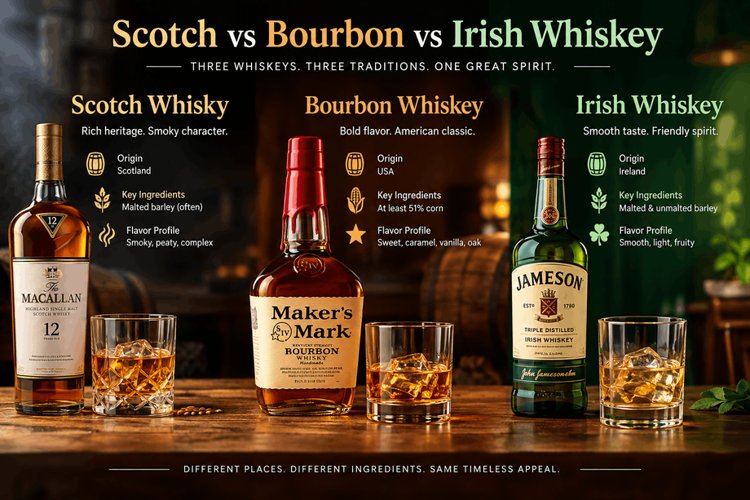
Choosing a whiskey can feel confusing when you see Scotch, Bourbon, and Irish Whiskey on the same shelf. Although all three are whiskey styles, they have different production traditions, ingredients, aging methods, and flavor characteristics. Understanding Scotch vs Bourbon vs Irish Whiskey makes it easier to recognize what separates each style.
For beginners, the Scotch vs Bourbon vs Irish whiskey difference starts with where each spirit is made and the rules that shape its production. The Scotch vs Bourbon vs Irish Whiskey taste can also vary noticeably, giving each category its own personality.
Scotch whisky is made in Scotland and follows specific production requirements. It is generally made from malted barley, although some Scotch styles use other grains. Scotch must be matured in oak casks for at least three years.
When exploring Scotch vs Bourbon vs Irish whiskey, Scotch is often associated with flavors such as malt, dried fruit, oak, smoke, vanilla, and spice. However, not every Scotch is smoky. Some are light, fruity, floral, or creamy.
The Scotch vs Bourbon vs Irish whiskey difference becomes especially interesting when looking at regional influences and maturation. Cask selection can have a major effect on the final character.
The Scotch vs Bourbon vs Irish Whiskey taste comparison therefore cannot be reduced to one simple flavor. Scotch can range from delicate and fresh to rich and smoky.
Bourbon is an American whiskey with a distinctive grain requirement. Its mash must contain at least 51% corn. Bourbon is also aged in new, charred oak containers, which contributes significantly to its recognizable character.
In Scotch vs Bourbon vs Irish Whiskey, Bourbon often stands out for its sweeter profile. Common notes include caramel, vanilla, toasted oak, brown sugar, and baking spices.
The Scotch vs Bourbon vs Irish whiskey difference is particularly clear when considering the type of oak used for maturation. New charred oak gives Bourbon strong access to flavors from the wood.
When comparing Scotch vs Bourbon vs Irish Whiskey taste, Bourbon may appeal to people who enjoy sweeter and fuller flavors. Different Bourbon recipes can still produce very different results.
Irish whiskey comes from Ireland and has its own long-standing whiskey-making traditions. Irish whiskey can be made from malted or unmalted barley and other grains, depending on the style.
One important part of the Scotch vs Bourbon vs Irish Whiskey comparison is the variety found within Irish whiskey itself. You can find single malt, single pot still, grain, and blended Irish whiskey.
The Scotch vs Bourbon vs Irish whiskey difference is therefore not simply about geography. Production methods, grain choices, distillation, maturation, and blending all influence the final spirit.
For the Scotch vs Bourbon vs Irish Whiskey taste comparison, Irish whiskey is often associated with smooth, approachable flavors such as honey, vanilla, cereal, fruit, and light spice. Some expressions can be richer and more complex.
Production is one of the easiest ways to understand Scotch vs Bourbon vs Irish Whiskey.
Scotch production commonly focuses on malted barley and traditional pot-still or column-still methods, depending on the category. Bourbon relies heavily on corn and new charred oak. Irish whiskey has several production approaches, including pot still and column still distillation.
The Scotch vs Bourbon vs Irish whiskey difference also appears in maturation requirements. Scotch must mature for at least three years in Scotland. Bourbon does not have the same minimum aging period for the general category, although specific terms have additional requirements.
Irish whiskey must generally mature for at least three years in wooden casks. These rules help create different styles before a bottle even reaches the consumer.
The Scotch vs Bourbon vs Irish Whiskey taste comparison is easiest when you think about common flavor families rather than fixed rules.
Scotch can offer malt, smoke, peat, fruit, honey, nuts, and oak. Bourbon commonly brings caramel, vanilla, corn sweetness, toasted wood, and spice. Irish whiskey can provide fruit, honey, vanilla, grain, cream, and gentle spice.
Still, individual bottles can taste very different. The Scotch vs Bourbon vs Irish Whiskey taste depends on ingredients, distillation, cask type, maturation time, blending, and the producer's approach.
For someone learning about Scotch vs Bourbon vs Irish Whiskey, tasting several expressions from each category can reveal these differences more clearly than relying on descriptions alone.
Yes, maturation can strongly influence whiskey. During aging, the spirit interacts with the wooden cask, gaining color and developing additional aromas and flavors.
In the Scotch vs Bourbon vs Irish Whiskey comparison, the type of cask can be particularly important. Scotch may mature in different types of previously used oak casks, while Bourbon traditionally uses new charred oak.
The Scotch vs Bourbon vs Irish whiskey difference can therefore become more noticeable as you examine cask influence. Bourbon's new oak often contributes pronounced vanilla, caramel, and toasted notes.
Irish whiskey can also be matured in different cask types, creating expressions that range from light and fruity to rich and dessert-like.
Geography is another important part of Scotch vs Bourbon vs Irish Whiskey. Scotch comes from Scotland, Bourbon is associated with the United States, and Irish whiskey comes from Ireland.
Climate and local production traditions can influence maturation and production decisions. However, geography alone does not determine flavor.
The Scotch vs Bourbon vs Irish whiskey difference comes from a combination of location and legal production standards. Each whiskey category developed through its own history and traditions.
When exploring Scotch vs Bourbon vs Irish Whiskey taste, geography gives you useful background, but the individual bottle still matters.
A beginner comparing Scotch vs Bourbon vs Irish Whiskey can start with approachable examples from each category.
For Scotch, a lighter or fruit-forward expression can be an easy introduction. Bourbon can provide familiar vanilla and caramel notes. Irish whiskey can be a comfortable starting point for someone who prefers a softer and smoother profile.
The Scotch vs Bourbon vs Irish whiskey difference becomes easier to recognize when you taste the categories side by side.
The Scotch vs Bourbon vs Irish Whiskey taste can also change depending on whether you drink the whiskey neat, with a little water, or in a cocktail.
Absolutely. This is an important point when learning Scotch vs Bourbon vs Irish Whiskey.
Scotch can be smoky, fruity, floral, nutty, or malty. Bourbon can range from sweet and soft to spicy and oak-forward. Irish whiskey can be light, creamy, fruity, spicy, or rich.
That variety means the Scotch vs Bourbon vs Irish whiskey difference is useful as a starting point rather than a strict description of every bottle.
Likewise, the Scotch vs Bourbon vs Irish Whiskey taste can differ considerably even between two bottles from the same category.
Labels can provide useful information when comparing Scotch vs Bourbon vs Irish Whiskey. Look for terms describing the whiskey type, age where applicable, alcohol strength, maturation, and whether it is blended or single-category whiskey.
Understanding these terms helps explain the Scotch vs Bourbon vs Irish whiskey difference without making the subject unnecessarily complicated.
The Scotch vs Bourbon vs Irish Whiskey taste is influenced by many of the details represented on the label, particularly maturation and whiskey type.
Bourbon is commonly associated with sweeter notes such as vanilla, caramel, and corn. Scotch can also be sweet, fruity, or rich depending on the expression.
Some Irish whiskeys are known for a soft and approachable character, but smoothness depends on the individual whiskey. Scotch also includes many gentle and easy-drinking styles.
The main differences involve origin, ingredients, production rules, distillation methods, and maturation. These factors create distinct styles within each category.
Scotch can feature malt, fruit, oak, and smoke; Bourbon often shows caramel, vanilla, and spice; Irish whiskey can offer fruit, honey, vanilla, and gentle spice.
No. Bourbon often has naturally sweet flavor notes, but its profile can also include oak, pepper, cinnamon, toasted flavors, and other spices.
Yes. While many Irish whiskeys are relatively light or fruity, certain expressions can have noticeable smoky or peated characteristics.
Age can influence flavor and complexity, but older does not automatically mean better. Cask quality, maturation conditions, blending, and production style also matter.
Yes. Scotch includes many different styles, including lighter, fruitier, and less smoky options that can be approachable for people who are new to whisky.