
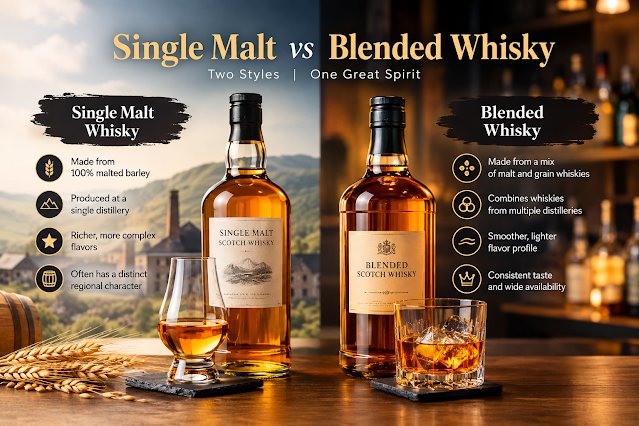
Choosing whisky can feel confusing when you see terms like single malt and blended whisky on different bottles. If you are new to whisky, understanding the difference can make shopping much easier. The topic of single malt vs blended whisky is mainly about how the whisky is made, how different whiskies are combined, and what kind of taste you can expect.
The difference between single malt and blended whisky does not simply mean that one is stronger or better than the other. Each style has its own character, and your choice may depend on your preferred flavor, occasion, budget, and drinking style.
When comparing single malt vs blended whisky, it helps to look at production first. Once you understand production, the differences in aroma, flavor, texture, and overall drinking experience become easier to recognize.
Single malt whisky is generally made at one distillery using malted barley. The whisky can come from different casks and batches produced at that same distillery, but the key point is that it comes from a single distillery.
In the single malt vs blended whisky discussion, this production approach is one of the most important differences. Single malt whisky can show the particular style of its distillery, including its preferred methods of fermentation, distillation, maturation, and cask selection.
Single malt does not automatically mean that every bottle tastes the same. A whisky can develop different flavors depending on its age, cask type, maturation conditions, and production choices.
Blended whisky is made by combining different whiskies. Depending on the style and regulations of the country where it is produced, a blend may contain malt whisky, grain whisky, or a combination of different whiskies.
This is another major point in the difference between single malt and blended whisky. A single malt comes from one distillery, while a blend can bring together whiskies from multiple distilleries.
Blending allows producers to create a particular flavor profile. The goal can be consistency, balance, smoothness, or a specific combination of aromas and flavors.
Production is where the single malt vs blended whisky comparison becomes especially interesting.
Single malt whisky begins with malted barley. The barley is mashed with water, fermented, and distilled before being placed into wooden casks for maturation. The whisky may spend years developing its character inside those casks.
Blended whisky involves an additional step: different whiskies are selected and combined. A blender carefully considers the characteristics of each whisky before creating the final product.
The difference between single malt and blended whisky can therefore be seen in the way the final flavor is built. Single malt often highlights the identity of one distillery, while blending brings several whisky components together.
When discussing single malt vs blended whisky, taste is often the first thing people want to understand.
Single malt can have a wide range of flavors. Depending on the whisky, you might notice notes of fruit, vanilla, honey, spices, caramel, nuts, oak, smoke, or dried fruit.
Some single malts are light and delicate, while others can be rich, smoky, earthy, or heavily flavored. This variety is why two single malts can taste completely different even though both belong to the same category.
The single malt vs blended whisky difference is not simply about stronger versus weaker flavor. Instead, it is about the character and balance created through the whisky-making process.
Blended whisky can also offer a wide range of flavors. Depending on the blend, you may experience vanilla, caramel, honey, fruit, oak, spice, grain sweetness, or gentle smoky notes.
One reason people discuss single malt or blended whisky is because blends can be designed to create a balanced drinking experience. Different whiskies can contribute different characteristics to the final bottle.
The difference between single malt and blended whisky can sometimes be noticeable through texture and flavor complexity, but there is no single flavor that applies to every bottle in either category.
Smoothness is a common consideration when people compare single malt vs blended whisky.
Many blended whiskies are designed to provide a balanced and approachable character. This can make certain blends comfortable choices for people who are still learning about whisky.
However, single malt can also be very smooth. Maturation, cask selection, alcohol strength, and production style can all influence how a whisky feels when you drink it.
So, when deciding between single malt or blended whisky, do not assume that one category is always smoother. Individual bottles can be very different.
Age is another factor to consider when exploring the difference between single malt and blended whisky.
Whisky generally develops during maturation in wooden casks. Longer maturation can influence flavors such as vanilla, oak, dried fruit, caramel, and spice. However, older does not automatically mean that a whisky will match your personal taste better.
When looking at single malt vs blended whisky, consider the entire flavor profile rather than focusing only on the age statement.
For someone completely new to whisky, choosing single malt or blended whisky can seem difficult.
A beginner may enjoy a blend because its flavor profile can be balanced and approachable. Blended whisky can also be useful for discovering which flavor characteristics you enjoy.
On the other hand, single malt can be a fun choice if you want to explore the character of individual distilleries.
The best way to understand single malt vs blended whisky is to taste different styles rather than relying only on category names.
Your choice between single malt or blended whisky may also depend on the occasion.
A blended whisky can work well when you want an easy-drinking option for a casual gathering. Some blends are also commonly used in mixed drinks because of their balanced character.
Single malt can be appealing when you want to spend more time exploring the aroma and flavor of the whisky itself.
The single malt vs blended whisky choice can therefore change depending on whether you are relaxing, entertaining guests, trying whisky for the first time, or exploring different flavor profiles.
If you want to understand the difference between single malt and blended whisky, try comparing them side by side.
Look at the color first, then smell the whisky gently. Notice whether you detect fruit, vanilla, spice, smoke, oak, honey, or other aromas.
Take a small sip and let the whisky sit briefly on your palate. Think about its sweetness, warmth, texture, and finish.
This simple tasting method makes the single malt vs blended whisky comparison much easier.
You can also write down your observations:
Using these points can help you decide whether single malt or blended whisky better matches your personal preferences.
When choosing between single malt vs blended whisky, start with your preferred flavor style rather than choosing based only on price or packaging.
If you enjoy rich, distinctive flavors and want to explore individual distillery styles, a single malt may be interesting to try. If you prefer balanced flavors and want to explore whisky through combinations of different styles, a blend may be worth considering.
The difference between single malt and blended whisky is also useful when reading bottle labels. Understanding the terminology can help you know what you are buying before opening the bottle.
Here is a simple way to understand the single malt vs blended whisky comparison:
Feature
Single Malt Whisky
Blended Whisky
Main production identity
One distillery
Combination of whiskies
Common base
Malted barley
May combine malt and grain whiskies
Flavor
Often distinctive
Often balanced and consistent
Variety
Different distillery styles
Different blending combinations
Beginner experience
Good for exploring whisky character
Often approachable
Drinking style
Neat or with a little water
Neat, with water, or in mixed drinks
This table makes the difference between single malt and blended whisky easier to understand without getting into complicated whisky terminology.
Complexity is often mentioned in the single malt vs blended whisky conversation, but it should not be treated as an automatic rule.
Some single malts can have layers of fruit, spice, oak, smoke, and sweetness. At the same time, carefully made blends can also contain several different flavor characteristics.
When deciding between single malt or blended whisky, tasting the individual bottle is more useful than assuming complexity from the category alone.
Absolutely. Exploring single malt vs blended whisky does not require choosing one category permanently.
You might enjoy a single malt when you want to explore detailed flavors and choose a blend when you want something balanced and easy to enjoy. Your preference can also change as you try different bottles.
Trying both is one of the simplest ways to understand the difference between single malt and blended whisky for yourself.
Single malt whisky is made at one distillery using malted barley, while blended whisky combines different whiskies. The difference between single malt and blended whisky mainly relates to production and blending.
Not necessarily. The alcohol strength depends on the individual bottle, so single malt vs blended whisky is not simply a comparison of strength.
Neither category is always smoother. Some blends are very approachable, while many single malts can also have a smooth and gentle character.
Both can suit beginners. Single malt or blended whisky may appeal differently depending on whether you prefer distinctive distillery character or a balanced flavor profile.
Taste is personal, so single malt does not automatically suit everyone. The single malt vs blended whisky choice depends on individual flavor preferences.
Yes. A carefully created blend can combine different flavors and textures to produce a layered drinking experience.
People compare single malt vs blended whisky to understand differences in production, flavor, texture, consistency, and drinking style.
Yes. Both can contain notes such as vanilla, fruit, caramel, spice, oak, or smoke. The exact profile depends on the individual whisky.
No. Age is only one factor. Cask type, maturation, production methods, and the overall flavor profile can also affect the whisky.
Try tasting examples from both categories and compare their aromas, flavors, texture, and finish. This makes the single malt vs blended whisky difference easier to recognize through experience.