
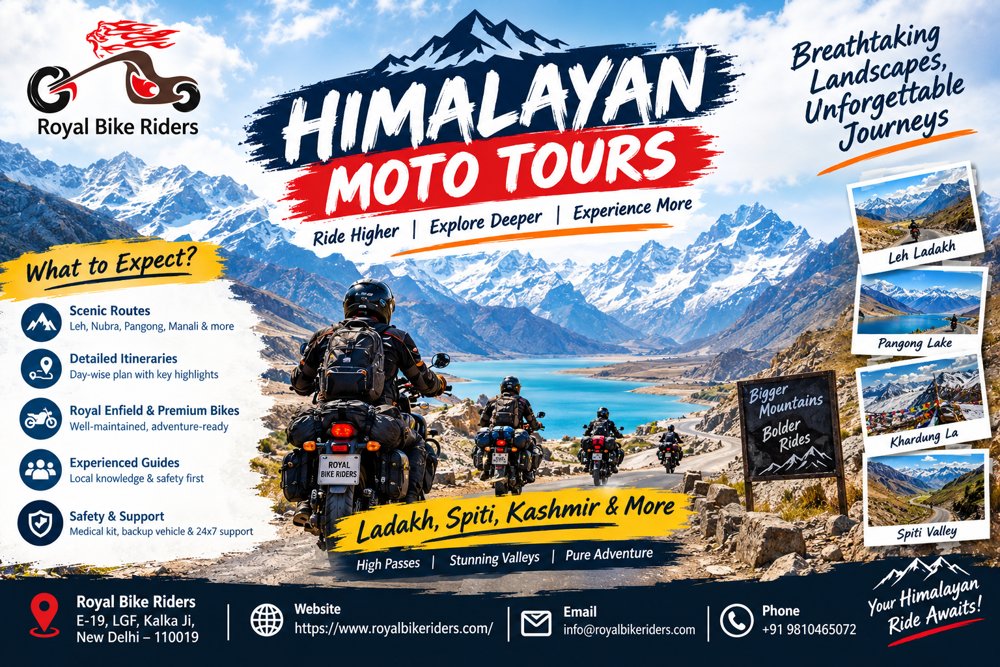
The Himalayas do not offer a single kind of ride. One day you are on a smooth valley road with pine forests on either side. Next, you are crossing a rocky plateau where the air feels thin and the horizon seems endless. This variety is exactly why Himalayan Moto Tours attract riders from all over the world, from first-time mountain tourers to people chasing their next big altitude challenge.
This guide explains how these tours work, what the terrain asks of you, and how to prepare. It also shows how Royal Bike Riders organise guided motorcycle journeys across the Himalayan region.
Himalayan Moto Tours are organised motorcycle journeys through the Himalayan mountains, usually led by experienced guides and supported by a back-up team. Rather than planning everything yourself, you join a structured itinerary that covers routes, accommodation, meals and safety support.
The term covers a wide range of rides. Some focus on Ladakh and its high passes. Others explore the wider Himalayan belt, with different landscapes, cultures and levels of difficulty. Royal Bike Riders lists several Himalayan itineraries on its website, including Umling La at 5,798 metres, a World Highest Ride, Ride High Through Little Tibet, the Trans-Himalaya Adventure Ride and Rediscover Himalaya on Royal Enfield. Check the tour pages for the latest details of each route.
A motorcycle brings you into the landscape in a way that a car cannot. You feel the temperature change on a climb, smell the pine on lower slopes and hear the silence when you stop at a high pass.
The riding itself is also rich. Himalayan roads combine smooth tarmac, broken patches, gravel, water crossings and tight hairpin bends. This keeps every day interesting and makes arriving at a viewpoint feel earned.
Then there is the culture. Monasteries sit on rocky ridges, prayer flags line mountain passes and small villages welcome travellers with tea and conversation. Many riders say these quiet encounters stay with them longer than the scenery.
On a typical road trip, the main questions are fuel and food. In the Himalayas, you also consider altitude, weather, road closures and the distance to the nearest mechanic.
Good Himalayan Moto Tours address these realities with:
This structure is why many riders prefer guided tours for their first Himalayan experience.
The Himalayan region is huge, and different areas offer different rides.
Ladakh: The best-known destination, with high passes, dry mountain scenery and lakes such as Pangong Tso. Riders usually enter from the Manali side or the Srinagar side, and many combine both.
Himachal's high country: Dramatic valleys, remote plateaus and winding mountain roads that lead toward the high-altitude regions.
Trans-Himalayan routes: Longer journeys that cross multiple regions and show how the landscape changes from green foothills to cold desert.
Little Tibet-style rides: Journeys through areas shaped by Tibetan Buddhist culture, with monasteries, prayer flags and remote villages.
Royal Bike Riders lists itineraries across several of these categories, so riders can match a tour to their time and experience.
The riding season depends on snowmelt and road clearance, and it varies by region. In general, high-altitude tours operate from early summer to early autumn. Exact dates shift each year.
Winter is not suitable for most Himalayan motorcycle touring because heavy snow closes many roads. Always check the latest road and weather information before finalising your dates.
You do not need racing skills, but you should be comfortable with:
Royal Enfield motorcycles are widely used in the Himalayas because they are sturdy and easy to service locally. Whatever you ride, make sure the tyres, brakes, chain, lights and electrics are in good shape.
If your riding experience is mostly urban, practise on hilly roads and rough surfaces before the trip. Fitness also helps, since long days at altitude are tiring.
Rules and fees change, so confirm current requirements before you travel. Riders commonly carry:
Keep printed copies in a waterproof pouch, because phone signal is unreliable. On a guided tour, the operator can usually advise on permits and simplify the process.
High-altitude riding changes how your body works. Thin air can disturb sleep, appetite and concentration, even in fit riders.
Weather can change within hours. Sudden snowfall on high passes can close roads, and glacial streams swell as the day warms. If you have a medical condition, speak with your doctor before booking.
Think in layers, and pack for the coldest conditions.
Royal Bike Riders publishes a riding kit list on its website, which is a handy cross-check.
The Himalayas reward preparation, and a good team makes a big difference. Royal Bike Riders organises guided motorcycle tours across the Himalayas and other parts of India. Riders can expect:
To explore tours, dates and inclusions, visit the Royal Bike Riders Himalayan Moto Tours page or contact the team directly.
Himalayan Moto Tours are about more than reaching a famous pass. They are about steady progress through changing landscapes, shared experiences with fellow riders and the quiet satisfaction of arriving under your own power. Choose your season carefully, respect the altitude, carry the right documents and ride within your comfort zone.
With experienced support, the Himalayas become far more approachable and enjoyable. Royal Bike Riders can help you turn a big idea into a well-organised journey.
1. What are Himalayan Moto Tours?
They are organised motorcycle journeys through the Himalayan region, usually with guides, accommodation, meals and support for bikes and safety.
2. What is the best time for Himalayan Moto Tours?
High-altitude tours generally run from early summer to early autumn. Dates vary by region and year, so check current conditions.
3. Are Himalayan Moto Tours suitable for beginners?
Riders with basic skills and good fitness can manage with preparation and guidance. A guided format adds helpful support for less experienced riders.
4. Which motorcycle is best for the Himalayas?
Rugged, easily serviced bikes such as Royal Enfields are popular. A well-maintained bike you can handle comfortably matters most.
5. Do I need permits for Himalayan Moto Tours?
Protected or restricted areas generally require permits. Rules and fees change, so verify current details or ask your operator.
6. How do I avoid altitude sickness?
Rest on arrival, drink water steadily, avoid overexertion and ascend gradually. Consult your doctor beforehand and report symptoms early.
7. What should I pack for a Himalayan motorcycle tour?
Pack protective riding gear, thermal layers, a windproof and waterproof shell, warm gloves, sun protection and personal medicines.
8. Is mobile signal available throughout the route?
No. Coverage is patchy in many areas, so carry offline maps and printed documents.
9. What happens if weather disrupts the schedule?
Experienced leaders can adjust timing or routes, and itineraries with buffer days handle delays better.
10. Why choose Royal Bike Riders for Himalayan Moto Tours?
Royal Bike Riders offers guided itineraries, experienced route leaders, support vehicles and well-maintained motorcycles, so you can focus on the ride.
Royal Bike Riders
Address : E-19, LGF, Kalka Ji, New Delhi – 110019
Website: https://www.royalbikeriders.com/
Email: info@royalbikeriders.com
Phone : +91-9810465072