
Finished Concrete Driveways: Why the Ground Chooses The Length Of Time Yours Lasts
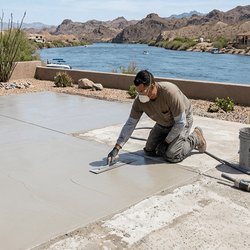
Drive around Parker, AZ enough time and you start to notice a pattern. 2 driveways of similar age rest a few blocks apart. One is tight and level with clean joints. The other has a spiderweb of cracks near the garage, a sunken panel by the street, and borders crumbling right into the gravel. Very same sunlight, very same trucks, exact same gales.
The difference almost never ever comes down to the concrete itself. It comes down to what occurred before the truck arrived.
Start with what Parker is improved
Soil in the Parker location is not one thing, and treating it as one point is exactly how driveways fail. Great deals near to the Colorado River via the Parker Strip, the Keys and down toward Poston, frequently sit on sandy, silty river-bottom deposits. That product drains well but has bad natural bearing strength, and it relocates quickly when water finds a path with it. Up on the benches and out towards Bouse and Freeway 95, you encounter caliche and decayed granite: hard, sometimes rock-hard, but often unequal, with soft pockets concealing under a rigid crust.
Both conditions demand attention, for contrary reasons. Loose river sand needs to be developed into something that will bring load. Caliche requirements to be broken and reworked so a driveway isn't bridging throughout a difficult rack on one end and soft fill on the various other. Irregular assistance is what produces a fractured panel, concrete is strong in compression and weak in bending, so the moment one section sheds its base, the piece flexes and damages.
Compaction is the action no one sees and everybody spends for
After excavation, a correct driveway obtains a granular base, usually four to 6 inches of aggregate base program positioned in lifts and compressed, not disposed and rated level. Lift density matters since a plate compactor or roller just compresses material so deep. 6 to 8 inches per lift, compressed separately, creates an uniform base. A solitary fourteen-inch dump compacts on the top and stays loose beneath.
Wetness is the part that catches individuals unsuspecting in the desert. Soil compacts best at a certain moisture content, and in Parker's completely dry air, base material often shows up also dry to reach density no matter how many passes it gets. Water needs to be included and operated in. Avoid that and the base looks compacted while remaining well short of the about 95 percent family member density that flatwork must be built on.
This is also the stage to fix drainage. Downpour tornados here go down a great deal of water in a brief window, and drainage that obtains under a slab edge will certainly comb out base material season after season. Grading the subgrade to drop water and maintaining irrigation lines and downspouts from discharging alongside the driveway which protects the put for years.
Forming and putting for desert conditions
Residential driveways are commonly poured at 4 inches. In Parker, where watercrafts, fifth wheels, plaything haulers and dually trucks are common, five to 6 inches with # 4 rebar on chairs is money well spent, specifically in the approach apron and anywhere a trailer jack lands. Support put between third of the slab does architectural work; mesh laid on the ground and strolled right into the mud does not.
Then there's the heat. Pouring concrete when air temperature levels run previous 105 ° F transforms the chemistry. The mix tenses quickly, water vaporizes from the surface before the piece can bleed effectively, and plastic contraction cracks open while the concrete is still soft. Experienced teams react by beginning at dawn, maintaining the mix temperature level down, withstanding the urge to add water on site which damages the finished slab, and using evaporation retarders and timely curing. Control joints obtain reduced at approximately 10 to twelve feet on a four-inch piece, so shrinkage splits land inside a tooled line as opposed to straying across the middle.
Curing is not optional. Concrete gains strength with hydration, moist, and a piece left to bake in 115-degree sunlight for a week will never ever reach its made stamina.
After that, and just then, the finish
As soon as the structure is right, appearance is the very easy component. Mop finishes give reliable traction. Integral shade, stamped rock patterns and attractive boundaries transform a driveway into part of the home's layout.
However no surface conserves a negative base. In Parker, a driveway that lasts thirty years is developed from the subgrade up, which is why employing a team that comprehends neighborhood dirt matters greater than any item on the surface.
https://www.parkerconcretecontractor.com/concrete-sidewalks-and-pathways/