
Add anything from anywhere. 50 really useful iPad 2 tips and tricks. Is Your School or Classroom Developing the Future Innovators? - Leading From the Classroom. Is Your School or Classroom Developing the Future Innovators? - Leading From the Classroom. Is Your School or Classroom Developing the Future Innovators? - Leading From the Classroom. Nine Stubborn Brain Myths That Just Won't Die, Debunked by Science. Learning Styles & Technology. Maslow's Hierarchy Hits Home - Coach G's Teaching Tips. Think You're An Auditory Or Visual Learner? Scientists Say It's Unlikely : Shots - Health Blog. iStockphoto.com We've all heard the theory that some students are visual learners, while others are auditory learners.

And still other kids learn best when lessons involve movement. But should teachers target instruction based on perceptions of students' strengths? Several psychologists say education could use some "evidence-based" teaching techniques, not unlike the way doctors try to use "evidence-based medicine. " Psychologist Dan Willingham at the University of Virginia, who studies how our brains learn, says teachers should not tailor instruction to different kinds of learners. For example, if a teacher believes a student to be a visual learner, he or she might introduce the concept of addition using pictures or groups of objects, assuming that child will learn better with the pictures than by simply "listening" to a lesson about addition.
50 really useful iPad 2 tips and tricks. The Innovative Educator. 50 really useful iPad 2 tips and tricks. 50 really useful iPad 2 tips and tricks. Is Your School or Classroom Developing the Future Innovators? - Leading From the Classroom. Do you think, “The Classroom Is Obsolete: It’s Time for Something New”? How to Re-program Your Memory to Become More Self-Reliant. The Kid Should See This.
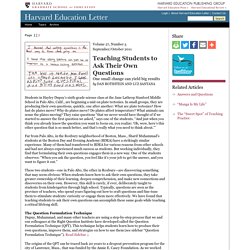
10 Infographics for Learning. Think You're An Auditory Or Visual Learner? Scientists Say It's Unlikely : Shots - Health Blog. Harvard Education Letter. Students in Hayley Dupuy’s sixth-grade science class at the Jane Lathrop Stanford Middle School in Palo Alto, Calif., are beginning a unit on plate tectonics.
The Procrastinating Caveman: What Human Evolution Teaches Us About Why We Put Off Work and How to Stop. July 10th, 2011 · 63 comments Survivor: Paleolithic Edition Rewind time 100,000 years ago: several different species of humans co-exist on earth.There was, of course, our own species, Homo sapien, but we were joined by our more athletic siblings from the Tree of Life, Homo erectus, who had left Africa and colonized Asia long before we ventured beyond the mother continent, all the while another sibling, the stocky Neanderthal, was hunkered down in a European ice age.
Advance another 90,000 years, however, and our species is the only game left in town. Scientists have worked hard to figure out why we survived while other early humans did not. The answer to this question lies at the core of our species’ story, but it also provides insight into a topic of significantly less importance on the grand scale, but nonetheless one that haunts many of us in our everyday lives: procrastination. The Planning Edge Rethinking Student Procrastination. The Curse of the “Smart” Student. Community Forums. Perhaps the larger questions are these: 1.
To what extent are teachers selected into teaching based on their lack of critical thinking abilities? (Particularly their tendencies toward compliance, unwillingess to question authority, risk-aversion, high need for conformity, discomfort with ambiguity, perceived status as an oppressed class, etc.) It may just be that the structure and history of the profession has attracted a large percentage of people who simply don't apply critical thinking in their work -- even if they apply it regularly outside of work. Mass customization in education. Seth Godin and Ken Robinson have again taken schools to task for their industrial model of educating students, complaining that we are turning out robots and fail to encourage the natural creativity and problem-solving abilities of every student.
Read Godin and watch Robinson. It's hard to disagree with anything about which they pontificate. What neither acknowledge, however, are the benefits that mass production have brought to society - the affordability of more goods for people at a wider range of economic levels. Mass producing cars, washing machines and blue jeans essentially made these items sufficiently inexpensive that almost everyone could purchase them. The wealthy still had the means to buy customized goods and tailored clothes, but most of us were pretty happy to have a good car - even if it looked just like the neighbor's. So too with education. Public schools were (are) designed to be economically efficient enough to provide a basic education for everyone. A convenient untruth. Study Links Academic Setbacks to Middle School Transition.
Published Online: November 28, 2011 Published in Print: November 28, 2011, as Learning Declines Linked to Moving to Middle School Includes correction(s): March 24, 2012 While policymakers and researchers alike have focused on improving students’ transition into high school, a new study of Florida schools suggests the critical transition problem may happen years before, when students enter middle school.
The study , part of the Program on Education Policy and Governance Working Papers Series at Harvard University, found that students moving from grade 5 into middle school show a “sharp drop” in math and language arts achievement in the transition year that plagues them as far out as 10th grade, even risking thwarting their ability to graduate from high school and go on to college. “I don’t see eliminating the transition at the high school level as important or beneficial as eliminating the transition at the middle school level,” said Martin R. Mr. Losing Their Edge For the Florida study, Mr. The Value of Teachers. Maslow's Hierarchy Hits Home - Coach G's Teaching Tips. Learning stuff since 1964. The Innovative Educator.
Getting started.