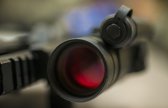
Scopes are accustomed to expanding your exactness when shooting at long distances by magnifying the picture of your target and giving you a reticle that shows precisely where your weapon is pointed. Utilizing a rifle scope requires a similar essential practice of shooting with conventional or "iron sights", yet replaces the back sight opening and front sight tip with a solitary magnifying part that may look like a little telescope.
These scopes arrive in an assortment of models and can give somewhere in the range of 1 to multiple times magnification of your target. Keep in mind that a more grounded magnification does not make you an increasingly precise shooter, so it's imperative to rehearse solid essentials while discharging with a rifle scope.
Mounting and Understanding Your Scope
1. Buy the fitting mounting gear. Most current rifle scopes come either pre-penetrated and tapped for a scope base or with scored areas for mounting connections. It's significant that you buy mounting equipment that matches the plan of your scope.
If your scope requires mounting rings, guarantee you buy ones with the right inside diameter, as the body of the scope will be mounted inside the ring.
If you are uncertain of the equipment you should mount your scope, ask the retailer you acquired the scope from to assist you in choosing the correct mounting equipment.
2. Adjust the reticle and change the eye relief. The reticle of your rifle scope is the picture you see on the focal point of the scope that shows where the weapon is pointed. It is generally a cross.
However, there are numerous reticle varieties that incorporate circles, exes, and various others. With the mounting rings lose, turn the scope until the reticle is the correct side up or until the cross is appropriately adjusted. With that done, alter the distance the focal point of the scope will be from your eye to guarantee it won't hit you when the weapon draws back.
3. Acquaint yourself with the different pieces of the scope. While there are many rifle scope makers, almost every one of them uses similar fundamental parts. Before you take your scope out shooting, you should realize what each bit of your scope is called and what it does. A rifle scope is generally comprised of a body, eyepiece, target focal point, shoulder, and windage, rise and parallax handles.
4. Decide whether your scope has a solitary or variable power focal point. A solitary focal point scope gives one degree of magnification, though a variable power scope has a ring that enables you to pick between different degrees of magnification. Most rifle scopes are single controlled.
However, if you're uncertain which your scope is, search for a power selector ring past the shoulder of the scope yet before the goal focal point. This flexible ring will allow you to pick between different degrees of magnification the scope can give.
If you have a variable power focal point in your scope, pick a setting for the motivations behind focusing the rifle and keep it on that until the scope has been appropriately focused.
When chasing or in strategic circumstances, keep variable focal point scopes set to the least magnification capacity to take into consideration the most extensive field of view while utilizing the scope.
5. Survey the degree of magnification your scope gives. You can decide the quality of your scope by seeing its model number. Scope model numbers incorporate two distinct components: the degree of magnification and the diameter of the goal focal point. A scope that is "4 x 30" implies that a picture will have all the earmarks of being multiple times bigger through the scope than it would appear to the unaided eye. The 30 demonstrated the number of millimeters the scope's target focal point is in diameter.
Keep in mind that the higher the magnification, the darker your target will give off an impression of being through the viewpoint because of the measure of light that can go through it. Bigger diameter focal points enable all the more light to enter the scope, hence making the picture more brilliant.
The higher the principal number in your scope's model number, the more grounded the degree of magnification it gives.
Scopes with variable power will have model numbers like "4-12 x 32," which means you can alter somewhere in the range of four and multiple times magnification.