
Mark Castle
i am a fine artist @theskullxrose tattoo artist fine artist ( ye i graduated from art school...) screen printer rock star singer/ rapper/ song writa poet philosopher prophet scholar basically a squarish gentleman...
Magnets in a copper pipe.
Meditation. Shop shit. - StumbleUpon. Geiranger - Geirangerfjord - Trollstigen - Aalesund 360 panorama sky cam - visit norway. Complete Hacking Algorithm. Waterproof Your Canvas Shoes. 100 Websites You Should Know and Use. In the spring of 2007, Julius Wiedemann, editor in charge at Taschen GmbH, gave a legendary TED University talk: an ultra-fast-moving ride through the “100 websites you should know and use.”

Six years later, it remains one of the most viewed TED blog posts ever. Time for an update? We think so. Below, the 2013 edition of the 100 websites to put on your radar and in your browser. To see the original list, click here. And now, the original list from 2007, created by Julius Wiedemann, editor in charge at Taschen GmbH. Science. [CES 2010] RCA Airnergy Charger Harvests Electricity From WiFi Signals. By Evan Ackerman This thing is, seriously, the highlight of CES for me (so far) this year. 3D TVs and eBook readers are fine, but there’s nothing amazing about them.
![[CES 2010] RCA Airnergy Charger Harvests Electricity From WiFi Signals](http://cdn.pearltrees.com/s/pic/th/airnergy-harvests-electricity-1625269)
The Airnergy Charger is amazing. This little box has, inside it, some kind of circuitry that harvests WiFi energy out of the air and converts it into electricity. This has been done before, but the Airnergy is able to harvest electricity with a high enough efficiency to make it practically useful: on the CES floor, they were able to charge a BlackBerry from 30% to full in about 90 minutes, using nothing but ambient WiFi signals as a power source.
The Airnergy has a battery inside it, so you can just carry it around and as long as you’re near some WiFi, it charges itself. Here is the really, really unbelievable part: RCA says that the USB charger will be available this summer for $40, and a battery with the WiFi harvesting technology will be available soon after. EcoGizmo - Page 2. Alan Watts discusses Nothing. 9 Implants that make human healthy body even more useful. Here’s a list of 9 ways you can modify your body to be even more useful, from bionic implants to portable power generators. 1.
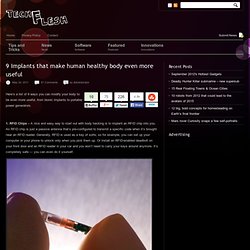
RFID Chips – A nice and easy way to start out with body hacking is to implant an RFID chip into you. An RFID chip is just a passive antenna that’s pre-configured to transmit a specific code when it’s brought near an RFID reader. Generally, RFID is used as a key of sorts; so for example, you can set up your computer or your phone to unlock only when you pick them up. Or install an RFID-enabled deadbolt on your front door and an RFID reader in your car and you won’t need to carry your keys around anymore. 2. 3. 4. 5. 6. 7. 8. 9. Source. Mogees - Gesture recognition with contact-microphones. BallDroppings.
Pearltrees videos. Generation Z. Terminology[edit] USA Today sponsored an online contest for readers to choose the name of the next generation after the Millennials.
In the article, Bruce Horovitz wrote that some might call the term "Generation Z" rather "off-putting" and a name that is "still in-the-running" for the next generation. The article proposed some alternate names including: iGeneration, Gen Tech, Gen Wii, Net Gen, Digital Natives, Gen Next, Post Gen.[1][3] In 2013, Jeanine Poggi reported in Ad Age that Nickelodeon channel is looking to serve a new breed of kids born after 2005 who it dubs "post-millennials".[2] "Scholars Generation" was proposed by a writer at A Time to Succeed coalition who "works to ensure that all children in the nation’s high-poverty communities have better learning time in school".[4] Authors William Strauss and Neil Howe wrote several popular books on the subject of generations.
Plurals is a name coined by marketing firm Frank N. Traits and trends[edit] See also[edit] References[edit] Augmented Grocery Shopping: How a Korean grocer moved virtual shopping to the subway. It’s the kind of experiment that seems like it was hatched for a satirical spoof video, but the results were anything but funny.

Home Plus, the 2nd largest grocery chain in South Korea formerly known as Tesco, needed to increase their market share without building more stores. The idea they had was simple and elegant, albeit completely offbeat and somewhat insane. “Let the store come to the people.” They created virtual stores to make grocery shopping something that could be done without while performing other duties such as waiting in the subway. With lighted billboard visualizations of the actual shopping experience, someone waiting for a subway who was armed with a smartphone with a QR Code reading app installed could order the groceries they needed without physically going to the store itself.
As you can see by the video, the results have been extraordinary with over 10,000 people visiting the online Home Plus mall using smartphones.