
FiPy. NGSolve. GetDP. Patrick Dular and Christophe Geuzaine Version 2.4.3, February 7 2014 Description | Download | Authors and credits | Documentation | Licensing | Links Description GetDP is a general finite element solver using mixed elements to discretize de Rham-type complexes in one, two and three dimensions.
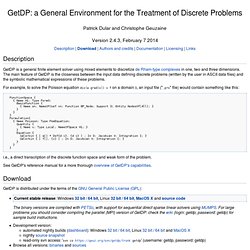
The main feature of GetDP is the closeness between the input data defining discrete problems (written by the user in ASCII data files) and the symbolic mathematical expressions of these problems. For example, to solve the Poisson equation div(a grad(v)) = f on a domain D, an input file (".pro" file) would contain something like this: i.e., a direct transcription of the discrete function space and weak form of the problem. See GetDP's reference manual for a more thorough overview of GetDP's capabilities. Download Authors and credits GetDP is developed by Patrick Dular and Christophe Geuzaine (both with the University of Liège).
Documentation Licensing GetDP is copyright (C) 1997-2014 by P. Links. Auxcapucins. OOFEM. OOFEM is free finite element code with object oriented architecture for solving mechanical, transport and fluid mechanics problems that operates on various platforms.

The aim of this project is to develop efficient and robust tool for FEM computations as well as to provide modular and extensible environment for future development. OOFEM is released under GNU Lesser General Public License (LGPL). The current version of OOFEM is 2.3; released Feb, 12, 2014 The following is a list of recent additions to this web. Whenever a new paper or specification is written or important event happens, a notice will be put here. Official Release of OOFEM, version 2.3 The official release of OOFEM 2.3 is now available. Official Release of OOFEM, version 2.2 The development team is pleased to announce the official release 2.2 of OOFEM. OOFEM version controll system migrated from svn to Git. FEniCS.
The FEniCS Project is a collaborative project for the development of innovative concepts and tools for automated scientific computing, with a particular focus on automated solution of differential equations by finite element methods.

The methodology and software developed as part of the FEniCS Project are documented in a number of research articles and a book. You can also learn more about FEniCS from the following presentations. Features FEniCS has an extensive list of features for automated, efficient solution of differential equations, including automated solution of variational problems, automated error control and adaptivity, a comprehensive library of finite elements, high performance linear algebra and many more. Components FEniCS is organized as a collection of interoperable components that together form the FEniCS Project.
Building on these components, software specialized to solving different problems are organised into separate applications. License About these pages. FreeFEM++ FreeFem++-cs : an integrated environment for FreeFem++ Untitled. FreeFem++ Third Edition, Version 3.

FrédéricHecht mailto:frederic.hecht@upmc.fr In collaboration with: Sylvian Auliac, mailto:auliac@ann.jussieu.fr, is PHD student , he do all the new optimization interface with nlopt, ipopt, cmaes, ... Olivier Pironneau, mailto:olivier.pironneau@upmc.fr, Olivier Pironneau is a professor of numerical analysis at the university of Paris VI and at LJLL.
Acknowledgments We are very grateful to l’École Polytechnique (Palaiseau, France) for printing thesecond edition of this manual ( ), and to l’Agence Nationalede la Recherche (Paris, France) for funding of the extension of FreeFem++ to a paralleltridimensional version ( Référence :ANR-07-CIS7-002-01.