
leigh anne
The Reading Lady. Teacher Store for Elementary & Preschool Classrooms. Classroom Architect. BA - Balanced Assessment: Technology Resource Packet. Student response system. Student Response Systems for K-12. Turning Technologies develops leading assessment delivery and data collection solutions for learning environments.
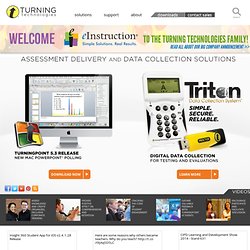
Our response technology not only creates interactive presentations, but is proven to enhance effective instruction, increase retention, engage participants, and immediately assess understanding. Turning has expanded its portfolio of products to include data collection systems that securely transfer digital data for various assessment, testing and certification programs. Founded in 2002, the company began with the development of response technology that was affordable, user-friendly and better documented so that users could easily grasp its benefits. Today, an estimated six million ResponseCard keypads have been delivered to K-12 schools, universities and businesses worldwide. Explore how response systems are working for K-12, Higher Education and Corporate/Government customers.
Partners Contact Us. Recipes4Success. Free online elementary educational language arts activities and interactive games. Study Skills. Once you have established a schedule to study you need to get the most out of that time.
Several things will help increase your effectiveness. As already mentioned, maintaining a regular schedule is one. Accommodations for Students with ADHD. Response: Several Ways To Help Students Become Better Listeners - Classroom Q&A With Larry Ferlazzo. UserID: iCustID: IsLogged: false IsSiteLicense: false.
Accommodations and Modifications. Accommodations, modifications, and alternative assessments may be necessary for a special needs child to succeed while working on materials for learning.
A student who cannot read nor write at grade level may be able to understand and participate in discussions about material that is read aloud and taught at the child's age-appropriate level. A child who cannot recall basic number facts may be able to do grade-appropriate problems using a calculator or working with number facts chart. A student with cerebral palsy may be able to take part in modified physical education with special equipment and carefully chosen exercises. Study Guides and Strategies. Ten Steps to Better Student Engagement. Tristan de Frondeville As a teacher, my goal was to go home at the end of each day with more energy than I had at the beginning of the day.
Seriously. Now, as I travel the country coaching teachers on how to successfully use project learning, my goal remains the same. Accommodations & Modifications ... Dysgraphia. Top 10 Sites for Creating Outlines. Learning Tools. Institute of Education Sciences (IES) Home Page, a part of the U.S. Department of Education. Institute of Education Sciences (IES) Home Page, a part of the U.S. Department of Education. Autism News and Resources. Siblings fo special needs children. SAS - Pennsylvania Department of Education Standards Aligned System. About UDL. Chapter 4: Teaching Every Student TOC: Information & Ideas.
Recognize essential cues and patterns.

Master skillful strategies for action. Engage with learning. Consider an example. Suppose Mr. Costa is teaching a civics unit on national elections and wants to convey the fundamental importance of voter participation. The Three Principles. Three primary principles, which are based on neuroscience research, guide UDL and provide the underlying framework for the Guidelines: Principle I: Provide Multiple Means of Representation (the “what” of learning) Learners differ in the ways that they perceive and comprehend information that is presented to them.
For example, those with sensory disabilities (e.g., blindness or deafness); learning disabilities (e.g., dyslexia); language or cultural differences, and so forth may all require different ways of approaching content. Others may simply grasp information quicker or more efficiently through visual or auditory means rather than printed text. Also learning, and transfer of learning, occurs when multiple representations are used, because it allows students to make connections within, as well as between, concepts.
4Teachers : Main Page. RubiStar Home. Universal Design for Learning and Assistive Technology. What is Universal Design for Learning? Universal Design for Learning (UDL) is an approach to teaching, learning, curriculum development and assessment that uses new technologies to respond to a variety of individual learner differences. IDEA 2004 defines Universal design using the same definition as the Assistive Technology Act of 1998, as amended, 29 U.S.C. 3002. Universal Design for Learning - The Center for Teaching and Faculty Development.
Logo for Universal Design for Learning Click Image to Enlarge Universal Design for Learning is a process of making course concepts accessible and skills attainable regardless of learning style, physical or sensory abilities. Home. Inclusion in the Classroom: The Teaching Methods. In order to meet the demands of Public Law 94-142, schools must provide students with disabilities a chance at placement in a "normal" classroom environment before putting them into a special needs classroom.

As such, methods of instruction that benefit these students, along with their non-disabled classmates must be implemented in order to serve the needs of all involved. Although a difficult task, five methods are commonly used in full inclusion classrooms to support the load of diversified students now entering the classrooms. These five methods shall be discussed in-depth including what they are, their classroom arrangement, how students are arranged and involved, and what sorts of lessons lend themselves well to this type of arrangement. Finally, three drawbacks involved in using these methods shall be discussed so as to promote awareness as to the limitations of the method at hand. Inclusion In The Classroom: Has It Gone Too Far?
Wisconsin Education Association Council. Inclusion remains a controversial concept in education because it relates to educational and social values, as well as to our sense of individual worth.

Any discussion about inclusion should address several important questions: Do we value all children equally? The Benefits of an Inclusion Classroom. The Inclusion Classroom. Inclusion. Inclusion is part of a much larger picture then just placement in the regular class within school.
It is being included in life and participating using one's abilities in day to day activities as a member of the community. It is being a part of what everyone else is, and being welcomed and embraced as a member who belongs. Inclusion can occur in schools, churches, play- grounds, work and in recreation. Human beings, regardless if they happen to have a disability or not, have basic needs that must be met in order to feel fulfilled.
The basic needs of food, water and shelter are necessary for us to exist. In school, inclusion does not occur by placement in the regular class alone, rather it is a desired end-state. Inclusion in school requires a shift in the paradigm, instead of getting the child ready for the regular class, the regular class gets ready for the child. Written by Colleen F. Material Copyrighted 1996 Kids Together, Inc. Inclusion. Inclusioninclassroomtips.pdf (application/pdf Object)
Getting started.