
Eric Gill. Know your type: Gill Sans. Original sketch of Gill Sans Bold Extra Condensed by Eric Gill for Monotype, April 5th 1937 (Photo: Jon Tangerine, Flickr) Called the “Helvetica of England,” the sixth installment in our ‘Know your type’ series is the humanist sans-serif Gill Sans.

Influenced by the ‘Underground’ The history of Gill Sans stems from Edward Johnston’s iconic typeface, Johnston Sans, designed for the London Underground in 1913. Eric Gill, who had studied under Johnston at London’s Central School of Arts and Crafts, later became a friend and apprentice—and even had a small role assisting in creation of the proprietary typeface. Left: Johnston Sans printing blocks now on display at the London Transport Museum, 1913 (Photo: Kaihsu Tai, Wikipedia); Right: London's Underground roundel set in Johnston Sans (often confused as Gill Sans), designed 1919 (Photo: danorbit, Flickr) Creating a ‘fool-proof’ typeface Not completely satisfied with Johnston’s work, Gill set out to create the perfect, legible typeface.
Usage. Eric Gill & The Cockerel Press. Eric Gill – born 22. 2. 1882 in Brighton, England, died 17. 11. 1940 in Uxbridge, England – sculptor, graphic artist, type designer.

Studied at the Chichester Technical and Art School. 1899–1903: works in an architect’s office. Takes lessons in lettering with Edward Johnston at the Central School of Arts and Crafts in London.1905–09: produces initials and book covers for Insel publishers in Leipzig.1906: designs inititals for Ashedene Press.1907: moves to Ditchling, Sussex. Here he produces stone sculptures, including for the BBC building in London.1914: produces sculptures for the stations of the cross in Westminster Cathedral in London.1924: moves to Capel-y-ffin.1925–31: works for the Golden Cockerell Press (initials, illustrations and an exclusive text type).1928: moves to Pigotts near High Wycombe.
Eric Gill - Font Designer of Gill Sans. Eric Gill – born 22. 2. 1882 in Brighton, England, died 17. 11. 1940 in Uxbridge, England – sculptor, graphic artist, type designer.

Studied at the Chichester Technical and Art School. 1899–1903: works in an architect’s office. Takes lessons in lettering with Edward Johnston at the Central School of Arts and Crafts in London. 1905–09: produces initials and book covers for Insel publishers in Leipzig. 1906: designs inititals for Ashedene Press. 1907: moves to Ditchling, Sussex. Here he produces stone sculptures, including for the BBC building in London. 1914: produces sculptures for the stations of the cross in Westminster Cathedral in London. 1924: moves to Capel-y-ffin. 1925–31: works for the Golden Cockerell Press (initials, illustrations and an exclusive text type). 1928: moves to Pigotts near High Wycombe.
Works for London Underground’s administrative headquarters. Publications include: "Essay on Typography", London 1931; "Autobiography", London 1940. More ... Eric Gill got it wrong; a re-evaluation of Gill Sans by Ben Archer. Eric Gill got it wrong; a re-evaluation of Gill Sans by Ben Archer This article is intended for an audience of contemporary designers and students who are at least one step removed from mid-century British typographic culture; it is a critique of the Gill Sans typeface and the idiosyncrasies of its creation from a contemporary perspective.
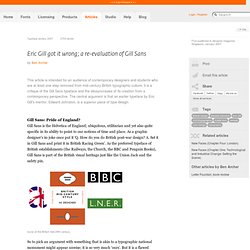
The central argument is that an earlier typeface by Eric Gill’s mentor, Edward Johnston, is a superior piece of type design. Gill Sans: Pride of England? Gill Sans is the Helvetica of England; ubiquitous, utilitarian and yet also quite specific in its ability to point to our notions of time and place. Icons of the British mid-20th century. So to pick an argument with something that is akin to a typographic national monument might appear unwise; it is so very much ‘ours’. The older Gill Sans MT appellation and Monotype icon set. The claim made against Johnston’s earlier design; pages 48-49 of Eric Gill’s Essay on Typography.