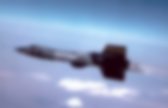
Special Hobby SH32022: 1/32 X-15A-2. The X-15, NASA's penultimate workhorse for research into the regime of hypersonic flight.
Born out of NACA studies initiated in 1952 around problems likely to be encountered in spaceflight, North American Aviation was selected in September of 1955 to produce three research aircraft. The history of this research program contains many milestones and technological advances. X-15 - Hypersonic Research at the Edge of Space. Hypersonic Research at the Edge of Space This joint program by NASA, the Air Force, the Navy, and North American operated the most remarkable of all the rocket research aircraft.
Composed of an internal structure of titanium and a skin surface of a chrome-nickel alloy known as Inconel X, the X-15 had its first, unpowered glide flight on June 8, 1959, while the first powered flight took place on September 17, 1959. Because of the large fuel consumption of its rocket engine, the X-15 was air launched from a B-52 aircraft at about 45,000 ft and speeds upward of 500 mph.
The airplane first set speed records in the Mach 4-6 range with Mach 4.43 on March 7, 1961; Mach 5.27 on June 23, 1961; Mach 6.04 on November 9, 1961; and Mach 6.7 on October 3, 1967. X-15A2 Walk Around Page 1. X-15A2 Walk Around Page 1. X. North American X-15A-2 by sonarmanb. North American X-15. The North American X-15 was a hypersonic rocket-powered aircraft operated by the United States Air Force and the National Aeronautics and Space Administration as part of the X-plane series of experimental aircraft.
The X-15 set speed and altitude records in the 1960s, reaching the edge of outer space and returning with valuable data used in aircraft and spacecraft design. As of July 2015[update], the X-15 holds the official world record for the highest speed ever reached by a manned, powered aircraft. Its maximum speed was 4,520 miles per hour (7,274 km/h), or Mach 6.72.[1] NASA Armstrong Fact Sheet: X-15 Hypersonic Research Program. In the joint X-15 hypersonic research program that NASA conducted with the Air Force, the Navy, and North American Aviation, Inc., the aircraft flew over a period of nearly 10 years and set the world's unofficial speed and altitude records of 4,520 mph (Mach 6.7) and 354,200 feet in a program to investigate all aspects of piloted hypersonic flight.
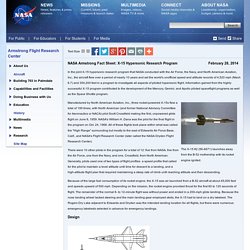
Information gained from the highly successful X-15 program contributed to the development of the Mercury, Gemini, and Apollo piloted spaceflight programs as well as the Space Shuttle program. Manufactured by North American Aviation, Inc., three rocket-powered X-15s flew a total of 199 times, with North American (and former National Advisory Committee for Aeronautics or NACA) pilot Scott Crossfield making the first, unpowered glide flight on June 8, 1959. NASA's William H. Photos: X-15 Rocket Plane Reaches Space in Test Flights. The X-15 Rocket Plane: Implications for Reusable Booster Schedule & Cost (1966) The X-15 is a strong contender for the title of “Everyone’s Favorite X-plane.”
Conceived in the 1952-1954 period, before Sputnik (4 October 1957) and the birth of NASA (1 October 1958), the North American Aviation-built rocket plane was intended to pioneer the technologies and techniques of hypersonic flight – that is, of flight faster than Mach 4 (four times the speed of sound). Between 1959 and 1968, three X-15 rocket planes, two modified B-52 bombers, and a dozen pilots took part in 199 joint U.S. The X-15 Hypersonic Flight Research Program. Chapter 6 The X-15 Hypersonic Flight Research Program:Politics and Permutations at NASA by W.
D. Kay. X-15 Research Results. Quieting the Boom is the story of the SSBD project to reduce the noise of sonic booms, as well as a general history of sonic boom research, emphasizing the people and organizations.
Credits: Mike Bryan On a hot and humid July day in 2003, a pair of small supersonic jet airplanes took off together from Cecil Field, a former naval air station on the eastern edge of Jacksonville, FL. Even though the Northrop Corporation had built both planes based on a common design, it was hard at first glance to tell that the two aircraft flying side by side were so closely related.
One was a sleek T-38 Talon, a two-seat aircraft that has served as the U.S. Air Force’s (USAF’s) advanced trainer since the early 1960s. Although on loan from the Navy’s aggressor training squadron, this particular F-5E no longer looked much like a fighter jet. This book follows up on a case study from 2009, “Softening the Sonic Boom: 50 Years of NASA Research.”
Kindle readers: MOBI [5.1 MB] Fixed layout: PDF [7.7 MB] X-15 Research Results: Contents. X-15 Research Results. History Photo: X-15 Crash at Mud Lake, Nevada. In this historic photo from the U.S. space agency, on November 9, 1962, an engine failure forced Jack McKay, a NASA research pilot, to make an emergency landing at Mud Lake, Nevada, in the second X-15.
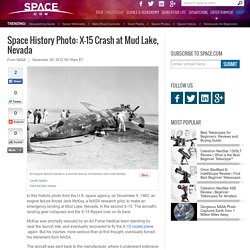
The aircraft's landing gear collapsed and the X-15 flipped over on its back. McKay was promptly rescued by an Air Force medical team standing by near the launch site, and eventually recovered to fly the X-15 rocket plane again. But his injuries, more serious than at first thought, eventually forced his retirement from NASA. The aircraft was sent back to the manufacturer, where it underwent extensive repairs and modifications. It returned to Edwards in February 1964 as the X-15A-2, with a longer fuselage (52 feet, 5 inches) and external fuel tanks.The basic X-15 was a rocket-powered aircraft 50-foot long with a wingspan of 22 feet. Each weekday, SPACE.com looks back at the history of spaceflight through photos (archive). X-15 Flight 90. Flight 90 of the North American X-15 was a test flight conducted by NASA and the US Air Force in 1963.
It was the first of two X-15 missions that reached space, along with Flight 91 the next month. The X-15 was flown by Joseph A. Walker, who flew both X-15 spaceflights. Crew[edit] Mission parameters[edit] Mass: 15,195 kg fueled; 6,577 kg burnout; 6,260 kg landedMaximum Altitude: 106.01 kmRange: 534 kmBurn Time: 84.6 secondsMach: 5.50Launch Vehicle: NB-52B Bomber #008 Mission highlights[edit] Maximum Speed - 5,971 km/h. X-15 Flight 91. X-15 Flight 91 was a 1963 American human spaceflight mission, and the second and final flight in the program to achieve sub-orbital spaceflight—a flight over 100 km in altitude—which was previously achieved during Flight 90 a month earlier.
It was the highest flight of the X-15 program. It was the first flight of a reused spacecraft, as plane number three flew the previous sub-orbital flight on July 19. This mission was piloted by Joseph A. Walker on August 22, 1963, with the air-launch occurring from a modified Boeing B-52 Stratofortress support plane over Smith Ranch Dry Lake, Nevada, United States. Walker piloted the X-15 to an altitude of 107.96 km and remained weightless for approximately five minutes. Crew[edit] Mission parameters[edit] Mass: 15,195 kg fueled; 6,577 kg burnout; 6,260 kg landedMaximum Altitude: 107.96 kmRange: 543.4 kmBurn time: 85.8 secondsMach: 5.58Launch vehicle: NB-52A Bomber #003 Mission highlights[edit] Launched by: NB-52A #003, Pilots Bement & Lewis.
Joseph A. Walker. Biography[edit] Early years and education[edit] Military service[edit] Test pilot career[edit] After World War II, Walker separated from the Army Air Force and joined the National Advisory Committee for Aeronautics (NACA) Aircraft Engine Research Laboratory in Cleveland, Ohio, as an experimental physicist. While in Cleveland, Walker became a test pilot, and he conducted icing research in flight, as well as in the NACA icing wind tunnel.
North American X-15. Transferred from United States Air Force, Andrews AFB Physical Description: North American X-15, rocket powered experimental aircraft; black titanium skin with wedge shaped horizontal stablizer; yellow stripe NASA inisignia on tail with stars and red bars United States national insignia on wings; white letter text "U.S. AIR FORCE" on the sides of the fuselage. The X-15 - AirSpaceAirSpace. During the 20th century, airplane design was driven by the mantra of “flying faster and higher.” Starting with the historic first flight of the Wright Flyer on December 17, 1903, aeronautical engineers focused on the design of new airplanes to achieve ever-increasing speeds and altitudes. Just 44 years later, on October 14, 1947, Capt. Chuck Yeager made aviation history by becoming the first to fly faster than the speed of sound; he piloted the Bell X-1, the first of a series of specially designed experimental airplanes – the X- airplanes.
When the sonic boom from this flight reverberated across the desert at Muroc Dry Lake in California, it opened a powerful new chapter in the history of the airplane – the age of supersonic flight. SR-71 Online - NASA Dryden Flight Research Center - Replica X-15 on Display Near Dryden Parking Lot. Aircraft Museum - X-15 Pictures. NASA Armstrong Fact Sheet X 15 Hypersonic Research Program NASA. The X 15 Hypersonic Flight Research Program. 607076main_X15ResearchResults-ebook.