
Here's What The Marketing Organization Of The Future Should Look Like.
eCommerce. The Secret to Growth Hacking. Could you grow your users at 5% for 15 months?

Or at 7% for 12 months? Or at 10% for 9 months? That’s how long it would take to double your user base at those growth rates. Though there is some science to growth developed by the technology-fluent marketer, aka growth hacker, growth remains a confounding art because there isn’t one feature - like implementing FB Connect or promoting Tweets or having a big red button on a home page.
Rather, it is the sum product of a hundred little things. Growth is iteratively engendered; growth is tested, discovered and explored. On Friday, there is a Growth Hackers Conference in San Francisco with some great speakers presenting their experiences from Facebook, LinkedIn, Square and Google. I suspect the unifying theme throughout the conference will be leveraging multivariate testing software to develop continuous small short term wins into long term compounding growth. At least, that’s how we grew at Google - testing different ad targeting models. Vanity Metrics vs. Actionable Metrics – Guest Post by Eric Ries. Vanity metrics: good for feeling awesome, bad for action.

(photo source: UK Guardian) This is a guest post by serial entrepreneur Eric Ries. He was most recently co-founder and CTO of IMVU, which has more than 20 million registered users and generates $1,000,000+ in revenue per month. Eric is also a venture advisor to Kleiner Perkins. How do you get to $1,000,000 per month in sales? Here is just one business-changing example, taken from the outstanding “How IMVU Learned its way to $10M a year” on Venture Hacks… IMVU learned its way to product/market fit. Enter Eric Ries… Vanity Metrics vs. The only metrics that entrepreneurs should invest energy in collecting are those that help them make decisions.
When you hear companies doing PR about the billions of messages sent using their product, or the total GDP of their economy, think vanity metrics. Now consider the case of an Actionable Metric. For example, here’s a pattern I’ve witnessed in companies large and small. 1. 2. 3. 4. Vanity Metrics vs. Actionable Metrics – Guest Post by Eric Ries.
Traction Verticals. 10 Facebook Advertising Tips For Brilliant Marketers. Your current Facebook ads don’t suck, it’s just that they could be better.

When spending money on Facebook advertising, you must monitor your ad spend closely, as the expense can skyrocket and suddenly kill your campaign’s effectiveness. Too many Facebook advertisers are making beginner mistakes that end up making Facebook rich and the marketer broke. Stop making those mistakes! Use these tips below and dramatically increase your Facebook advertising skills. One of the most important things for any advertiser is to ensure that the advertisements you are running are the best that they can be. In the image below there are two sample ads. There are a limited number of variables that you can change, but here are the four primary groups that you should be testing ads against: Ad copy – What does the text of your advertisement say?
While some ads will perform better than others, the last thing you want to do is throw money away at underperforming advertisements. Convert 10% of Visitors into Subscribers from Your Guest Post with These 10 Landing Page Tricks. Getting that guest blogging gig is one thing…actually getting subscribers and customers from it is quite another.

For example, if you land an article on a huge site like Lifehacker or Tim Ferriss’ blog, you are likely to create some serious traffic to your site. The question is…is your site prepared to convert one percent of those visitors? Five percent? Ten percent? Over the years I’ve seen some terrible landing pages and I’ve seen some really great ones. Marketers Have It Wrong: Forget Engagement, Consumers Want Simplicity. Business - Derek Thompson - This Graph Is Disastrous for Print and Great for Facebook—or the Opposite! If you work anywhere near media, you'll want to take a long look at this graph.
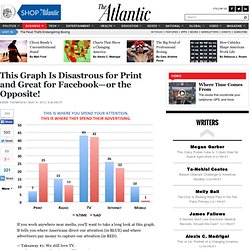
It tells you where Americans direct our attention (in BLUE) and where advertisers pay money to capture our attention (in RED). -- Takeaway #1: We still love TV. -- Takeaway #2: Advertisers still love print.-- Takeaway #3: Audiences move faster than advertisers. According to this chart -- adapted from a Mary Meeker slideshow excerpted by Bill Gross -- we spend more time engaging with mobile devices than reading print. But print publications still get 25-times more ad money than mobile. Either the eyeballs are moving faster than the advertisers, who will eventually stop paying for print ... or the ad teams don't think a minute spent around mobile ads is worth a minute spend around print ads. We can take this chart in a lot of directions. Since the Facebook IPO, I've been thinking a lot about attention. But in one key measure of attention economics, it doesn't dominate at all.