
How Obama's Internet Campaign Changed Politics. The Obama campaign’s use of the Internet has been cited as playing a large role in upending how presidential races are fought.
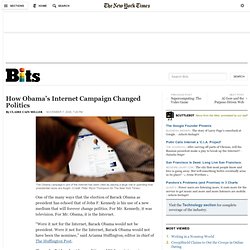
(Credit: Peter Wynn Thompson for The New York Times) One of the many ways that the election of Barack Obama as president has echoed that of John F. Kennedy is his use of a new medium that will forever change politics. For Mr. Kennedy, it was television. “Were it not for the Internet, Barack Obama would not be president. She spoke Friday about how politics and Web 2.0 intersect on a panel with Joe Trippi, a political consultant, and Gavin Newsom, the mayor of San Francisco, at the Web 2.0 Summit in San Francisco. Howard Dean’s 2004 campaign -– which was run by Mr. Mr. “The tools changed between 2004 and 2008. Mr. “The campaign’s official stuff they created for YouTube was watched for 14.5 million hours,” Mr. The John McCain campaign, for example, originally said that Governor Sarah Palin opposed the so-called bridge to nowhere in Alaska, Ms.
These days, Mr. Barack Obama and the Facebook Election. The presidential election of 2008 will go down in history for an obvious symbolic reason that will inspire future generations.

Yet while pundits were focused on Barack Obama's race, another largely overlooked factor in his success was his powerful techno-demographic appeal. We know that Obama's landmark victory was due, in part, to a groundswell of support among young Americans. Early in his campaign, political pollsters were observing that Obama was "rocking the youth vote. " This proved true: Exit polls revealed that Obama had won nearly 70 percent of the vote among Americans under age 25—the highest percentage since U.S. exit polling began in 1976. Obama enjoyed a groundswell of support among, for lack of a better term, the Facebook generation. This election was the first in which all candidates—presidential and congressional—attempted to connect directly with American voters via online social networking sites like Facebook and MySpace.
Mirror of Utøya Gunman Anders Behring Breivik’s Facebook Page and Photo Gallery. These are screenshots and the collected photos from the Facebook account of Anders Behring Breivik, the alleged gunman in the attack on the Utøya youth camp.

We are providing this mirror because profiles on social networking sites are often removed after their owners engage in high profile criminal/terrorist activities.Update: The Facebook page has now been removed. Screenshots of Facebook Account Wall and Complete Info Photos in Gallery. Les révoltes arabes sont-elles des "révolutions 2.0" ? Les internautes et blogueurs, adeptes de Facebook, Twitter et YouTube, ont déclenché une mobilisation populaire qui s'étend à presque tous les pays arabes.
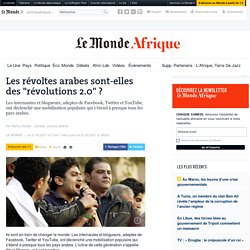
Ils sont en train de changer le monde. Les internautes et blogueurs, adeptes de Facebook, Twitter et YouTube, ont déclenché une mobilisation populaire qui s'étend à presque tous les pays arabes. L'icône de cette génération s'appelle Wael Ghonim, et il est égyptien. Agé de 30 ans, chef du marketing de Google pour le Moyen-Orient, vivant à Dubaï avec sa femme américaine et leurs deux enfants, il a reconnu, après être venu au Caire pour participer à la manifestation du 25 janvier et avoir été détenu douze jours par les forces de sécurité, être le créateur de la page Facebook "We are all Khaled Said".
"Internet est l'espace de liberté du peuple, l'espace où chacun peut s'informer et communiquer, et “We are all Khaled Said” a joué un rôle crucial", témoigne l'avocat Gamal Eid, du Réseau arabe pour l'information sur les droits de l'homme.