
Jerome Newton
NJ Army National Guard 76 - 79 US Air Force 79 - 95 loves to travel,has toured 48 states, Japan, South Korea, England, Germany, France musician, plays guitar, loves jazz, funk, freehand graphic artist, writes poetry and short stories, family historian
Survival & Backpacking. Self-Reliance. Astromony and Space. Space Shuttle. 30 years of Space Shuttle history. The Space Shuttle. Since 1981, NASA space shuttles have been rocketing from the Florida coast into Earth orbit.
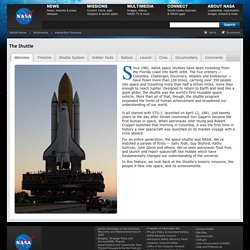
The five orbiters — Columbia, Challenger, Discovery, Atlantis and Endeavour — have flown more than 130 times, carrying over 350 people into space and travelling more than half a billion miles, more than enough to reach Jupiter. Designed to return to Earth and land like a giant glider, the shuttle was the world's first reusable space vehicle. More than all of that, though, the shuttle program expanded the limits of human achievement and broadened our understanding of our world. It all started with STS-1, launched on April 12, 1981, just twenty years to the day after Soviet cosmonaut Yuri Gagarin became the first human in space.
When astronauts John Young and Robert Crippen launched that morning in Columbia, it was the first time in history a new spacecraft was launched on its maiden voyage with a crew aboard. Space shuttle era ends with Atlantis. The History of the Space Shuttle - Alan Taylor - In Focus. From its first launch 30 years ago to its final mission scheduled for next Friday, NASA's Space Shuttle program has seen moments of dizzying inspiration and of crushing disappointment.

When next week's launch is complete, the program will have sent up 135 missions, ferrying more than 350 humans and thousands of tons of material and equipment into low Earth orbit. The missions have been risky, the engineering complex, the hazards extreme. Indeed, over the years 14 shuttle astronauts lost their lives. As we near the end of the program, let's look back at the past few decades of shuttle history. [61 photos] Use j/k keys or ←/→ to navigate Choose: Space Shuttle Columbia lifts off from Kennedy Space Center, on April 12, 1981.
While on a visit to watch the launch of Apollo 16 on April 15, 1972, Russian Poet Yevgeny Yevtushenko (left) listens as Kennedy Space Center Director Dr. A scale model of the proposed Space Shuttle wing configuration. Flight director Charles R. Cosmonaut Valeriy V. When "Rocket Science" Meets "The Dismal Science" When Physics, Economics, and Reality Collide The Challenge of Cheap Orbital Access by John M.

Jurist, M.D. Sam Dinkin, Ph.D David Livingston, DBA Contents - Section Two. Last flight of the Space Shuttle: a 30-year retrospective. The United States has been a space-faring nation for just over 50 years, ever since Alan Shepard's suborbital pop shot aboard Freedom 7 on May 5, 1961.
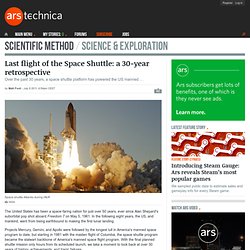
In the following eight years, the US, and mankind, went from being earthbound to making the first lunar landing. A Rocket To Nowhere. A Rocket To Nowhere The Space Shuttle Discovery is up in orbit, safely docked to the International Space Station, and for the next five days, astronauts will be busy figuring out whether it's safe for them to come home.
In the meantime, the rest of the Shuttle fleet is grounded (confined to base, not allowed to play with its spacecraft friends) because that pesky foam on the fuel tank keeps falling off. There are 28 Space Shuttle flights still scheduled, firmly or tentatively, through 2010, when the current orbiter is supposed to retire in favor of a yet-to-be-designed replacement (which will not fly until 2014). On the eve of this launch, NASA put the likelihood of losing an orbiter at 1 in 100, a somewhat stunning concession by an agency notorious for minimizing the risk of its prize program. For all the talk of safety improvements, there really isn't a way to make the Shuttle much safer. The Air Force was only too happy to agree, but at a crippling price. Space Shuttle program. The program formally commenced in 1972, although the concept had been explored since the late 1960s, and was the sole focus of NASA's manned operations after the final Apollo and Skylab flights in the mid-1970s.
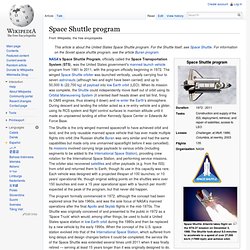
The Shuttle was originally conceived of and presented to the public in 1972 as a 'Space Truck' which would, among other things, be used to build a United States space station in low Earth orbit during the 1980s and then be replaced by a new vehicle by the early 1990s. When the concept of the U.S. space station evolved into that of the International Space Station, which suffered from long delays and design changes before it could be completed, the service life of the Space Shuttle was extended several times until 2011 when it was finally retired — serving at least 15 years longer than it was originally designed to do.
In 2004, according to the President George W. Conception and development[edit] Early U.S. space shuttle concepts STS-1 at liftoff. Program history[edit] Budget[edit] Space Shuttle main engine. The RS-25, otherwise known as the Space Shuttle Main Engine (SSME), is a liquid-fuel cryogenic rocket engine that was used on NASA's Space Shuttle and is planned to be used on its successor, the Space Launch System.

Built in the United States by Rocketdyne, the RS-25 burns cryogenic liquid hydrogen & liquid oxygen propellants, with each engine producing 1,859 kN (418,000 lbf) of thrust at liftoff. Physics. Self Sufficiency.
Pearltrees tips.