Gloss. From Wikipedia, the free encyclopedia Gloss may refer to: Text[edit] Shininess[edit] People[edit] Fiction[edit]

The Mechanic Muse — From Scroll to Screen. At the End of the Anomaly of the Age of Printed Books. Negative space. FedEx logo with an arrow between letters E and X.

Synesthesia. How someone with synesthesia might perceive (not "see") certain letters and numbers.
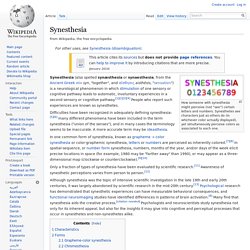
Synesthetes see characters just as others do (in whichever color actually displayed), yet simultaneously perceive colors as associated to each one. Synesthesia (also spelled synæsthesia or synaesthesia; from the Ancient Greek σύν syn, "together", and αἴσθησις aisthēsis, "sensation") is a neurological phenomenon in which stimulation of one sensory or cognitive pathway leads to automatic, involuntary experiences in a second sensory or cognitive pathway.[1][2][3][4] People who report such experiences are known as synesthetes.
Difficulties have been recognized in adequately defining synesthesia:[5][6] many different phenomena have been included in the term synesthesia ("union of the senses"), and in many cases the terminology seems to be inaccurate. A more accurate term may be ideasthesia. Characteristics[edit] There are two overall forms of synesthesia: projecting synesthesia and associative synesthesia. Sestina. A sestina (Old Occitan: cledisat [klediˈzat]; also known as sestine, sextine, sextain) is a fixed verse form consisting of six stanzas of six lines each, normally followed by a three-line envoi.

Sestina. The sestina is a complex form that achieves its often spectacular effects through intricate repetition.

The thirty-nine-line form is attributed to Arnaut Daniel, the Provencal troubadour of the twelfth century. The name "troubadour" likely comes from trobar, which means "to invent or compose verse. " The troubadours sang their verses accompanied by music and were quite competitive, each trying to top the next in wit, as well as complexity and difficulty of style. Courtly love often was the theme of the troubadours, and this emphasis continued as the sestina migrated to Italy, where Dante and Petrarch practiced the form with great reverence for Daniel, who, as Petrarch said, was "the first among all others, great master of love. " Armoured train. The 'Hurban' Armoured train located in Zvolen, Slovakia.

It is not the original, but a replica used in a film. Only two preserved original cars exist; they are stored nearby in the railway repair shops at Zvolen, where they were produced in 1944 An armoured train is a railway train protected with armour. They are usually equipped with railroad cars armed with artillery and machine guns. They were mostly used during the late 19th and early 20th century, when they offered an innovative way to quickly move large amounts of firepower. Design and equipment[edit] Polish Armoured Trains. PIBWL presents: This page is devoted to little-known subject of the Polish armoured trains. As we were starting in 1999, there were very few publications on the Polish trains, mostly quite old, all of them partial or too general, so we had to reconstruct the trains' compostion and service from partial information, often contradictory.
Our work was often pioneering. Cargo cult. Vanuatu cargo cult marks 50 years. One of the world's last surviving cargo cults is celebrating its official 50th anniversary on Tanna island in Vanuatu.

The John Frum Movement worships a mysterious spirit that urged them to reject the teachings of the Church and maintain their traditional customs. The cult was reinforced during WWII, when US forces landed with huge amounts of cargo - weapons, food and medicine. Villagers believe the spirit of John Frum sent the US military to their South Pacific home to help them. Devotees say that an apparition of John Frum first appeared before tribal elders in the 1930s. He urged them to rebel against the aggressive teachings of Christian missionaries and instead said they should put their faith in their own customs. Stars and Stripes. Musica universalis. Musica universalis (lit. universal music, or music of the spheres) or Harmony of the Spheres is an ancient philosophical concept that regards proportions in the movements of celestial bodies—the Sun, Moon, and planets—as a form of musica (the Medieval Latin name for music).

This 'music' is not usually thought to be literally audible, but a harmonic and/or mathematical and/or religious concept. The idea continued to appeal to thinkers about music until the end of the Renaissance, influencing scholars of many kinds, including humanists. History[edit] Engraving from Renaissance Italy showing Apollo, the Muses, the planetary spheres and musical ratios.
Spaceship Earth. Spaceship Earth is a world view term usually expressing concern over the use of limited resources available on Earth and encouraging everyone on it to act as a harmonious crew working toward the greater good.

The earliest known use is a passage in Henry George's best known work, Progress and Poverty[1] (1879). From book IV, chapter 2: It is a well-provisioned ship, this on which we sail through space. If the bread and beef above decks seem to grow scarce, we but open a hatch and there is a new supply, of which before we never dreamed.