
Computer vision technology has quietly become one of the most powerful forces shaping the modern digital world. From unlocking smartphones with a glance to helping cars detect pedestrians, this technology now touches almost every part of daily life. Yet most people never stop to think about how far it has come. The journey of computer vision technology is a remarkable story of curiosity, failure, persistence, and breakthrough moments that changed everything.
In this article, we will walk through the complete history of computer vision, from its earliest experiments to the advanced AI systems we rely on today. Understanding this journey helps us appreciate just how much effort, research, and innovation went into making machines capable of seeing and understanding the world.
Before diving into the timeline, it helps to understand what computer vision technology actually means. At its core, it is a branch of artificial intelligence that trains computers to interpret and understand visual information from the world, whether that comes from photos, videos, or live camera feeds. Using image sensors and CMOS hardware, cameras capture raw visual data, and then algorithms process that data to identify objects, faces, patterns, and movements.
Today, computer vision technology powers everything from medical diagnostics to industrial automation. But it did not start out this advanced. It began as a simple academic question: can a machine be taught to see?
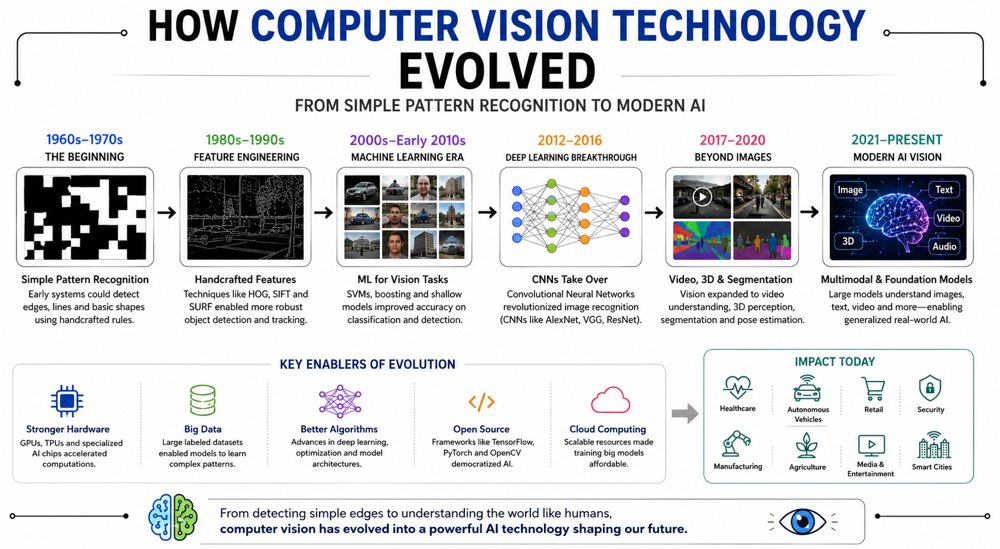
The story begins in research labs during the 1960s, when scientists first started exploring whether machines could process visual information the way humans do. Early researchers were fascinated by the idea of machines learned to see, even though the technology of the time was extremely limited.
One of the most important moments in this era was the famous summer vision project, an ambitious research effort that attempted to connect a camera to a computer and have the system describe what it saw. While the results were far from perfect, this project laid the foundation for decades of research that followed. It is often considered one of the first computer vision experiments in history, and it showed researchers just how complex visual perception truly is.
During this period, the focus was almost entirely on basic shapes, edges, and simple geometric recognition. The hardware available could barely process small black and white images, but the dream of computer vision technology had officially begun.
Throughout the 1970s, researchers shifted their attention toward pattern recognition and edge detection. This era focused on teaching computers to identify boundaries between objects within an image, which is a critical step toward true visual understanding.
The history of pattern recognition during this decade involved mathematical models that could detect changes in brightness or color to outline shapes. Similarly, the history of edge detection saw the introduction of algorithms that could trace the outlines of objects, even in noisy or low quality images.
These early techniques were primitive compared to modern standards, but they were essential building blocks. Without solid edge detection and pattern recognition methods, none of the advanced object detection algorithms used today would have been possible.
The 1980s and early 1990s brought a wave of new algorithmic approaches to visual processing. This period also saw major progress in the history of optical character recognition, as researchers developed systems capable of reading printed text from scanned documents. This technology eventually became the backbone of document digitization tools used by businesses worldwide.
Another major milestone during this time was the history of the neocognitron, an early neural network model designed to recognize visual patterns regardless of their position in an image. While it was not as powerful as modern convolutional neural networks (CNN), the neocognitron introduced ideas that would later become central to deep learning.
This era also marked steady progress in the history of image processing, as digital cameras became more common and computers gained enough power to handle larger image files. Computer vision technology was slowly moving from theory into practical, real world tools.
By the mid 1990s, computer vision technology started becoming more accessible to developers and researchers outside of major universities. The release of the history of opencv, an open source library of computer vision functions, gave programmers around the world the tools they needed to experiment with image processing without building everything from scratch.
This period also saw major advances in facial recognition. The viola jones algorithm, introduced in the early 2000s, became one of the first systems capable of detecting faces in real time using ordinary computer hardware. This breakthrough answered a question many people were asking: who invented facial recognition technology that could actually work outside of a research lab?
The viola jones algorithm became widely used in digital cameras for autofocus and became a stepping stone toward more advanced facial recognition systems used today.
If there is one period that truly defines modern computer vision technology, it is the early 2010s. This is when deep learning transformed computer vision completely, moving the field away from hand crafted algorithms toward systems that could learn directly from massive amounts of data.
The history of imagenet played a central role here. ImageNet was a massive labeled dataset of images that researchers used to train and test computer vision systems. In 2012, the history of alexnet marked a turning point when a deep convolutional neural network dramatically outperformed all previous approaches in an image recognition competition.
This success triggered rapid development of new architectures. The history of vggnet, history of googlenet, and history of resnet each pushed accuracy higher while solving new technical challenges, such as training extremely deep networks without losing important information. Transfer learning in computer vision also emerged during this time, allowing developers to reuse pretrained models for new tasks instead of training systems from scratch, saving enormous amounts of time and computing power.
As computer vision technology matured, researchers focused on more than just identifying what was in an image. They wanted systems that could locate multiple objects within a single frame in real time. This led to the history of object detection becoming one of the most active research areas in AI.
Several competing approaches emerged during this period. The history of r-cnn introduced region based detection methods, while the single shot detector and the history of yolo offered faster, real time alternatives. The ongoing comparison of yolo vs r-cnn vs ssd became a common topic among developers choosing the right model for their applications. Improvements like the history of faster r-cnn and anchor boxes in object detection made these systems even more accurate and efficient.
These advances directly enabled real time computer vision tools used in security cameras, retail analytics, and embedded computer vision hardware found in smart devices.
Today, computer vision technology has expanded far beyond simple object recognition. Vision transformers represent a major shift, applying techniques originally developed for language models to visual tasks with impressive results.
Generative AI has also reshaped the field. The history of ai image generation, including tools related to the history of dall·e, history of stable diffusion, and history of midjourney, shows how computer vision technology now works in both directions, not only understanding images but creating entirely new ones. Neural style transfer allows artistic styles to be applied to photos automatically, while generative AI data augmentation helps train models using synthetic dataset generation when real world data is limited.
On the security side, the history of deepface and history of apple face id show how facial recognition has become part of everyday consumer technology, though facial recognition and privacy concerns continue to spark important conversations about how this technology should be regulated.
The applications of computer vision technology today are incredibly broad. Self driving cars and computer vision systems work together to detect lanes, pedestrians, and obstacles in real time. Medical imaging AI helps doctors detect diseases earlier and more accurately than ever before. Computer vision in manufacturing supports machine vision automation on production lines, catching defects that human inspectors might miss.
Other industries benefiting from advanced computer vision solutions include agriculture, where drones and computer vision are used to monitor crops, and sports, where computer vision in sports tracks player movement and ball trajectories for performance analysis. History of augmented reality and history of google lens have also brought computer vision technology directly into the hands of everyday smartphone users.
Cloud based computer vision technology and edge AI inference now allow these systems to run efficiently, whether processing happens on powerful servers or directly on small embedded devices. As industrial computer vision systems become more affordable, even small businesses can now access smart camera computer vision technology that was once limited to large corporations.
No history of computer vision would be complete without mentioning the researchers who made it possible. Yann lecun pioneered early convolutional neural network research that became foundational to modern deep learning. Geoffrey hinton and computer vision research helped revive interest in neural networks during a period when many researchers had given up on them. Andrew ng and computer vision education helped bring machine learning and AI knowledge to millions of students and professionals around the world through accessible online courses.
Their combined contributions, along with countless other researchers, shaped the deep learning frameworks that power today's AI computer vision technology trends.
Computer vision technology is used to help machines interpret visual data from the real world. Common uses include facial recognition, medical imaging, self driving vehicles, manufacturing quality control, augmented reality, and video understanding in AI applications like content moderation and surveillance.
The earliest experiments date back to the 1960s, with foundational research projects exploring whether computers could process and describe visual information from cameras.
Older methods relied on hand crafted rules and algorithms designed by humans. Modern computer vision technology uses convolutional neural networks and other deep learning models that learn patterns directly from large datasets, resulting in much higher accuracy.
Not exactly. The ongoing comparison of computer vision vs human vision shows that while machines can process certain visual tasks faster and more consistently, human vision still excels at understanding context, emotion, and ambiguous scenes in ways AI is still learning to replicate.
The future of computer vision software points toward more multimodal systems that combine vision with language and audio understanding, faster real time processing on edge devices, and continued improvements in generative AI for both image creation and analysis.
The story of computer vision technology is far from over. What started as a simple summer research project decades ago has grown into a powerful field that touches healthcare, transportation, security, entertainment, and nearly every other industry. From early pattern recognition and edge detection to today's vision transformers and generative AI tools, each step forward has built on the discoveries that came before it.
As history of multimodal ai continues to evolve and new breakthroughs emerge, computer vision technology will keep transforming how machines interact with the visual world, and how we interact with the technology around us every single day.