
When customer inquiries overwhelm capacity, small business owners face a familiar decision: hire help or find another solution. Increasingly, that "other solution" is AI—and the comparison reshapes traditional staffing calculations.
The decision isn't simply about cost. It's about capability, availability, scalability, and the strategic allocation of limited resources.
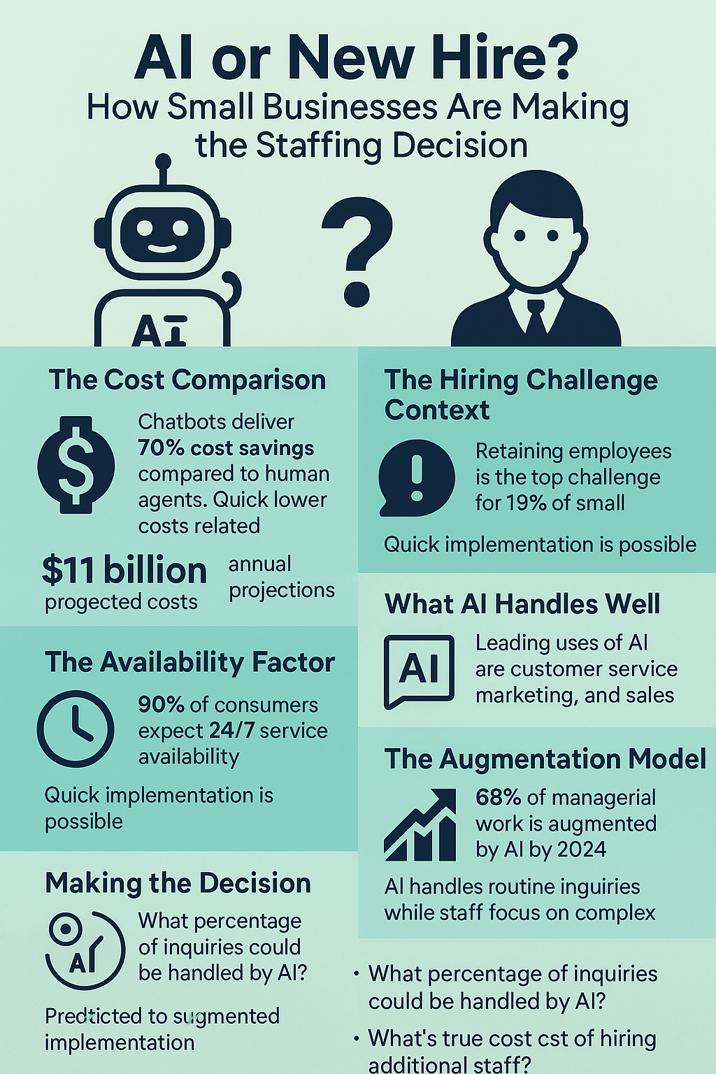
Juniper Research provides the headline comparison: chatbots deliver 70% cost savings compared to human agents handling equivalent customer service inquiries. The economics reflect fundamental differences in how AI and human staff operate.
A customer service employee requires salary, benefits, training, management oversight, workspace, and equipment. AI requires implementation cost and ongoing subscription—typically a fraction of employment costs for equivalent inquiry handling capacity.
For specific dollar comparisons, consider that Juniper projects chatbots will save businesses $11 billion annually by 2027, with an average of 4 minutes saved per customer interaction. Those savings accumulate from thousands of businesses making the same calculation: AI handles routine inquiries more economically than hiring additional staff.
Cost comparison tells only part of the story. Microsoft's 2023 State of Global Customer Service Report found that 90% of consumers expect 24/7 service availability. Meeting that expectation with human staff requires multiple shifts, overnight coverage, and weekend scheduling—dramatically increasing the true cost of human customer service.
AI doesn't require shifts. The same system handles 3 PM inquiries and 3 AM inquiries without overtime, night differential, or scheduling complexity. For businesses where after-hours inquiries matter—Gartner reports a 35% increase since 2020—AI provides availability that human staffing struggles to match economically.
The staffing decision doesn't occur in a vacuum. Guidant Financial's 2023 Small Business Trends Report found that finding and retaining employees is the top challenge for 19% of small businesses. The U.S. Chamber of Commerce reports that 49% cite employee recruitment and retention as their primary concern.
The choice between AI and hiring isn't always about cost preference—sometimes it's about hiring feasibility. Businesses struggling to find qualified staff can implement AI immediately, without recruiting, interviewing, or training delays.
For businesses evaluating options, AI tools designed for small business offer implementation timelines measured in hours rather than the weeks or months that hiring typically requires.
The staffing decision requires honest assessment of which tasks AI handles effectively and which genuinely require human judgment.
Salesforce's research identified primary AI use cases: customer service leads at 32%, followed by marketing at 28%, and sales at 25%. These functions involve significant routine work—answering common questions, providing standard information, handling predictable inquiries—that AI manages effectively.
IBM's Global AI Adoption Index found that businesses using AI report 30-40% time savings on routine tasks and 6.9% improvement in customer satisfaction. The satisfaction improvement suggests AI isn't just handling inquiries—it's handling them well.
The most effective approach for many businesses isn't AI instead of staff—it's AI augmenting staff. AI handles routine inquiries while human team members focus on complex situations, relationship building, and judgment-intensive work.
Gartner predicts that AI will augment 69% of managerial work by 2024. This augmentation model applies throughout organizations: AI handles what it does well, freeing humans for what they do best.
Forbes Advisor found that 60% of business owners believe AI will improve customer relationships. This belief reflects understanding that AI-human collaboration often exceeds what either achieves alone.
For businesses currently overwhelmed by customer inquiries, the decision framework involves several questions:
What percentage of inquiries follow predictable patterns that AI could handle? (Often 70-85%)
What's the true cost of hiring, including recruitment, training, benefits, and management?
How important is after-hours and weekend availability?
How quickly is additional capacity needed?
A free ROI calculator can help quantify the comparison based on specific business circumstances.
Beyond immediate cost comparison, the staffing decision has strategic implications. Businesses that automate routine operations free human capacity for higher-value activities—the growth-focused work that QuickBooks found occupies only 31.9% of small business owner time.
The choice between AI and hiring isn't just about handling today's inquiries. It's about building operational structure that scales efficiently while maintaining the human judgment and relationship quality that customers value.
Businesses implementing AI alongside existing teams often discover that the combination delivers better results than either approach alone.