
Tachyonic field. A tachyonic field, or simply tachyon, is a quantum field with an imaginary mass that represents an instability.

The term "tachyon" was coined by Gerald Feinberg in a 1967 paper[1] that studied quantum fields with imaginary mass. Feinberg believed such fields permitted faster than light propagation, but it was soon realized that Feinberg's model in fact did not allow for superluminal speeds,[2] and instead that an imaginary mass causes an instability to a process known as tachyon condensation. Today, the term "tachyon" refers both to hypothetical particles that always move faster than light and to fields with imaginary mass.[3] The latter have come to play an important role in modern physics[4][5][6] and are discussed in popular books on physics.[3][7] Due to the instability caused by the imaginary mass, any configuration in which one or more field excitations are tachyonic will spontaneously decay.
In some cases this decay ends with another, stable configuration with no tachyons. Faster-than-light neutrino anomaly. Fig. 1 What OPERA saw.
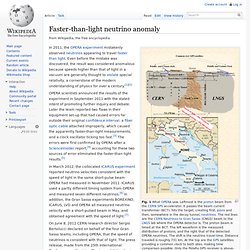
Leftmost is the proton beam from the CERNSPS accelerator. It passes the beam current transformer (BCT), hits the target, creating first, pions and then, somewhere in the decay tunnel, neutrinos. The red lines are the CERN Neutrinos to Gran Sasso (CNGS) beam to the LNGS lab where the OPERA detector is. Wheeler–Feynman absorber theory. The Wheeler–Feynman absorber theory (also called the Wheeler–Feynman time-symmetric theory) is an interpretation of electrodynamics derived from the assumption that the solutions of the electromagnetic field equations must be invariant under time-reversal symmetry, as are the field equations themselves.

Indeed, there is no apparent reason for the time-reversal symmetry breaking which singles out a preferential time direction and thus makes a distinction between past and future. A time-reversal invariant theory is more logical and elegant. Another key principle, resulting from this interpretation and reminiscent of Mach's principle due to Tetrode, is that elementary particles are not self-interacting.
This immediately removes the problem of self-energies. This theory is named after its originators, the late physicists Richard Feynman and John Archibald Wheeler. T-symmetry and causality[edit] and point , which will arrive at point. Alcubierre drive. Two-dimensional visualization of the Alcubierre drive, showing the opposing regions of expanding and contracting spacetime that displace the central region.
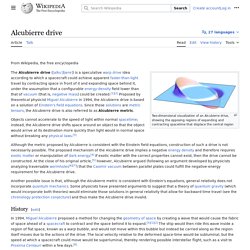
The Alcubierre drive or Alcubierre warp drive (or Alcubierre metric, referring to metric tensor) is a speculative idea based on a solution of Einstein's field equations in general relativity as proposed by theoretical physicist Miguel Alcubierre, by which a spacecraft could achieve faster-than-light travel if a configurable energy-density field lower than that of vacuum (that is, negative mass) could be created. Rather than exceeding the speed of light within a local reference frame, a spacecraft would traverse distances by contracting space in front of it and expanding space behind it, resulting in effective faster-than-light travel.
Another possible issue is that, although the Alcubierre metric is consistent with Einstein's equations, general relativity does not incorporate quantum mechanics. History[edit] Alcubierre drive. Krasnikov tube. A Krasnikov tube is a speculative mechanism for space travel involving the warping of spacetime into permanent superluminal tunnels.

The resulting structure is analogous to a wormhole with the endpoints displaced in time as well as space. Faster-than-light. Faster-than-light (also superluminal or FTL) communication and travel are the conjectural propagation of information or matter faster than the speed of light.
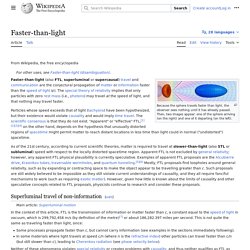
According to the current scientific theories, matter is required to travel at slower-than-light (also subluminal or STL) speed with respect to the locally distorted spacetime region. Apparent FTL is not excluded by general relativity; however, any apparent FTL physical plausibility is speculative. Intergalactic travel. Intergalactic travel is space travel between galaxies.

Due to the enormous distances between our own galaxy the Milky Way and even its closest neighbors — hundreds of thousands to millions of light-years — any such venture would be far more technologically demanding than even interstellar travel. Intergalactic distances are roughly one-million fold (six orders of magnitude) greater than their interstellar counterparts. The technology required to travel between galaxies right now is far beyond humanity's present capabilities, and currently only the subject of speculation, hypothesis, and science fiction. However, scientifically speaking, there is nothing to indicate that intergalactic travel is impossible.
There are, in fact, several at least conceivable methods of doing it. Superluminal motion. Superluminal motion In astronomy, superluminal motion is the apparently faster-than-light motion seen in some radio galaxies, quasars and recently also in some galactic sources called microquasars.

All of these sources are thought to contain a black hole, responsible for the ejection of mass at high velocities. When first observed in the early 1970s, superluminal motion was taken to be a piece of evidence against quasars having cosmological distances. Although a few astrophysicists still argue in favor of this view, most believe that apparent velocities greater than the velocity of light are optical illusions and involve no physics incompatible with the theory of special relativity.
Explanation[edit] This phenomenon is caused because the jets are travelling very near the speed of light and at a very small angle towards the observer. Superluminal motion is often seen in two opposing jets, one moving away and one toward Earth. Some contrary evidence[edit] Signal velocity[edit] from point B. If. Intergalactic travel. Alcubierre drive. Speed of light. Faster-than-light. Faster-than-light.