
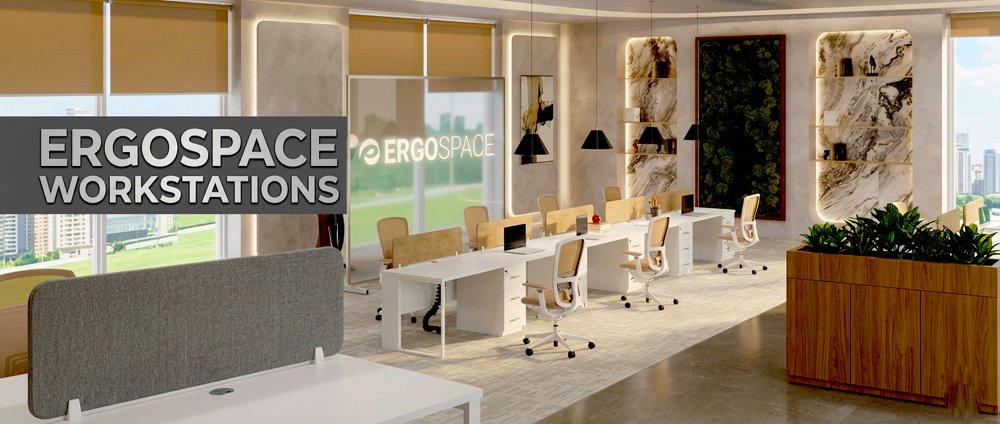
Ergospace workstations are designed for companies that treat workspace design as a performance driver, not just an interior requirement. In Dubai’s fast-moving commercial environment, offices are expected to support productivity, reflect brand identity, and adapt quickly to organizational change. Workstations play a central role in achieving this balance because they directly influence how teams work, collaborate, and stay focused throughout the day.
Modern businesses are no longer selecting workstations based only on appearance. The decision is driven by operational efficiency, employee wellbeing, space utilization, and long-term scalability. Ergospace workstation solutions are built around these business expectations, offering structured systems that support daily workflows while maintaining a clean, professional office environment.
In most corporate environments, workspace challenges are consistent. Teams grow, departments change, hybrid work becomes standard, and office space remains expensive. Ergospace workstations are designed to address these realities through modular planning and functional layouts.
Instead of fixed and rigid office furniture, these workstation systems allow businesses to restructure spaces without major disruption. This flexibility is especially important for companies in Dubai, where expansion cycles are fast and operational decisions need to be agile.
The focus is not only on fitting employees into a space but on creating an environment where movement, communication, and focus happen naturally.
Workstations are central to employee comfort and productivity. In corporate environments where long working hours are common, poor posture and discomfort directly affect output quality.
Ergospace workstations are designed with ergonomic alignment in mind. Proper desk height, structured leg space, and screen positioning support healthier working habits. When combined with ergonomic seating, the workstation becomes a structured productivity zone rather than just a desk setup.
For HR teams and operations managers, this translates into reduced fatigue complaints, improved focus, and better retention of employees who spend most of their day at their desks.
Commercial space in Dubai carries high operational cost, which makes space optimization a critical factor in office planning. Workstations are designed to maximize usable area without making the environment feel congested.
Open-plan configurations allow companies to accommodate more teams within the same footprint while maintaining comfort and accessibility. At the same time, structured partitions provide the right balance between collaboration and privacy.
The goal is not to fill space but to use it strategically so that every square meter contributes to productivity.
One of the key challenges in office planning is long-term adaptability. Businesses rarely stay static. Teams expand, departments restructure, and hybrid models evolve.
Ergospace workstations are built on modular principles, allowing companies to:
This approach reduces downtime and prevents unnecessary refurbishment costs, which is often a major concern for procurement teams.
Workstations are not just functional elements; they also contribute to how a company is perceived internally and externally. A well-designed workspace reflects organizational structure, discipline, and brand positioning.
Ergospace workstation designs support multiple aesthetic directions, from minimal executive environments to dynamic collaborative setups. The use of coordinated finishes, structured layouts, and clean design language ensures that the workspace looks consistent and professional across all departments.
For client-facing businesses, this becomes part of the brand experience. When clients walk into an office, the workstation environment communicates operational maturity without needing explanation.
Modern offices are heavily dependent on digital tools. Workstations must support this reality without creating clutter or inefficiency.
Ergospace workstation systems are designed to integrate:
This ensures that digital workflows remain smooth and uninterrupted, especially in environments where multiple tools and devices are used throughout the day.
Different departments require different working environments. A one-size-fits-all approach no longer works in structured office planning. Ergospace offers workstation categories that align with functional requirements across business teams.
Workstation TypeIdeal Use CaseKey Benefit
Open Plan WorkstationsLarge teams and collaborative departmentsMaximizes space efficiency and teamwork flow
Executive WorkstationsManagement and leadership zonesPrivacy with premium design presence
Modular Cluster WorkstationsGrowing teams and dynamic departmentsFlexible scaling and reconfiguration
Focus WorkstationsTask-heavy or analytical rolesReduced distraction and improved concentration
Collaborative WorkstationsCreative and project-based teamsEncourages communication and idea sharing
Each configuration is designed to serve a specific working behavior rather than forcing all employees into the same structure.
Workstation design has a direct influence on daily output. Poorly planned desks lead to clutter, distraction, and inefficient movement. Well-structured workstations create clarity in workspace usage.
In practical terms, businesses experience:
For decision-makers, this translates into measurable operational improvements without changing core business processes.
From a procurement standpoint, workstation investment is evaluated based on durability, flexibility, and lifecycle cost. Ergospace workstation systems are designed to reduce long-term replacement frequency and minimize redesign cycles.
Instead of short-term furniture purchases, businesses are investing in structured workspace systems that evolve with them. This reduces total cost of ownership while maintaining consistent office quality over time.
The ability to reconfigure rather than replace is a key advantage for companies managing multiple office expansions or relocations.
Ergospace workstations represent a shift from traditional office furniture thinking to structured workspace engineering. In a market like Dubai, where business speed, real estate cost, and operational efficiency are critical, workstation design becomes a strategic decision rather than a visual one.
These systems support productivity, employee comfort, space efficiency, and brand alignment within a single framework. For growing businesses, the value lies not only in how the workspace looks today but in how easily it can evolve tomorrow without disruption.
Ergospace workstations are built for that continuity, making them a practical choice for organizations that treat workspace as a long-term business asset rather than a one-time purchase.