
In today’s fast-changing world, choosing between an electric scooter and a petrol scooty is no longer just about style or speed—it’s about smart savings, sustainability, and long-term value. With rising fuel prices and increasing awareness about eco-friendly transportation, the debate around electric scooter vs petrol scooter, which is better, has become more relevant than ever.
Let’s break it down in a simple and practical way so you can clearly understand the real cost difference and make a smart decision.
One of the biggest advantages of an electric scooter is its extremely low running cost. Petrol prices in India are constantly fluctuating, while electricity remains much more affordable and stable.
A petrol scooty typically delivers a mileage of 40–50 km per litre. With petrol prices around ₹100 per litre, the cost comes to approximately ₹2–₹2.5 per km.
On the other hand, an electric scooty consumes about 3–4 units of electricity per full charge, costing around ₹25–₹30, and offers a range of 60–80 km. This brings the running cost down to just ₹0.30–₹0.50 per km.
Clearly, in the electric scooter vs petrol scooter comparison, electric scooters are far more economical for daily commuting.
When comparing an electric scooter vs a petrol scooter, many people confuse mileage with range.
While petrol scooters offer quick refueling, modern electric scooter bikes provide enough range for daily city travel.
For example:
This means most users can easily ride for 1–2 days on a single charge.
For city commuting, the range of an electric scooter is more than sufficient.
Let’s compare the monthly expenses to see the real impact:
Monthly savings: ₹1,400+
This clearly answers the question: electric scooter vs petrol scooter, which one is better in terms of running cost—electric scooters win by a huge margin.
Maintenance is another important factor in the electric scooter vs petrol scooter debate.
These regular services increase long-term expenses.
Since electric scooters have no engine and fewer moving parts, their maintenance cost is significantly lower.
This makes electric scooters more convenient and budget-friendly in the long run.
If you’re planning for the long term, an electric scooter is a clear winner.
Over 3–5 years:
Whereas:
Even if the electric scooter vs petrol scooter price shows a slightly higher upfront cost for EVs, the savings on fuel and service quickly balance it out.
In most cases, users recover the extra cost within 1–2 years.
Cost isn’t just about money—it’s also about the environment.
Choosing an electric scooter bike not only saves money but also helps reduce your carbon footprint.
So, in the electric scooter vs petrol scooter comparison, EVs are better for both your wallet and the planet.
Many buyers worry about battery life when choosing an electric scooter.
Here’s the reality:
On the other hand:
So while both have lifecycle costs, electric scooters remain more economical overall.
Here’s a quick comparison:
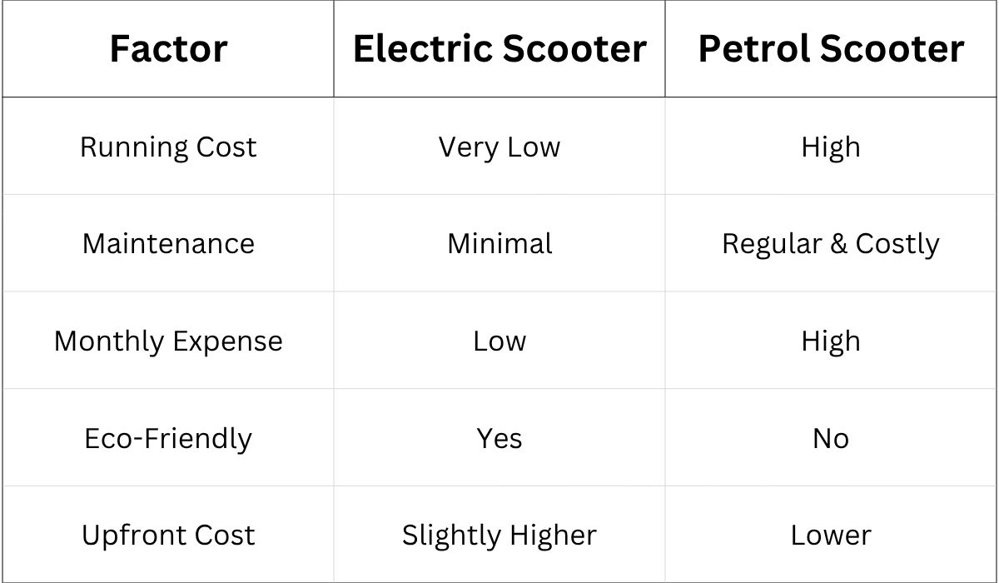
If your daily commute is within city limits, an electric scooty is the smarter choice.
The shift from petrol to electric is not just a trend—it’s a smart financial and environmental decision. From daily savings to long-term benefits and low maintenance, the electric scooter clearly stands out.
With reliable options available in the market, now is the perfect time to switch to electric mobility.
AMO Mobility Solutions Pvt. Ltd.
📞 Phone: +91 7011294211, 9625224030
📧 Email: contact01@amomobility.com
🌐 Website: www.amomobility.com
🛒 Listed on: Amazon & Flipkart
https://www.amomobility.com/blog/top-low-speed-electric-scooters-for-daily-commuting-1348093688
https://www.amomobility.com/blog/electric-scooters-a-small-vehicle-with-a-big-impact-884341242