
Eric
Prise de son : le piano. La plage de fréquence très étendue du piano combinée aux grandes dimensions de ce dernier fait que la prise de son stéréo avec un ou plusieurs couples appairés s'impose avec évidence.

Le placement des micros a beaucoup à voir avec le type de tonalité que vous recherchez. Dans la plupart des cas, le couvercle devra, tout le temps de l'enregistrement, rester ouvert. Lorsqu'une isolation est nécessaire, nombreux sont les ingénieurs du son qui règlent le couvercle à mi-hauteur et qui placent une couverture de déménagement dans l'ouverture de façon à isoler les micros. 1. Pop/rock Plus les micros sont placés près des marteaux et plus le son semble percutant. 2. Le jazz et les balades pop requièrent en général le son plus plein qu'on obtient en éloignant davantage encore les micros des marteaux. 3. PG Music Inc. - Band-in-a-Box, PowerTracks Pro Audio, and More..
Realbook Jazz Charts. Jazz courses. Learn Jazz Piano, by Scot Ranney. If you have a question, ask!

Pro jazz pianists in the forums want to help you out, but you need to ask if you want answers. The best answers always come from your own discussions. Search LearnJazzPiano.com: The lessons you will find here are built on years of practical on-the-job experience. I can't supply you with the same kind of information you will get from an educational institution, I can't tell you what Monk's favorite joke was, and I never did understand French 6ths. What I do know is how to play professionally with anyone who needs a piano player.
Enjoy, and ask questions! The Piano Lounge Jazz Piano Discussions: log in, create an account, and be part of the original & longest running online jazz piano community the web has to offer! Comping What do we do about comping? The Basics Some information to get you started. Simple Blues First exploration of the roots of jazz- the blues Advanced Blues More exploration into the blues Reharmonization 101. Online Blues Piano Lessons. 8notes.com - Beginners Blues lesson for piano. By David Bruce Improvising the blues on the piano is a lot easier than you might think.

It's a great way for beginners to sound very cool, without having to be as good as Oscar Peterson. If you're just browsing, scroll to the bottom of this page and listen to the audio example to get an idea of what this lesson is about. In this lesson we'll introduce some neat blues ideas to get you started.
Assumed knowledge: A basic idea of where the notes names are on the piano. The 4 Note Blues Learn the blues scale and you're half way to playing the blues. The first stage is to improvise around these notes. You can change direction whenever you like, and repeat notes as often as you like - but do not skip a note. Once you've practised the right hand by itself a bit, add a C and a G in the left hand as shown: Try playing the left hand notes, then a long phrase using the four right hand notes.
Click here to listen to an example: That's a great first step towards learning the blues on the piano. Part 2.
Chodrs progression. Interactive Circle of Fifths. Circle of fifths. Circle of fifths showing major and minor keys Nikolay Diletsky's circle of fifths in Idea grammatiki musikiyskoy (Moscow, 1679) In music theory, the circle of fifths (or circle of fourths) is a visual representation of the relationships among the 12 tones of the chromatic scale, their corresponding key signatures, and the associated major and minor keys.
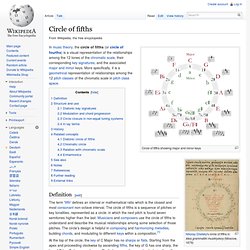
More specifically, it is a geometrical representation of relationships among the 12 pitch classes of the chromatic scale in pitch class space. Definition[edit] Structure and use[edit] Pitches within the chromatic scale are related not only by the number of semitones between them within the chromatic scale, but also related harmonically within the circle of fifths. Octaves (7 × 1200 = 8400) versus fifths (12 × 700 = 8400), depicted as with Cuisenaire rods (red (2) is used for 1200, black (7) is used for 700). Diatonic key signatures[edit] The circle is commonly used to represent the relationship between diatonic scales.
Play . History[edit] .
Met_208.gif (644×960) Accords Guitare. Screencasts. Help. Friends.