
N. Lygeros - Caractéristiques de l'intelligence extrême. Mensa France. The intellectual and psychosocial nature of extreme giftedness. Powell, P.
& Haden, T. Roeper Review Volume 6, No. 3, pp. 131--133 February 1984 This article by Philip Powell and Tony Haden compares the differences of average, moderately and extremely gifted individuals. The authors explore the psychological difficulties of the highly gifted, especially in terms of self-esteem and self-conception. The article discusses the difficulties the extremely gifted have in obtaining consistent, accurate and valid feedback in regard to their self-concept. The information provided has implications for educators, parents, and psychologists. The highly gifted create structure, generate ideas, and efficiently process information in ways that are qualitatively superior to moderately gifted and average ability individuals. The highly gifted are rare in the population. General intelligence Desire to know Originality Common sense Torrance (1965) has argued that the gifted are independent thinkers.
Another important difference is in the desire to know complex ideas. Exceptionally Gifted Children: Different Minds. Exceptionally Gifted Children: Different Minds While there have been many studies that explore adult giftedness, few have examined the thinking processes of gifted children.

Most theories of giftedness assume that adult measures of cognition are directly applicable to children. Sternberg and Davidson (1985) concluded that information processing of gifted children is similar to that of adults in capitalizing on patterns of information using environmental shaping techniques, having, exceptional problem-finding ability, and exceptional ability to conceive higher order relations. Dark and Benbow (cited in Benbow, 1991) found that gifted adolescents in the SMPY program process information in a quantitatively, rather than qualitatively, different manner from older individuals. These students were described as precocious in their abilities. What is Highly Gifted? Exceptionally Gifted? Profoundly Gifted?
Given the much lower scores resulting from the newest generation of tests (WISC-IV, SB-5 and WJ-III cognitive), professionals who work with the gifted are suggesting a new set of scores and descriptive levels of giftedness, beginning at 120 to 125 for "moderately" gifted, and progressing to 142 to 145+ for "profoundly" gifted.
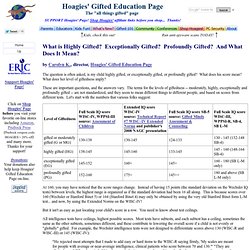
But these levels are still under investigation. How do you know if your child "hit the ceiling? " It depends on the test, and some additional information from the tester. Here are the questions to ask... If the child had continued getting questions right could he have scored any higher, or did he reach the highest score for his age on this subtest (usually a 19 on WISC / SB-5, but sometimes lower)?
There are also achievement tests, which offer a standard score, that is a score based on a mean of 100, and a standard deviation of some number, commonly 15 or 16, to match the Wechsler or Stanford Binet, respectively. What is eg/pg? "The child of 160 IQ (top 0.01%) is as different from the child of 130 IQ (top 2%) as that child is from the child of average ability.
" Leta Hollingworth – ‘Children Above 180 IQ’ (1942) UK Government policy on the ‘Gifted and Talented’ is focused upon a broad spectrum of children falling into the top 2%, 5% or even 10% of the school population – in other words the ‘top children of the top set’. Yet this fails to acknowledge that there are degrees of giftedness, and that real differences exist between children who are moderately or highly gifted, and those who are exceptionally or even profoundly gifted.
This tendency to group all gifted children together under one blanket term pervades even the gifted literature, and gives rise to a mistaken belief that the difficulties of educating gifted children may be addressed by a ‘one-solution-fits-all’ approach. This clearly makes a huge difference to the educational requirements of each individual child. In other words: Profoundly Gifted Children. Not all gifted children have the same level of abilities.
Like average children, they represent a wide range. Extremely gifted, also known as the profoundly gifted, are on the highest end of the gifted ability range. They are at least as different from gifted children with an IQ of 130 as those children are from children with an IQ of 100. Their exceptional abilities present some special challenges for parents and teachers alike. Small poppies: Highly gifted children in the early years"Cutting down the tall poppies" is an expression used in Australia to refer to the attempts to put gifted children in their place or to make them like everyone else. Tips for Parents: Helping Parents Understand their Profoundly Gifted Children. Clark, B.

Davidson Institute for Talent Development 2004 This Tips for Parents article is from a seminar hosted by Barbara Clark, who briefly touches on the basic structure and function of the brain and then goes on to describe three levels of giftedness: moderate, high, and profound. Characteristics of the profoundly gifted are offered as well as a summary of clues from brain research for parents and educators. The very definition of profound giftedness includes the extremely individual nature of the development of these children. We can discuss this development in general terms, however, much of what we discuss will apply differently to each profoundly gifted child.
Nature and Nurture It has been established that at birth nearly all human infants come equipped with a marvelous, complex heritage that contains some 100 to 200 billion brain cells. A follow-up of subjects scoring above 180 IQ in Terman's genetic studies of genius. Feldman, D.
H. Exceptional Children Council for Exceptional Children Vol. 50, No. 6, pp. 518-523 1984 This article by David Feldman presents the results of the author's follow-up study of those above 180 IQ in Terman's "Genetic Studies of Genius. " The author reviewed the Terman files of all the subjects who scored at this level. He provides a short summary of educational and occupational attainments, then presents a qualitative analysis of the data. Gifted: Exceptionally and Profoundly Gifted Students: An Underserved Population. By Miraca U.M.
Gross Originally published in Understanding Our Gifted, Winter 2000. Reprinted with Permission, Open Space Communications, 800-494-6178. Www.openspacecomm.com Paula is a happy successful student, popular with her classmates and appreciated by her teachers. Paula learned to read before her 5th birthday. 10 most commonly asked questions about highly gifted children. 2.

How many highly gifted children are there? No one really knows. Although many researchers have made estimates, and test norms indicate the statistically rare incidence of children in this population, the actual numbers of such children may well be greater than the statistical norms imply. Webb, Meckstroth, and Tolan (1982) state that one child in about 2,000 has an IQ above 150 on the Stanford-Binet Form L-M; one child in a half-million has an IQ above 170. Losing Our Minds: Gifted Children Left Behind: Amazon.fr: Deborah L. Ruf: Livres anglais et étrangers. ED Helping Your Highly Gifted Child. THQI tentative de compréhension : Discussions et Débats. Depuis un bon moment, je me pose des questions quant aux spécificités des THQI si tant est qu'il y en a.

Je lance donc ce sujet dans l'idée de regrouper de la doc (tu veux bien mettre les liens que tu m'as filé, doonarrala?) , de partager des expériences et questionnements pour dégager peut-être une ébauche de vision d'ensemble. Visiblement, les anglo-saxons n'hésitent pas à créer des graduations dans la douance et ils disent qu'une personne avec un QI de 160 est autant en décalage par rapport à une personne à 130 de QI que celle-ci par rapport à la population moyenne. On parle de THQI à partir de 145 sur échelle de Wechsler tout en supposant un seuil à ce chiffre qui serait dû à la rareté de ces personnes. Dans le groupe des surdoués, les THQI sont représentés à la même fréquence que les surdoués dans la population moyenne. Et c'est là que les choses se compliquent: vu le petit nombre, on manque de données et le gros des études dont on dispose vient des US et porte sur des enfants.