
SOLAR SINTER (2MIN EDIT) SunCutter : markus kayser. Lisa Harouni: A primer on 3D printing. Uld the house of the future look like a spider's web? Out-there architects issue plan for 3D-printed home. Concept put together by London-based architecture collective Softkill DesignThey are the latest entrants to the race to put together the first 3D-printable homeComponents would be manufactured off-site then stuck together like velcro By Damien Gayle Published: 18:43 GMT, 14 February 2013 | Updated: 21:56 GMT, 16 February 2013.

Will 3D-printed houses stand up as architecture? 'Enter a new architecture' ... 3D-printed house by Janjaap Ruijssenaars.

Photograph: Universe Architecture. 3D printed car is strong as steel, half the weight and nearing production. Picture an assembly line that isn't made up of robotic arms spewing sparks to weld heavy steel, but a warehouse of plastic-spraying printers producing light, cheap and highly efficient automobiles.

If Jim Kor's dream is realised, that's exactly how the next generation of urban runabouts will be produced. His creation is called the Urbee 2 and it could revolutionise parts manufacturing while creating a cottage industry of small-batch automakers intent on challenging the status quo. Urbee's approach to maximum miles per gallon starts with lightweight construction -- something that 3D printing is particularly well suited for. The designers were able to focus more on the optimal automobile physics, rather than working to install a hyper efficient motor in a heavy steel-body automobile. 3-D Printing Will Change the World. To anyone who hasn’t seen it demonstrated, 3-D printing sounds futuristic—like the meals that materialized in the Jetsons’ oven at the touch of a keypad.
But the technology is quite straightforward: It is a small evolutionary step from spraying toner on paper to putting down layers of something more substantial (such as plastic resin) until the layers add up to an object. And yet, by enabling a machine to produce objects of any shape, on the spot and as needed, 3-D printing really is ushering in a new era. As applications of the technology expand and prices drop, the first big implication is that more goods will be manufactured at or close to their point of purchase or consumption. This might even mean household-level production of some things. (You’ll pay for raw materials and the IP—the software files for any designs you can’t find free on the web.) China won’t be a loser in the new era, but it will have to give up on being the world’s manufacturing powerhouse. Sensors and Actuators A: Physical - A miniature flow sensor fabricated by micro-stereolithography employing a magnetite/acrylic nanocomposite resin. Abstract Micro-stereolithography (MSL) is an important technique for fabrication of three-dimensional (3D) structures and micro-devices.

With the recent developments to the MSL process such as the use of multiple resins in single components, the number of applications for devices produced with this process has expanded greatly. Self-healing electronic chip tests may aid space travel. 21 December 2011Last updated at 19:07 ET By Leo Kelion Technology reporter.

Unfold. Future Tech: How 3D Printing Will Change the World. Photo Credit: Mary MacTavish May 9, 2012 | Like this article?

Join our email list: Stay up to date with the latest headlines via email. 3D printing is a hot topic right now, especially with reports of this incredible technology entering the consumer marketplace. U.S. Army Embraces 3D Printers: “It’s Kind of a Magical Thing” Rapid Technologies Branch Chief Rick Moore explains the many ways 3D printing is being used at the Army’s Edgewood Chemical Biological Center.

The following article was written by Singularity Hub Member David McNally from the U.S. Army’s Research, Development and Engineering Command, and appeared on www.army.mil. ABERDEEN PROVING GROUND, Md. (Oct. 3, 2012) — When you walk into this research lab you hear the overpowering hum of massive machines with robotic parts swinging past viewing windows as technicians spray objects with lasers attached to limber metallic arms. Fifty years ago what goes on in this lab would have been considered science fiction, but what these Army researchers do is scientific fact. The 'chemputer' that could print out any drug. Professor Lee Cronin is a likably impatient presence, a one-man catalyst.
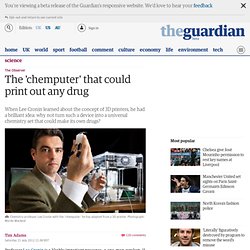
"I just want to get stuff done fast," he says. And: "I am a control freak in rehab. " Cronin, 39, is the leader of a world-class team of 45 researchers at Glasgow University, primarily making complex molecules. But that is not the extent of his ambition. A couple of years ago, at a TED conference, he described one goal as the creation of "inorganic life", and went on to detail his efforts to generate "evolutionary algorithms" in inert matter.
Second industrial revolution is under way. Cookies on the New Scientist website close Our website uses cookies, which are small text files that are widely used in order to make websites work more effectively.
To continue using our website and consent to the use of cookies, click away from this box or click 'Close' Find out about our cookies and how to change them Log in. Global Innovation Barometer 2013. Could 3D printing be a climate revolution? Rise of 3DPrinting. Currently several universities and researching institutes are working on the research and devleopment of bio-manufacturing, ceramic forming, laser sintering machines and materials. Although China has become the unchallenged global manufacturing centre, China's manufacturing industry has a lot of pressure from high labour costs and low efficiency of economic growth.
Su thinks the development and broader use of 3Dprinting technology could improve China's productivity and ease China's pressure on energy and resources. Peigen Li, president of the Huazhong University of Science and Technology said that China was on par with western countries in development and application of the 3Dprinting technology. Organovo Partners With Autodesk Research to Develop 3D Bioprinting Software. SAN DIEGO, Dec. 18, 2012 — (PRNewswire) — Organovo Holdings, Inc. (OTCQX: ONVO) ("Organovo"), a creator and manufacturer of functional, three-dimensional human tissues for medical research and therapeutic applications, is working together with researchers at Autodesk, Inc., the leader in cloud-based design and engineering software, to create the first 3D design software for bioprinting. The software, which will be used to control Organovo's NovoGen MMX bioprinter, will represent a major step forward in usability and functionality for designing three-dimensional human tissues, and has the potential to open up bioprinting to a broader group of users.
"Autodesk is an excellent partner for Organovo in developing new software for 3D bioprinters," said Keith Murphy, Chairman and Chief Executive Officer at Organovo. "Bioprinting has the potential to change the world," said Jeff Kowalski, Senior Vice President and Chief Technology Officer at Autodesk.
About Organovo Holdings, Inc. 3D printing: A third-world dimension. A 3-D Printed House That Grows Like Human Bone. Creation and copyright law: the case of 3D printing. The Australian Law Reform Commission is conducting an inquiry into copyright law and the digital economy in 2012 and 2013.The President, Rosalind Croucher, stated: “While the Copyright Act has been amended on occasion over the past 12 years to account for digital developments, these changes occurred before the digital economy took off. The Australian Law Reform Commission will need to find reforms that are responsive to this new environment, and to future scenarios that are still in the realm of the imagination.
It is a complex and important area of law and we are looking forward to some robust debate and discussion during the course of this very important Inquiry.” In August 2012, the Commission published its issues paper, Copyright and the Digital Economy. The Commission has posed the question: “Should the Copyright Act 1968 (Cth) be amended to include a broad, flexible exception?” Creating A Whole Other Dimension – Enabled by 3D Printing. Shape-shifting robot made by MIT scientists. 4 December 2012Last updated at 08:25 ET.
Researchers Build a 3D-Printed Transform Robot. Japanese hobby researchers at Brave Robotics have developed a functioning, entirely 3D-printed robot inspired by Transformers. Make a DIY 3D bioprinter out of an old inkjet to print biomaterials. Jan.25, 2013. In conversation with Martha Lane Fox. What's the Deal with Copyright and 3D Printing? 3D Printing and Fabbing. 3D Printing « Robert's Blog. TCT - Additive Manufacturing & Professional 3D Printing Intelligence. Lee Cronin: can we app medicine. SolarSinter : markus kayser. Solar Sinter 2011. 3D printing breakthrough could accelerate drug testing process. 6 February 2013 Researchers have used 3D printing to arrange human embryonic stem cells (hESCs) for the first time, an advance that could accelerate drug testing processes and eventually help to provide transplant organs on demand.
The breakthrough was published yesterday in Biofabrication. Co-author of the study, Dr Will Wenmiao Shu, from Heriot-Watt University, said: ‘The generation of 3D structures from hESCs will allow us to create more accurate human tissue models, which are essential for in vitro drug development and toxicity testing. Since the majority of drug discovery is targeting human disease, it makes sense to use human tissues.’ In the longer term, this new method of printing may also pave the way for incorporating hESCs into artificially created organs and tissues ready for transplantation into patients.