
The third-party candidate who could derail Mitt Romney. A virtually unknown presidential candidate in Virginia could derail Mitt Romney’s bid for president.

But how rare is it for a third-party candidate to influence a race for president? Currently, Virgil Goode, a candidate running in Virginia, has about 9 percent of the projected vote in the upcoming November election, according to polling data. With Mitt Romney needing Virginia—especially if President Barack Obama can take Ohio or Florida—Goode could become the little-known spoiler in the national election. The former congressman has a strong enough following in rural Virginia to take votes away from Romney, and Goode has no plans to end his low-budget campaign. Speaking with a TV station in Lynchburg, Goode said he wanted to take votes away from both candidates. Not surprisingly, there are already challenges to Goode’s petition effort to get on the Virginia ballot. In the past, third-party or independent candidates have affected the presidential election. Recent Constitution Daily Stories.
America's History in the Making — Historical Thinking Skills Interactives. This series of interactive activities introduces and models the Historical Thinking Skills defined by the National Center for History in the Schools.
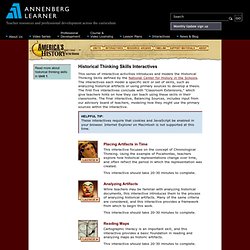
The interactives each model a specific skill or set of skills, such as analyzing historical artifacts or using primary sources to develop a thesis. The first five interactives conclude with "Classroom Extensions," which give teachers hints on how they can teach using these skills in their classrooms. The final interactive, Balancing Sources, includes input from our advisory board of teachers, modeling how they might use the primary sources within the interactive. These interactives require that cookies and JavaScript be enabled in your browser. Internet Explorer on Macintosh is not supported at this time. Launch Placing Artifacts in Time This interactive focuses on the concept of Chronological Thinking. This interactive should take 20-30 minutes to complete. Analyzing Artifacts Reading Maps Evaluating Evidence Curating an Exhibit Balancing Sources. Critical Thinking. Analyzing Primary Sources. Where To Go Next Now that you have analyzed individual sources, it is time to think about how to interpret the sources collectively, so you you can identify preliminary questions.

These questions are designed to develop critical thinking skills useful in historical analysis. Analyzing Primary Sources Considerations in Examining All of the Primary Sources: How did the documents' creators' viewpoints influence the language (including visual language) used in the documents? How did the creators of the documents understand peoples' desires? If the documents refer to a different culture, how do the sources treat the people of the other culture?
What do the authors find interesting, relevant, repulsive about other people? What do the authors find interesting, relevant, repulsive about their own culture? What language (including visual language) is used to describe/interpret other cultures? What language (including visual language) is used to describe one's own culture? Preliminary Questions. Historical Thinking Skills. Finding a Worthwhile Topic As a student of history, you will want to find a historical topic or problem worth addressing.

First, you have to determine a general area in which you have an interest. If you choose to write a paper "about the Civil War", you may run into difficulties with such a broad topic. You may become "swamped" with information and feel a sense of "information overload. " The next step is to narrow your topic. Once you reach this stage, try to formulate your research topic as a question. Read and Compare Secondary History Sources Being able to read and reconstruct the past helps you to develop a historical viewpoint.
Historical comprehension gives you a knowledge of facts and terms, an understanding of concepts, principles and theories, as well as an understanding of the relationship between concepts. If Napa Valley College's McCarthy Library does not have a particular book or article, ask a reference librarian for assistance. Producing New Knowledge. The Gilder Lehrman Institute of American History.