
The first time you go surfing, the experience can be very different from what you imagined. From the beach, surfing may look like a simple combination of paddling, standing up, and riding a wave. Once you are actually in the water, however, you quickly discover that surfing involves timing, balance, awareness, patience, and plenty of small adjustments.
For a first-time surfer, these details often become the most valuable lessons. Understanding them can make the transition from watching waves to riding them much easier.
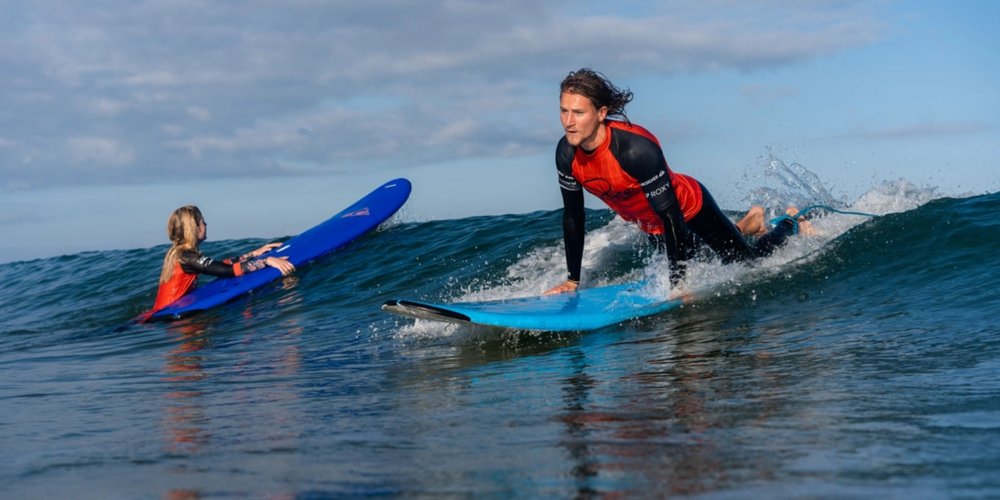
Before getting into the water, there is a natural period of observation.
You begin noticing how the waves are forming, where they are breaking, and how experienced surfers position themselves. This is an important part of learning because the ocean is constantly changing.
Rather than immediately searching for the biggest wave, beginners can benefit from watching the water and choosing conditions that match their experience.
The first useful surfing lesson often begins before the board even touches the water.
Being on a surfboard in moving water feels completely different from practicing on land.
The board moves beneath you, waves approach from different directions, and maintaining balance requires constant adjustment. Even lying comfortably on the board can take some practice.
This is where patience becomes important. Trying to control every movement at once can make surfing feel complicated. Focusing on one skill at a time makes the experience easier to understand.
A surfboard is not simply something you stand on. Your position on the board affects how efficiently it moves through the water.
Small changes in body position can influence paddling, stability, and the ability to catch a wave. Beginners gradually learn to recognize when the board feels balanced and when their weight needs to shift.
This understanding develops through repetition. Each attempt provides information about what works and what needs adjustment.
One of the biggest changes in a beginner's surfing journey happens when they stop looking at waves as simply moving walls of water.
A wave has a shape, direction, speed, and breaking point. Learning to recognize these characteristics helps surfers make better decisions about when and where to paddle.
Small waves can be particularly useful for developing this awareness. They give beginners opportunities to practice timing without needing to manage the speed and power of larger waves.
Over time, reading the water becomes less about guessing and more about recognizing familiar patterns.
Surfing involves plenty of imperfect attempts.
A beginner may paddle too early, miss the wave, lose balance while standing, or position the board incorrectly. These moments can feel frustrating, but they are also part of the learning process.
Instead of treating every failed attempt as a setback, it helps to identify what caused it.
Was the timing too early? Was the board poorly positioned? Was the wave unsuitable? Was the pop-up rushed?
Answering these questions turns mistakes into useful feedback.
After several sessions, beginners often notice improvements that are not immediately obvious.
Paddling may become more natural. Standing up can require less thought. Wave timing starts to make more sense, and the surfer becomes more comfortable moving around the lineup.
Confidence develops alongside technique.
This progression is one reason surfing can be so rewarding. Improvement does not always come from learning a complicated new manoeuvre. Sometimes it comes from becoming more comfortable with something that previously felt difficult.
As experience grows, the focus naturally moves beyond catching individual waves.
Surfers begin paying more attention to equipment, ocean conditions, positioning, fitness, recovery, and respectful behaviour around other people in the water.
These habits contribute to a better overall surfing experience.
Good preparation also becomes easier. Checking conditions, understanding personal limits, and choosing appropriate equipment become normal parts of getting ready for a session rather than afterthoughts.
A first surf session is rarely about riding perfect waves. It is about becoming familiar with an environment that behaves differently every time you enter it.
The board teaches balance. The waves teach timing. Mistakes provide feedback. Repetition builds confidence.
With each session, these individual lessons begin to connect. What initially feels unfamiliar gradually becomes easier to understand, creating a foundation for continued progress in surfing.
For anyone beginning their surfing journey, the most useful essentials are not just pieces of equipment or individual techniques. They are the ability to observe, adapt, practise, and learn from every session.