
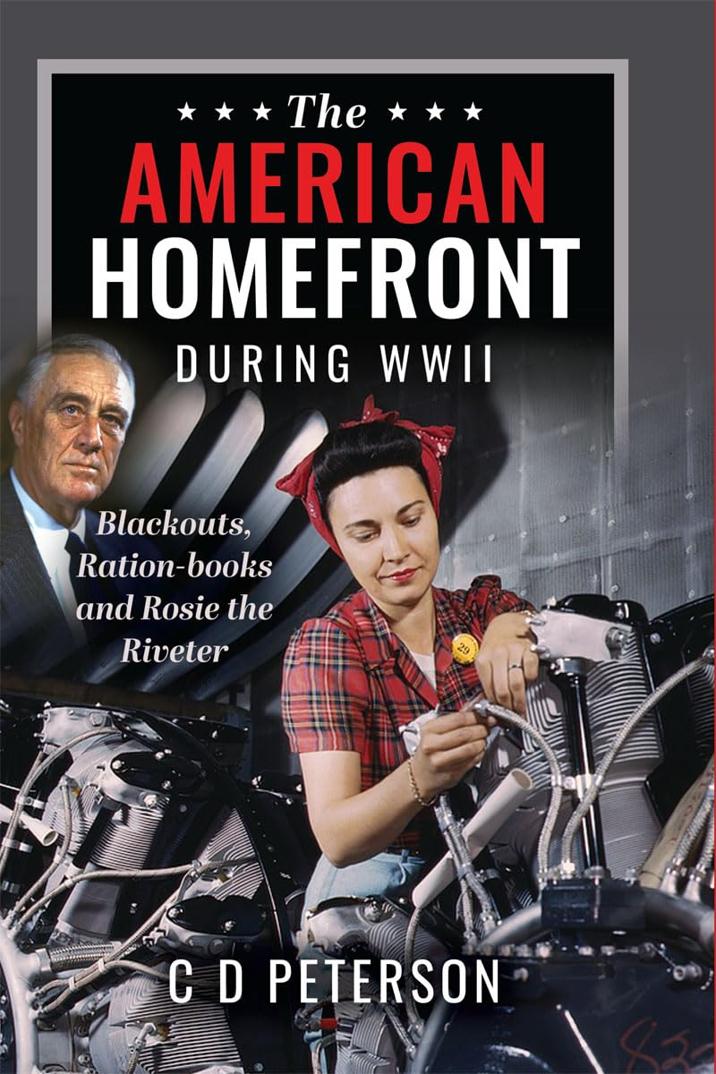
In the months leading up to December 7, 1941, the United States stood on a knife's edge. The nation was emerging from the long shadows of the Great Depression and cautiously watching the growing conflict in Europe and Asia. Although war was far from American soil, its presence was felt in factories, political debates, and around kitchen tables across the country. C.D. Peterson’s America’s Home Front in WWII provides a detailed and compelling portrait of this tense prelude to global conflict, capturing the uncertainty, the ideological divides, and the quiet, determined preparations that would soon ignite into total war.
At the heart of America's hesitancy was its divided stance on intervention. Isolationism, shaped by the lingering trauma of World War I, had deep roots in American society. Influential voices like Charles Lindbergh and organizations such as the America First Committee championed a policy of neutrality, arguing that Europe’s war was not America's to fight. Meanwhile, others sounded the alarm. The Committee to Defend America by Aiding the Allies, bolstered by support from journalists, politicians, and even Walt Disney, pushed for material support to Britain and later the Soviet Union.
Peterson skillfully brings these tensions to life, recounting how organizations with conflicting ideologies clashed in public rallies, press campaigns, and even Congressional hearings. The book also uncovers the darker side of the isolationist movement, highlighting the rise of anti-Semitic and pro-Nazi rhetoric from groups like the Mothers’ Movement and the German American Bund.
Despite the vocal resistance, the U.S. government, under President Franklin D. Roosevelt, began taking measured steps toward readiness. The Selective Training and Service Act of 1940 instituted the first peacetime draft in U.S. history. Military bases were constructed, the Navy was expanded, and defense industries were encouraged—sometimes gently, sometimes forcefully—to shift toward war production. These early efforts, detailed thoroughly in the book, laid the groundwork for the rapid mobilization that followed the attack on Pearl Harbor.
One of the more striking features of this prewar period, as documented by Peterson, is the public's shifting mood. As reports of Nazi conquests mounted and Japan’s aggression intensified in Asia, Americans began to accept that war might be inevitable. The Lend-Lease Act, passed in March 1941, became a symbol of the nation’s evolving stance. Though not yet officially at war, the United States was now the "arsenal of democracy," supplying vital materials to embattled allies.
Peterson does not limit his scope to high-level politics. The book captures the everyday details of life in 1941—flags flying from windows, families gathering around radios, patriotic songs like “God Bless America” topping the charts. It was a year suspended in tension, caught between the memory of peace and the certainty of conflict.
This rich narrative makes America’s Home Front in WWII essential reading for anyone interested in how a divided, uncertain nation transformed into a unified wartime force. The book demonstrates that the road to war was not sudden, but paved by debate, policy, and a slow, reluctant march toward responsibility on the world stage. As Peterson reveals, the story of the American home front began not on December 7, but many months before, when the drums of war were still distant but unmistakable.
Get Your copy Now: https://www.amazon.com/dp/B0DDL1GXF2