
Ice Age Flower: 30,000-Year-Old Seeds Buried In Siberian Permafrost Are Resurrected Into Flower. Fruit and seeds hidden in an Ice Age squirrel's burrow in Siberian permafrost have been resurrected into a flower by Russian scientists.

Using a pioneering experiment, the Sylene stenophylla has become the oldest plant ever to be regrown and it is fertile, producing white flowers and viable seeds. The seeds date back 30,000 to 32,000 years and raise hopes that iconic Ice Age mammals like the woolly mammoth could also eventually be resurrected. The researchers, who published their findings in Proceedings of the National Academy of Sciences in the US, said the results prove that permafrost serves a natural depository for ancient life forms. "We consider it essential to continue permafrost studies in search of an ancient genetic pool, that of pre-existing life, which hypothetically has long since vanished from the earth's surface," the scientists said in the article.
Canadian researchers had earlier regenerated some significantly younger plants from seeds found in burrows. Campaign Against Fraudulent Medical Research. The Analysis of mind, by Bertrand Russell. - StumbleUpon. Radio_broadcasts.jpg from jackadam.net - StumbleUpon. Solar Nirvana / 6 November 2011. Scale-of-universe-v1.swf from primaxstudio.com - StumbleUpon.
The Easter Island “Heads” Have Bodies - StumbleUpon. Hundreds of prehistoric insects found intact within huge amber deposit. The Story of Mankind - StumbleUpon. Scientists Create World's 1st Practical Artificial Leaf, 10X as... - StumbleUpon. Microsoft has figured out how to turn any surface into a touch screen Video. Log in 110% Awesomeness Cynthia Yildirim Microsoft has figured out how to turn any surface into a touch screen OmniTouch is a wearable depth-sensing and projection system that enables interactive multitouch applications on everyday surfaces.
World's most powerful laser to tear apart the vacuum of space. SETI-infographic-lo-quality.jpg (JPEG Image, 750x5562 pixels) - Scaled (11%) How to turn water into marbles. NASA Unveils Next Generation 'Monster' Space Rocket : The Two-Way. Hide captionArtist concept of SLS launching.

If things go without a hitch, NASA said its newly unveiled Space Launch System could take its first manned test flight in 2017. The new rocket design looks a lot like the Apollo era rockets that took American astronauts to the moon, but NASA said the new rocket is much more powerful than any other rocket they've made before and in conjunction with the Orion Multi-Purpose Crew Vehicle, already in development, it could set up astronauts for deep space exploration. The SLS will be NASA's first exploration-class vehicle since the Saturn V took astronauts to the moon. "We're investing in technologies to live and work in space, and it sets the stage for visiting asteroids and Mars," NASA Administrator Charles Bolden said at a news conference. hide captionArtist concept of future destinations.
Artist concept of future destinations. Addiction Is Not A Disease Of The Brain : 13.7: Cosmos And Culture. Hulton Archive/Getty Images Addiction has been moralized, medicalized, politicized, and criminalized.

And, of course, many of us are addicts, have been addicts or have been close to addicts. Addiction runs very hot as a theme. Part of what makes addiction so compelling is that it forms a kind of conceptual/political crossroads for thinking about human nature. Why The U.S. Needs To Learn More Science : 13.7: Cosmos And Culture. Hide caption Galileo Galilei (1564 - 1642): Think for yourself!

Hulton Archive/Getty Images Quite often, people ask me why, as a research physicist, do I bother writing for the general public. Systemesolaire2.jpg from wikimedia.org - StumbleUpon. Michael Pritchard's water filter turns filthy water drinkable. Pale Blue Dot « a simple prop. QuantumLevitation. Astronauts' tracks, trash seen in new moon photos.
WASHINGTON (AP) — A spacecraft circling the moon has snapped the sharpest photos ever of the tracks and trash left behind by Apollo astronauts in their visits from 1969 to 1972.

Images taken by NASA's Lunar Reconnaissance Orbiter from 13 to 15 miles up show the astronauts' paths when they walked on the moon, as well as ruts left by a moon buggy. Experts could even identify the backpacks astronauts pitched out of their lunar landers before they returned to Earth. "What we're seeing is a trail," said Arizona State University geology professor Mark Robinson, the orbiter's chief scientist.
"It's totally awesome. " However, the photos were not close enough to see individual bootprints, Robinson said. The pictures were taken two weeks ago and show the landing sites for Apollo 12, 14 and 17. Scientists squeeze light past quantum limit › News in Science (ABC Science) News in Science Monday, 12 September 2011 Stuart GaryABC Tiny ripples The race to discover gravity waves may be getting closer to the finish line with scientists successfully squeezing light using quantum mechanics.
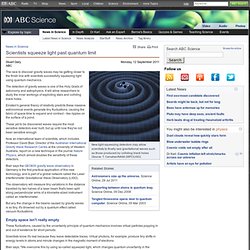
The detection of gravity waves is one of the Holy Grails of astronomy and astrophysics. It will allow researchers to study the inner workings of exploding stars and colliding black holes. Einstein's general theory of relativity predicts these massive astronomical events generate tiny fluctuations, causing the fabric of space-time to expand and contract - like ripples on the surface of a pond. These yet to be discovered waves require the most sensitive detectors ever built, but up until now they've not been sensitive enough. Newly Discovered Planet: Hot, Muggy And (Maybe) Liveable : The Two-Way. Sort of like Washington, D.C., in the summer: "It would feel like a steam bath — hot, sticky and beyond uncomfortable.
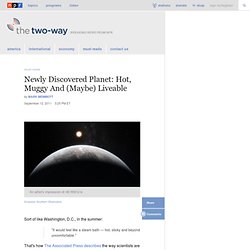
" That's how The Associated Press describes the way scientists are describing "HD 85512 b ... a newly discovered planet about 35 light-years from Earth in the constellation Vela. " It's the second planet outside our solar system that seems to be orbiting in "the habitable zone" around its star, according to the European Southern Observatory, which today announced the discovery of HD 85512 b and more than 50 other plants around other stars. NASA Science.