
Computing. Education. Deeper learning. Pedagogy. Mind-Body. Personal Development. Digital Literacy. Thinking in a Foreign Language Makes Decisions More Rational. To judge a risk more clearly, it may help to consider it in a foreign language.
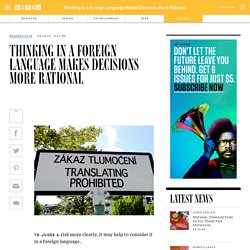
A series of experiments on more than 300 people from the U.S. and Korea found that thinking in a second language reduced deep-seated, misleading biases that unduly influence how risks and benefits are perceived. “Would you make the same decisions in a foreign language as you would in your native tongue?” Asked psychologists led by Boaz Keysar of the University of Chicago in an April 18 Psychological Science study. “It may be intuitive that people would make the same choices regardless of the language they are using, or that the difficulty of using a foreign language would make decisions less systematic. We discovered, however, that the opposite is true: Using a foreign language reduces decision-making biases,” wrote Keysar’s team. 'Would you make the same decisions in a foreign language?
' The first experiment involved 121 American students who learned Japanese as a second language. Click to Open Overlay Gallery.
Dyslexia. Anxiety disorders. Fact sheet 20: Bullying « Youthbeyondblue. The experience of being bullied is different for everyone.

People may feel alone, anxious, scared, miserable and powerless, while others may feel overwhelmed by sadness, ashamed or rejected. They may feel there is no escape from the bully or that there is no hope that things will change. Anger is another common reaction, as the attack from the bully is unfair and unwarranted. Bullying can affect every part of a person’s life, including relationships with their friends and family.
It can affect a person’s confidence and performance at school, in a sports team or at work.
Psychology. Body Language. Personality Tests. Brain things. More mental health. Inspiration. Persuasion. Literacy. NSW Literacy continuum K–10 An overview of the literacy continuum K–10 This short accessible document provides background information on the NSW Literacy continuum K–10 and how it can be used as a tool to support literacy in primary and secondary schools.

Overview (.pdf 571kB) Print and PDF versions of the continuum K–10 The continuum is available in two parts that are designed to sit together (K–6 and 7–10) in PDF form or as a print poster. Literacy continuum K–6 (.pdf 1.10MB) Literacy continuum 7–10 (.pdf 307.33kB) (Please note: this resource has been made available for DEC school use only and not for commercial publication.) Non-government schools can place orders for the NSW Literacy continuum K–10 at: annette.gray@det.nsw.edu.au Interactive Literacy continuum K–10 The interactive continuum is a versatile online tool that can be manipulated to be viewed in different ways. Please note: this link is accessible via the DEC portal (DEC teachers are required to login to access). 21st Century Learning.
Digcit. Maths. Professional development. Blended Learning. Scaffolding. Special needs. I Love That Teaching Idea! Colleagues. Colleagues. Google. Free. Pearltrees videos. Pearltrees tips. Cooperative Games. Games. Ipad apps. Education. Digital storytelling. Special needs. 10 Tech Skills Every Student Should Have. Classroom Resources. Space.