
Cargo cult. A cargo cult is a kind of Melanesian millenarian movement encompassing a diverse range of practices and occurring in the wake of contact with the commercial networks of colonizing societies.

The name derives from the apparent belief that various ritualistic acts will lead to a bestowing of material wealth ("cargo").[1][2] Contact with colonizing groups brought about a considerable transformation in the way indigenous peoples of Melanesia have thought about other societies. Early theories of cargo cults began from the assumption that practitioners simply failed to understand technology, colonization, or capitalist reform; in this model, cargo cults are a misunderstanding of the trade networks involved in resource distribution and an attempt to acquire such goods in the wake of interrupted trade.
However, many of these practitioners actually focus on the importance of sustaining and creating new social relationships, with material relations being secondary.[5] Examples[edit] Post-war[edit] Musica universalis. Musica universalis (lit. universal music, or music of the spheres) or Harmony of the Spheres is an ancient philosophical concept that regards proportions in the movements of celestial bodies—the Sun, Moon, and planets—as a form of musica (the Medieval Latin name for music).

This 'music' is not usually thought to be literally audible, but a harmonic and/or mathematical and/or religious concept. The idea continued to appeal to thinkers about music until the end of the Renaissance, influencing scholars of many kinds, including humanists. History[edit] Engraving from Renaissance Italy showing Apollo, the Muses, the planetary spheres and musical ratios.
Aesthetics. "Aesthetician" redirects here.
For a cosmetologist who specializes in the study of skin care, see Esthetician. More specific aesthetic theory, often with practical implications, relating to a particular branch of the arts is divided into areas of aesthetics such as art theory, literary theory, film theory and music theory.
Mathematical beauty. Mathematical beauty describes the notion that some mathematicians may derive aesthetic pleasure from their work, and from mathematics in general.

They express this pleasure by describing mathematics (or, at least, some aspect of mathematics) as beautiful. Sometimes mathematicians describe mathematics as an art form or, at a minimum, as a creative activity. Comparisons are often made with music and poetry. Determinism Irrelevant. Years ago I decided that the issue of "free will vs. determinism" is irrelevant to questions of ethics, and untestable with respect to matters of science.

Since then I have tried to avoid wasting time on it. But it comes up every now and then in Freethinker circles, and many people are lured into arguing at length over it. Our ordinary practice is to ascribe "free will" to beings which are conscious and intelligent. Fallibilism. Fallibilism (from medieval Latin fallibilis, "liable to err") is the philosophical principle that human beings could be wrong about their beliefs, expectations, or their understanding of the world, and yet still be justified in holding their incorrect beliefs.
In the most commonly used sense of the term, this consists in being open to new evidence that would disprove some previously held position or belief, and in the recognition that "any claim justified today may need to be revised or withdrawn in light of new evidence, new arguments, and new experiences. "[1] This position is taken for granted in the natural sciences.[2] Absurdism. Absurdism is very closely related to existentialism and nihilism and has its origins in the 19th century Danish philosopher Søren Kierkegaard, who chose to confront the crisis humans faced with the Absurd by developing existentialist philosophy.[3] Absurdism as a belief system was born of the European existentialist movement that ensued, specifically when the French Algerian philosopher and writer Albert Camus rejected certain aspects from that philosophical line of thought[4] and published his essay The Myth of Sisyphus.

The aftermath of World War II provided the social environment that stimulated absurdist views and allowed for their popular development, especially in the devastated country of France. Overview[edit] "... in spite of or in defiance of the whole of existence he wills to be himself with it, to take it along, almost defying his torment. Relationship with existentialism and nihilism[edit] Related works by Søren Kierkegaard[edit] What is the Absurd? Synesthesia. How someone with synesthesia might perceive (not "see") certain letters and numbers.
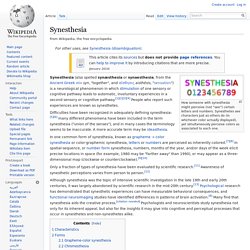
Synesthetes see characters just as others do (in whichever color actually displayed), yet simultaneously perceive colors as associated to each one. Synesthesia (also spelled synæsthesia or synaesthesia; from the Ancient Greek σύν syn, "together", and αἴσθησις aisthēsis, "sensation") is a neurological phenomenon in which stimulation of one sensory or cognitive pathway leads to automatic, involuntary experiences in a second sensory or cognitive pathway.[1][2][3][4] People who report such experiences are known as synesthetes. Difficulties have been recognized in adequately defining synesthesia:[5][6] many different phenomena have been included in the term synesthesia ("union of the senses"), and in many cases the terminology seems to be inaccurate.
A more accurate term may be ideasthesia. Characteristics[edit] There are two overall forms of synesthesia: projecting synesthesia and associative synesthesia.
Pearltrees tips.