
Monsanto. Monsanto. Monsanto. Monsanto. Monsanto. Monsanto. Monsanto. Marcellus Shale Resources (Fracking) Marcellus Shale Resources (Fracking) Fish dumping must be banned to protect stocks, EU chief rules - Nature - Environment. Click HERE to view graphic (151k jpg) The controversial dumping of "discards", fish that have been caught but are too small or too uncommercial to be landed, must be stopped, and all fish caught will have to be brought to port, said the EU Fisheries Commissioner Maria Damanaki.

She was announcing a series of measures designed to restore the health of Europe's overexploited fish stocks and give struggling fishermen a secure economic future. Mrs Damanaki's proposals, centring on the aim of bringing all stocks back to "sustainable" levels by 2015, seek to repair a CFP which has brought both the fishing industry and the Euro- pean marine environment to a crisis. At least 70 per cent of Europe's fish stocks are now fully or over-exploited – a far higher figure than in other parts of the world such as Australia or the US – and without radical action, it is estimated that the figure will exceed 90 per cent in ten years' time.
Rainforest Facts. Orangutan Crisis – Sumatran Orangutan Society. Sumatran Orangutans - on the edge of extinction The Sumatran orangutan is classified as Critically Endangered by the IUCN, the World Conservation Union.
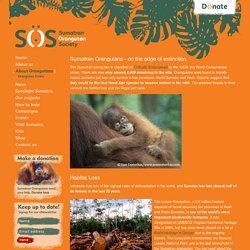
There are now only around 6,600 remaining in the wild. Orangutans were found in forests across Sumatra but now only survive in two provinces: North Sumatra and Aceh. Experts suggest that they could be the first Great Ape species to become extinct in the wild. The greatest threats to their survival are habitat loss and the illegal pet trade. Habitat Loss Indonesia has one of the highest rates of deforestation in the world, and Sumatra has lost almost half of its forests in the last 25 years. The Leuser Ecosystem, a 2.6 million hectare expanse of forest spanning the provinces of Aceh and North Sumatra, is one of the world's most important biodiversity hotspots. The expansion of farmlands and the building of new roads opens up the forest, making it easier for hunters and poachers to capture orangutans and other protected wildlife. Orangutans and oil palm plantations.
Of approximately 11 million hectares of oil palm plantations globally, about 6 million hectares are found in Indonesia1 (in 2006) - and counting.
But in many places, these plantations are taking over rainforests, the natural habitat of endangered species such as orangutans. Habitat conversion from natural forests to oil palm plantations has been shown to have a devastating impact on tropical forests, along with plants and animals that depend on them. For example, there are nearly 80 mammal species in Malaysia's primary forests, just over 30 in disturbed forests, and only 11 or 12 in oil palm plantations.2 A similar loss in diversity occurs for insects, birds, reptiles, and most important of all, for soil microorganisms. Find out more. Borneo. Deforestation in the Amazon. While this is welcome news for Earth's largest rainforest, it is nonetheless important to understand why more than 580,000 square kilometers (224,000 square miles) of Amazon forest has destroyed in Brazil since 1980.
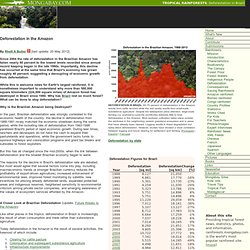
Why has Brazil lost so much forest? What can be done to stop deforestation? In the past, Brazilian deforestation was strongly correlated to the economic health of the country: the decline in deforestation from 1988-1991 nicely matched the economic slowdown during the same period, while the rocketing rate of deforestation from 1993-1998 paralleled Brazil's period of rapid economic growth. During lean times, ranchers and developers do not have the cash to expand their pasturelands and operations, while the government lacks funds to sponsor highways and colonization programs and grant tax breaks and subsidies to forest exploiters.
But this has all changed since the mid-2000s, when the link between deforestation and the broader Brazilian economy began to wane. Logging Fires.