
Amazon rainforest. Etymology The name 'Amazon' is said to arise from a war Francisco de Orellana fought with a tribe of Tapuyas and other tribes from South America.
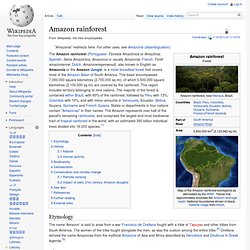
The women of the tribe fought alongside the men, as was the custom among the entire tribe.[2] Orellana derived the name Amazonas from the mythical Amazons of Asia and Africa described by Herodotus and Diodorus in Greek legends.[2] History Natural Aerial view of the Amazon rainforest, near Manaus The rainforest likely formed during the Eocene era. Aerial view of the Amazon rainforest. During the mid-Eocene, it is believed that the drainage basin of the Amazon was split along the middle of the continent by the Purus Arch. More than half of the dust needed for fertilizing the Amazon rainforest is provided by the Bodélé depression in Sahara. Human activity Geoglyphs on deforested land in the Amazon rainforest, Acre. Left - nutrient-poor soil; right - terra preta Biodiversity The rainforest contains several species that can pose a hazard. Deforestation. Greece. Greece (Greek: Ελλάδα, Elláda, pronounced [eˈlaða] ( )), officially the Hellenic Republic (Ελληνική Δημοκρατία [eliniˈci ðimokraˈti.a] Ellīnikī́ Dīmokratía)[11] and known since ancient times as Hellas (Greek: Ἑλλάς), is a country in Southern Europe.[12] According to the 2011 census, Greece's population is around 11 million.
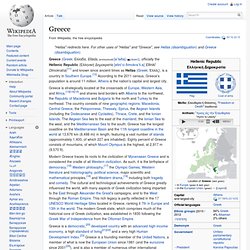
Athens is the nation's capital and largest city. Modern Greece traces its roots to the civilization of Mycenaean Greece and is considered the cradle of all Western civilization. As such, it is the birthplace of democracy,[16] Western philosophy,[17] the Olympic Games, Western literature and historiography, political science, major scientific and mathematical principles,[18] and Western drama,[19] including both tragedy and comedy. The cultural and technological achievements of Greece greatly influenced the world, with many aspects of Greek civilization being imparted to the East through Alexander the Great's campaigns, and to the West through the Roman Empire. History. Egypt. Egypt i/ˈiːdʒɪpt/ (Arabic: مصر Miṣr), is a transcontinental country spanning the northeast corner of Africa and southwest corner of Asia, via a land bridge formed by the Sinai Peninsula.
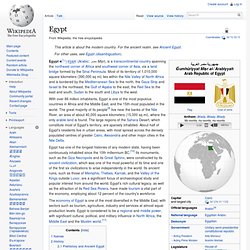
Most of its territory of 1,010,000 square kilometers (390,000 sq mi) lies within the Nile Valley of North Africa and is bordered by the Mediterranean Sea to the north, the Gaza Strip and Israel to the northeast, the Gulf of Aqaba to the east, the Red Sea to the east and south, Sudan to the south and Libya to the west. With over 86 million inhabitants, Egypt is one of the most populous countries in Africa and the Middle East, and the 15th-most populated in the world. The great majority of its people[4] live near the banks of the Nile River, an area of about 40,000 square kilometers (15,000 sq mi), where the only arable land is found. The large regions of the Sahara Desert, which constitute most of Egypt's territory, are sparsely inhabited. Names History Prehistory and Ancient Egypt Ptolemaic and Roman Egypt. Caribbean. The Caribbean (/ˌkærɨˈbiːən/ or /kəˈrɪbiən/; Spanish: Caribe; Dutch: Caraïben ; French: Caraïbe or more commonly Antilles) is a region that consists of the Caribbean Sea, its islands (some surrounded by the Caribbean Sea and some bordering both the Caribbean Sea and the North Atlantic Ocean), and the surrounding coasts.

The region is southeast of the Gulf of Mexico and the North American mainland, east of Central America, and north of South America. Situated largely on the Caribbean Plate, the region comprises more than 700 islands, islets, reefs, and cays. (See the list.) Geopolitically, the Caribbean islands are usually regarded as a subregion of North America[4][5][6][7][8] and are organized into 30 territories including sovereign states, overseas departments, and dependencies. Etymology and pronunciation[edit] The region takes its name from that of the Carib, an ethnic group present in the Lesser Antilles and parts of adjacent South America at the time of the Spanish conquest.[9]