
Pineal gland. The pineal gland, also known as the pineal body, conarium or epiphysis cerebri, is a small endocrine gland in the vertebrate brain.
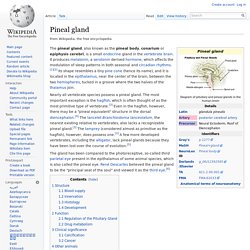
It produces melatonin, a serotonin derived hormone, which affects the modulation of sleep patterns in both seasonal and circadian rhythms.[1][2] Its shape resembles a tiny pine cone (hence its name), and it is located in the epithalamus, near the center of the brain, between the two hemispheres, tucked in a groove where the two halves of the thalamus join. Nearly all vertebrate species possess a pineal gland. The gland has been compared to the photoreceptive, so-called third parietal eye present in the epithalamus of some animal species, which is also called the pineal eye. René Descartes believed the pineal gland to be the "principal seat of the soul" and viewed it as the third eye.[6] Structure[edit] SPECIESDATA - BRAINMAPS.ORG - BRAIN ATLAS, BRAIN MAPS, BRAIN STRUCTURE, NEUROINFORMATICS, BRAIN, STEREOTAXIC ATLAS, NEUROSCIENCE.
Thalamus. The thalamus (from Greek θάλαμος, "chamber")[1] is a midline symmetrical structure of two halves, within the vertebrate brain, situated between the cerebral cortex and the midbrain.

Some of its functions are the relaying of sensory and motor signals to the cerebral cortex,[2][3] and the regulation of consciousness, sleep, and alertness. The two thalami surround the third ventricle.