
Women Who Have Unprotected Sex Are Happier, Smarter Thanks to Mood-Elevating Properties of Semen. Social Psychology. Pineal gland. The pineal gland, also known as the pineal body, conarium or epiphysis cerebri, is a small endocrine gland in the vertebrate brain.
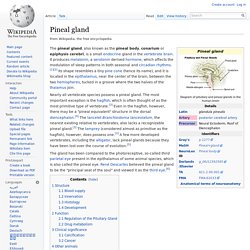
It produces melatonin, a serotonin derived hormone, which affects the modulation of sleep patterns in both seasonal and circadian rhythms.[1][2] Its shape resembles a tiny pine cone (hence its name), and it is located in the epithalamus, near the center of the brain, between the two hemispheres, tucked in a groove where the two halves of the thalamus join. Nearly all vertebrate species possess a pineal gland. The gland has been compared to the photoreceptive, so-called third parietal eye present in the epithalamus of some animal species, which is also called the pineal eye. René Descartes believed the pineal gland to be the "principal seat of the soul" and viewed it as the third eye.[6] "Theory" in sociology. What is a sociological theory?
And how does it relate to the challenge of providing explanations of social facts? In the natural sciences the answer to this question is fairly clear. A theory is a hypothesis about one or more entities or processes and a specification of their operations and interactions. A theory is articulated in terms that permit rigorous and unambiguous derivation of implications for the behavior of a body of phenomena -- perhaps through specification of a set of equations or through a set of statements with deductive consequences. A theory may specify deterministic properties of a set of entities -- thus permitting point predictions about future states of the relevant system; or it may specify probabilistic relations among entities, giving rise to statements about the distribution of possible future states of the system.