
On Language - Synecdoche. Essays by Dana Gioia. Glossary of Poetic Terms from BOB'S BYWAY. Alliteration, assonance, emotive language, colloquial, slang, jargon, neologism, cliché, rhetorical questions, Required skills and knowledge - language features and techniques, Skills by mode: reading and writing, English Skills Year 9, NSW. Alliteration Alliteration is the repetition of consonant sounds at the start of a word: Alliteration is used to link two or more words (and ideas) together.

Elements of Poetry. Each of the following lessons is designed to help you understand how poets create meaning and sound in their writings.
After reading each set of notes, complete the assignment that is linked to it. If you choose not to participate in the day's class discussion about the assignment or were absent, please click on the Class Discussion link above and post any responses that you had while reading or during class. Creating Meaning with Words Diction and Connotation Metaphor and Simile Allusion Symbolism and Allegory Syntax Imagery Creating Sound Rhythm and Meter Alliteration, Assonance, and Consonance Rhyme Using Form Open and Closed Forms Sonnet Sestina Villanelle.
Rhyme and Music. SyllabusCraft of Poetry Home Remember how in "Line and Meter" last week we encountered "alliteration" when we were discussing Old English accentual verse?

Alliteration is only one of several ways to produce "music" in poetry. Let's use Gwendolyn Brooks's poem "We Real Cool" (Strong Measures 38) to illustrate some of these methods. Here's the whole poem: The Pool Players. We real cool. Line (poetic term) A formal structural division of a poem, consisting of one or more feet arranged as a separate rhythmical entity.
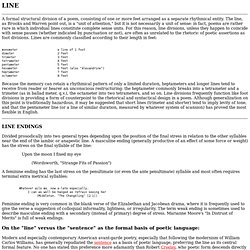
The line, as Brooks and Warren point out, is a "unit of attention," but it is not necessarily a unit of sense: in fact, poems are rather rare in which individual lines constitute complete sense units. For this reason, line divisions, unless they happen to coincide with sense pauses (whether indicated by punctuation or not), are often as unrelated to the rhetoric of poetic assertions as foot divisions. Lines are commonly classified according to their length in feet: monometer a line of 1 foot dimeter 2 feet trimeter 3 feet tetrameter 4 feet pentameter 5 feet hexameter 6 feet (also "Alexandrine") heptameter 7 feet octameter 8 feet Divided prosodically into two general types depending upon the position of the final stress in relation to the other syllables near the end of the iambic or anapestic line. Upon the moon I fixed my eye. Voice. By Gigi GoshkoAcademy of American Studies, New York Grade Level: 9 - 10 Unit Length: 13 Class Periods Unit Overview New York City ninth grade teacher Gigi Goshko has created her unit, "Voice," as an introduction to poetry that presents students with a diverse group of poets and poems.
Cadence - Glossary. Pronunciation: Cadence is a term borrowed from music, where it refers to the use of a group of notes or chords used to end a piece of music or a phrase within it.

As it can also be used to refer to the audible features of speech - a statement slowing and falling in pitch as it ends, for example, or the pause that a comma demands - it has been taken up by poets to refer to the pitch and rhythm of words within a poem. Unlike discussions of metre, which refer to the beat underlying what is said, cadence attends to actual variations. For example, Ian McMillan's 'For Me', a poem about not having to rhyme, makes three ridiculous arguments that use the same cadences; this achieves the effects of linking the stanzas by sound, without using rhyme. Each stanza in Elizabeth Bartlett's 'Painting of a Bedroom with Cats' is a single sentence, each with a semi-colon at the end of the fourth line; this gives each stanza a similar cadence, but Bartlett ensures they are never boringly identical.
Poetry: Close Reading. Introduction Once somewhat ignored in scholarly circles, close reading of poetry is making something of a comeback.
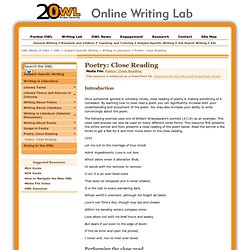
By learning how to close read a poem you can significantly increase both your understanding and enjoyment of the poem. You may also increase your ability to write convincingly about the poem. The following exercise uses one of William Shakespeare’s sonnets (#116) as an example. This close read process can also be used on many different verse forms. Let me not to the marriage of true minds Admit impediments. Which alters when it alteration finds, Or bends with the remover to remove: O no! Writing About Poetry. Summary: This section covers the basics of how to write about poetry.
Including why it is done, what you should know, and what you can write about. Image in Poetry. Summary: This section covers images as they appear in poetry and covers related terminology, definitions and origins of images, uses of images, and several exercises.
Contributors:Purdue OWLLast Edited: 2010-04-21 08:28:17 Introduction What is an image? Pattern and Variation: Aural. Summary: A brief exploration of the various aspects of sound that can be utilized when making a poem.
The crafting of the aural aspects of a poem is what we may call "ear training. " Thus, the crafting of the visual aspects is what we'd call "eye training. " Contributors:Sean M.