
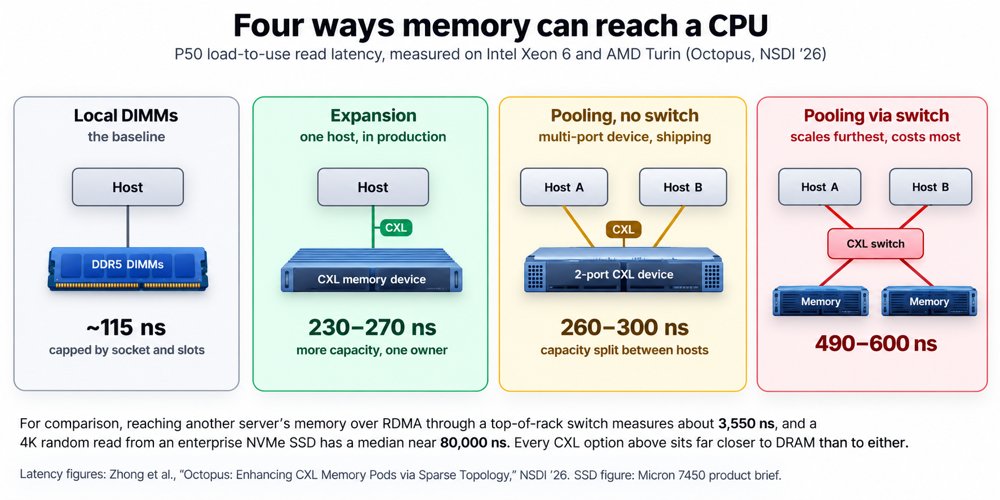
Compute Express Link (CXL) is opening new possibilities for server memory expansion and pooling. Instead of relying entirely on the DIMM slots available inside a server, CXL allows compatible systems to access additional memory through a high-speed, cache-coherent interconnect. This could help data centers improve memory utilization, reduce hardware waste, and support increasingly demanding AI workloads.
However, memory expansion and memory pooling are not the same. CXL memory expansion is already being deployed, while large-scale multi-server pooling still faces challenges involving latency, hardware costs, and system compatibility. Research suggests that the benefits depend heavily on workload requirements and system architecture.
One important takeaway is that memory can remain valuable long after its original server reaches the end of its service life. As data centers upgrade their infrastructure, organizations can recover value from surplus DDR4 and DDR5 modules instead of discarding them with retired equipment. Businesses looking to sell RAM or sell server RAM can explore the secondary market while helping extend the useful life of existing hardware.
CXL may not eliminate the need for local DRAM, but it could give data centers more flexibility in how they expand and allocate memory. The next major question is whether real-world deployments can deliver measurable cost savings without sacrificing performance.